


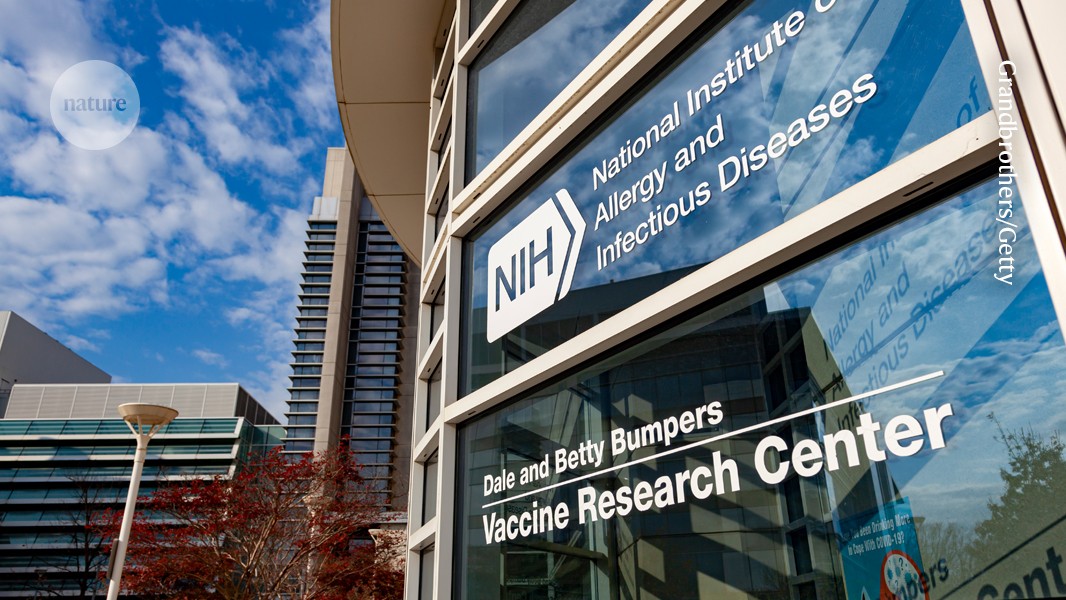

The National Institute of Allergy and Infectious Diseases has seen changes in nearly all of its senior leadership positions since early 2025. Credit: Grandbrothers/Getty
Three senior officials at the US National Institute of Allergy and Infectious Diseases (NIAID) have been given the choice to either accept reassignment outside the institute or resign, sources at the NIAID have told Nature.
US science after a year of Trump: what has been lost and what remains
The three officials are the latest high-ranking NIAID scientists to lose their positions since President Donald Trump began his second term as president in January 2025. Last year, senior officials at the US National Institutes of Health (NIH), which oversees the NIAID, ousted Jeanne Marrazzo, successor to Anthony Fauci as NIAID director.
With the new departures, scientists in most of the senior positions at the NIAID will have been required to vacate their jobs, including officials in eight of the ten top leadership slots. All but one of the eight scientists worked under Fauci, who was director of the NIAID for 38 years before he stepped down in 2022. Fauci has been criticized by Trump and other Republican politicians over public-health measures used during the COVID-19 pandemic. And in the past month, the Trump administration has pursued charges against scientists in Fauci’s orbit who were involved with COVID-19 research.
Unusual moves
The reassignment of career scientists, such as the three who have just lost their positions, is highly unusual for the NIH. Career scientists are typically not replaced when presidential administrations change, and the forced reassignments worry some scientists, who fear a growing political influence over science at the institute, which has a yearly budget of US$6.6 billion.
NIH pivots away from agency-directed science
Betty Diamond, an immunologist at the Feinstein Institutes for Medical Research in Manhasset, New York, says the lack of stability in leadership at the NIAID is concerning. “When you’ve spent years to put in place certain kinds of programmes and earn the trust and admiration of the scientific community, disruption for the sake of disruption is not useful,” she says.
The reassignments were confirmed by several staff members at the NIAID, who requested anonymity when they spoke with Nature, out of fear of reprisal. Andrew Nixon, a spokesperson for the NIH’s parent agency, the Department of Health and Human Services, says that the NIH does not comment on personnel matters, but that it “remains committed to maintaining strong scientific leadership across its institutes and centers”. NIH director Jayanta Bhattacharya has said that the agency needs reform and must move away from ‘politicized’ science.
Lost expertise
The officials who are being forced out now are Daniel Rotrosen, who has been the top scientist for the institute’s Division of Allergy, Immunology, and Transplantation for nearly 30 years; Kelly Poe, director of the Division of Extramural Activities, which manages the grant-related activities and policies of the institute; and Andrea Wurster, Poe’s deputy. All three also worked under Fauci.
Rotrosen was offered a reassignment in the NIH’s office for programme coordination and strategic initiatives, and Poe and Wurster were offered reassignments to the National Institute on Minority Health and Health Disparities (NIMHD). They were not given reasons for their reassignments, staff members told Nature.
Jennifer Troyer, who previously oversaw extramural operations at the National Human Genome Research Institute but resigned in December over concerns about political interference in scientific review at the NIH, says these reassignments are “major demotions”. The NIAID’s budget is more than ten times that of the NIMHD, which the Trump administration has tried to shutter twice but which has so far been protected by Congress.
New vision
At a meeting on 30 January, Bhattacharya and other top agency officials outlined a new vision for the NIAID that reorients the agency towards research on infectious diseases affecting the United States today, rather than research on how to prepare for the next pandemic. Bhattacharya’s vision also emphasizes basic immunology and calls for a move away from research into HIV/AIDS and biodefence. Those subjects and pandemic preparedness, Bhattacharya said, were Fauci’s legacy. Among those fired or reassigned last year were the division chiefs who oversaw research into HIV/AIDS and into infectious diseases and microbiology.

