


You have full access to this article via your institution.
Hello Nature readers, would you like to get this Briefing in your inbox free every day? Sign up here.

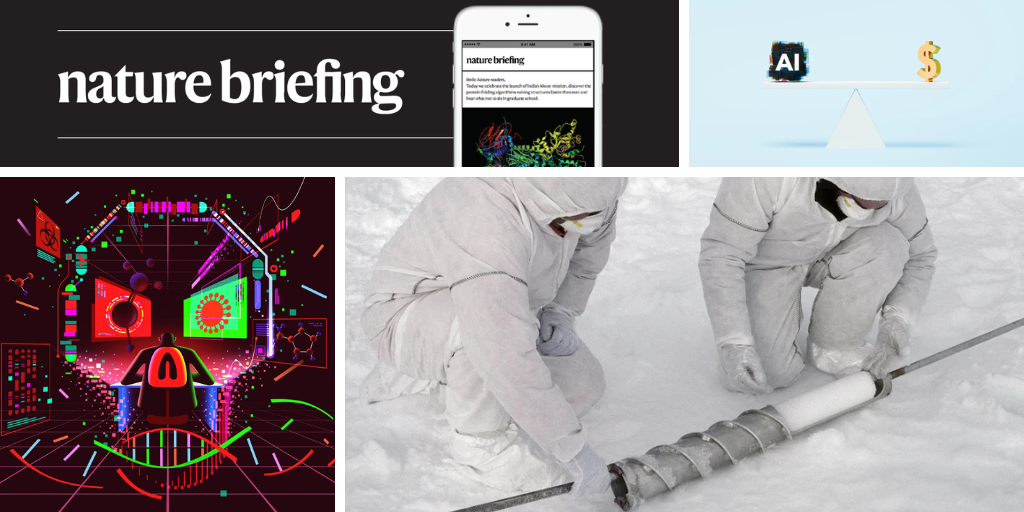
Antarctic ice cores preserve tiny bubbles of ancient air, offering a record of Earth’s past atmosphere.Credit: British Antarctic Survey/Science Photo Library
A 2.8-kilometre-deep ice core has yielded the longest continuous record of Earth’s climate and atmospheric conditions, stretching back 1.2 million years. Data from the core show how the concentration of carbon dioxide in the atmosphere tracked changes in global temperatures across multiple cycles of climate change. The core covers a period in Earth’s history during which ice ages became less frequent but more brutal. Researchers are hoping the oxygen isotopes and carbon dioxide in the core can provide some hints as to what caused the switch.
The largest-ever survey of physicists found that experts (and physics fans) remain divided about some of the field’s biggest questions. A poll of more than 1,500 readers of Physics Magazine and members of the American Physical Society revealed some surprising areas of disagreement. For example, there was “considerable skepticism over the standard model of cosmology” — called Λ cold dark matter (ΛCDM), in which cosmic history is largely the result of a struggle between the pull of dark matter and the push of dark energy.
Watch leading physicists discuss the results (1 hour video) or explore them yourself using an interactive dashboard.
Reference: arXiv preprint (not peer reviewed)
AI update

Illustration: Adrià Voltà
Artificial-intelligence tools, such as the revolutionary AlphaFold, have enabled biologists to produce innovative drugs and to design bespoke proteins that kill superbugs. But these benefits come with the potential to create more-potent toxins, viruses or bioweapons. The threat is very real, say more than 20 scientists and policy researchers. But they don’t agree on what we should do about it. Some are calling for limits on biological AI, but others worry that such restrictions could limit research. Some believe that attempts to introduce regulations are already too late, and the focus should be on detecting and countering AI bioweapon attacks.
The demand for subscription-based AI assistance tools — from researchers and the public alike — has put a strain on the computing power of providers such as OpenAI. Firms such as Anthropic have introduced usage limits on some of their tools as a countermeasure, and code-sharing platform GitHub has introduced usage-based billing for its AI. The changes have forced some researchers to reevaluate whether what they pay for the tools is worth it: in some cases, the fees are in the same ballpark as the cost of supporting a postdoctoral fellow.
Features & opinion
People in the United States are unlikely to catch the ‘Andes’ variant of hantavirus linked to a recent outbreak on a cruise ship, writes epidemiologist Gregg Gonsalves. “The real story is the collapse of pandemic preparedness in this country,” he argues, noting cuts to related research, the abandonment of the World Health Organization and a proliferation of unqualified appointees in top public-health roles. “Hantavirus is not the coming plague, but one is surely coming for us in the future. We’ve never been as exposed and vulnerable as we are now for when that moment arrives.”
In April, data from the influential UK Biobank system was found listed for sale on a Chinese e-commerce site owned by Alibaba. And in January, fringe researchers misused data from the Adolescent Brain Cognitive Development Study to promote white supremacist views. The breaches challenged a data-sharing model that relies on trust between participants, institutions, researchers and countries. Simply locking down such data will hamper science, argues human population geneticist Shuhua Xu. Instead, a move from “from trust-based openness to enforceable openness” will require support from institutions and international collaboration, he writes.
If you enjoy this newsletter, please consider recommending it to a friend or colleague. Click here to forward it by e-mail. Thank you!
Thanks for reading,
Flora Graham, senior editor, Nature Briefing
With contributions by Jacob Smith
• Nature Briefing: Careers — insights, advice and award-winning journalism to help you optimize your working life
• Nature Briefing: Microbiology — the most abundant living entities on our planet — microorganisms — and the role they play in health, the environment and food systems
• Nature Briefing: Anthropocene — climate change, biodiversity, sustainability and geoengineering
• Nature Briefing: AI & Robotics — 100% written by humans, of course
• Nature Briefing: Cancer — a weekly newsletter written with cancer researchers in mind
• Nature Briefing: Translational Research — covers biotechnology, drug discovery and pharma

