


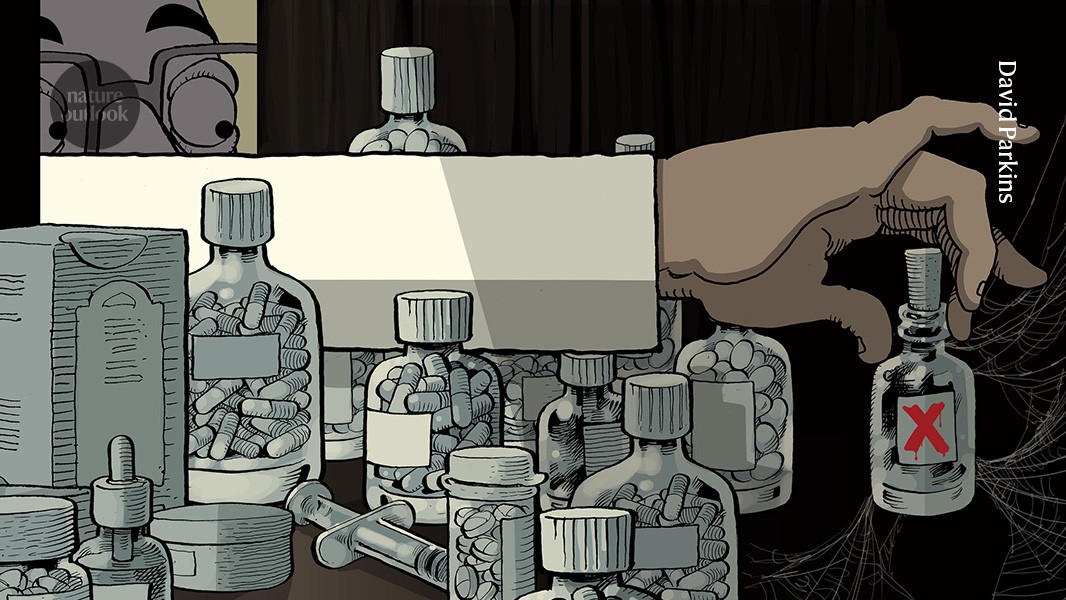
An alarming increase in bacterial infections that don’t respond to many medicines has forced physicians to reach for outdated drugs at the back of the cupboard. In doing so, however, they might have stumbled on a wellspring of options for tackling the threat of antimicrobial resistance.
The unfashionable antibiotics in question are antimicrobial peptides (AMPs). Microorganisms, insects and mammals alike make thousands of these small proteins, typically no more than 60 amino acids in length. Many work by targeting parts of the bacterium’s protective layer that are crucial to its structural integrity, which makes it challenging for bacteria to evolve resistance to these drugs.
Nature Outlook: Antimicrobial resistance
Since the adoption of AMPs in the mid-twentieth century, they have fallen out of use because of their toxicity to humans. As resistance to other antibiotics increases, however, physicians are again having to use AMPs such as polymyxin as a last resort. But now, some scientists say that the peptides should be re-evaluated — not just as a final roll of the dice for a person in desperate need of treatment, but as a potentially rich source of fresh therapies.
Researchers think that tools such as molecular imaging and computer modelling that weren’t around when these drugs were discovered could help to overcome some of the problems that led to AMPs falling out of use. Some scientists are trying to tinker with the design of established peptides such as polymyxin; others are aiming to develop new ones using machine learning. And some researchers see in AMPs an opportunity to take a different approach to bringing antibiotics to market.
Poky peptides
In nature, AMPs help microbes to protect themselves against pathogens. Computational biologist Ewa Szczurek, who co-directs the Institute for AI for Health at Helmholtz Munich in Germany, estimates that about 30,000 have been documented. Of these, just a handful have been developed for use as antibiotics or in food preservation.
Compared with most small-molecule antibiotics, “AMPs represent a fundamentally different antimicrobial strategy”, says Niv Bachnoff, co-founder and chief scientific officer of the Jerusalem-based biopharmaceutical firm Omnix Medical.
Many conventional antibiotics target bacterial enzymes. AMPs, by contrast, usually target bacterial envelopes — the microbes’ protective coverings, which are made up of cell walls and lipid membranes. The peptides’ strong positive electrical charge draws them to the oppositely charged bacterial envelopes. Once there, “they make a hole in the membrane and stuff falls out”, says Szczurek.
This mode of destruction has distinct advantages. Because healthy human cells are typically neutral in charge overall, AMPs rarely go after them. And an assault on the bacterial envelope should be harder for microbes to defend against than the enzyme-focused attacks of many other antibiotics. “Even when resistance mechanisms do emerge, they often carry high fitness costs for the microbe,” says Bachnoff. The fast mechanism of action also reduces the time bacteria have to adapt, and makes resistance to AMPs less likely to develop.
Despite all of this, AMPs have had limited clinical success. Polymyxin and another AMP called vancomycin were derived from soil bacteria in the 1940s and 1950s, respectively. Since then, more-effective antibiotics have come onto the scene. AMPs have a narrow therapeutic range — the doses required for them to be effective in humans tend to be so large that they can be toxic. This, as well as economic factors and the peptides’ lack of stability inside the body, has made it difficult to bring new AMPs to market.
Taming toxicity
Jian Li, a microbiologist at Monash University in Melbourne, Australia, has spent decades investigating polymyxin pharmacology. When safer, more-effective antibiotics became readily available, physicians understandably moved on to those instead of finding the best ways to use the AMP. Li, who developed dosing guidelines for polymyxin that have been adopted by the European Medicines Agency in Amsterdam, is now drawing on his knowledge of the drug’s dynamics to try to improve its effectiveness in the lungs and reduce its toxicity in the kidneys.
Li and his team systematically made specific modifications to polymyxin, one atom at a time, and monitored how the resulting compounds performed in tests against three multi-drug resistant pathogens classed by the World Health Organization as a top priority for new antibiotic development1. Most changes simply stopped the molecule from working at all, but after creating around 1,400 analogues of polymyxin, the researchers found a version with several important advantages. It retains its interaction with the bacterial membrane, but has a small chemical change that prevents it from damaging kidney cells. Other changes make it less prone to bind to chemicals called surfactants in the lung, improving its ability to target pneumonia in mice.
Brii Biosciences, which is based in China and the United States, has acquired the rights to this compound, called QPX9003. The firm is developing it for use in treating pneumonias caused by Acinetobacter baumannii and Pseudomonas aeruginosa that are resistant to a class of antibiotics called carbapenems.
Omnix Medical is also targeting drug-resistant A. baumannii, particularly in older people. One of their candidate AMPs, called OMN6, is derived from a species of giant silk moth (Hyalophora cecropia). A phase I clinical trial found no safety concerns, says Bachnoff.
Membrane mechanics
Markus Weingarth, a chemist at Utrecht University in the Netherlands, hopes that a more detailed understanding of how AMPs pierce bacterial envelopes might lead to more-effective and less toxic versions of the drugs.
Weingarth uses nuclear magnetic resonance to image interactions between the peptides and the bacterial envelope with atomic-scale resolution, focusing on the involvement of a membrane component called lipid II. This molecule is found in the membranes of bacteria, including P. aeruginosa and many other drug-resistant microbes, and is a common target for AMPs. It has two parts: a peptide and a chemical group called a pyrophosphate. Bacteria can make limited changes to the peptide region to evade antibiotics, such as vancomycin, that target it. But Weingarth’s imaging studies2 have shown that an AMP discovered in soil bacteria in 2015, called teixobactin, instead targets the pyrophosphate, which Weingarth calls “immutable”.
The studies show that teixobactin works, in part, by trapping the pyrophosphate inside a superstructure that persists for days3 — an eternity in bacterial time. This doesn’t directly kill bacteria, but it prevents them from growing. The drug is now in late preclinical development at NovoBiotic Pharmaceuticals in Cambridge, Massachusetts.
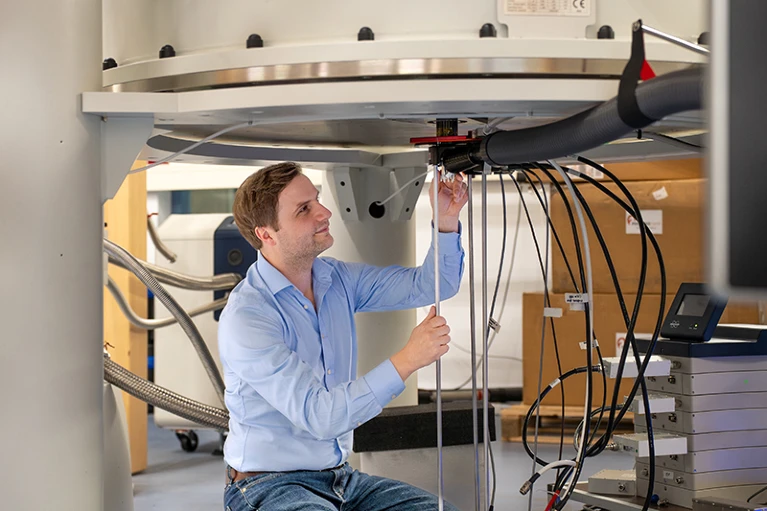
Chemist Markus Weingarth with the nuclear magnetic resonance instrument he uses to study how AMPs pierce bacterial membranes. Credit: Marit Bijkerk/Utrecht University
The techniques used to find teixobactin could yet yield other AMPs. The soil bacterium in which teixobactin was discovered has proved difficult to grow in a laboratory, but researchers at NovoBiotic have found ways to recreate its environmental conditions in culture.
Szczurek, meanwhile, hopes to go beyond what nature can provide and use machine learning to design peptides from scratch. There are more ways to arrange a chain of 25 amino acids than there are bacteria on Earth, she says, “and nature has explored only a tiny fraction of this”. But for a computer model to provide any insight into which of the 1032 possible sequences are worth exploring, it must first be trained to recognize what it is seeing, and computational biologists currently have little reliable experimental data to build on.
“To find something novel, you have to be very courageous and explore sequences we haven’t seen before,” Szczurek says. But extrapolating beyond what is already known requires a lot of data. She and others are working on assembling consistent databases that can be used to train artificial-intelligence tools, in the hope that future scientists won’t have to synthesize and test hundreds of variants, as Li’s team did.
Biofilm beater
The fact that AMPs use a different mechanism to other antibiotics might still not be enough to make them a commercial success, says microbiologist Robert Hancock at the University of British Columbia in Vancouver, Canada. Pharmaceutical companies must demonstrate that an AMP works at least as well as first-line therapies, which are often relatively inexpensive. Attempts to clear this hurdle have often ended in failure, he says, leading some drug companies to go bankrupt after bringing new antibiotics to market.
With this in mind, Hancock wants to develop AMPs that attack the problem from a different angle. In particular, he is interested in using AMPs to break down biofilms: dense, persistent communities of microbes that form on body surfaces. Biofilms account for about 65% of all bacterial infections, but conventional antibiotics don’t penetrate these networks well. A drug that can inhibit the growth of bacteria in a lab will be ineffective in practice if it can’t get through a biofilm in someone’s sinuses or lungs.
Biofilm infections, such as those responsible for persistent sinusitis, are typically tackled by mechanically scraping them out — after which they often come back. AMPs might offer a strong alternative, because they tend to act against multiple strains of microbes and have several modes of action. Besides poking holes in bacterial envelopes, some AMPs seem to interrupt the stress-response pathways that bacteria use in biofilms, says Hancock.
Hancock is working with the biotechnology firm ABT Innovations in Victoria, Canada, to target oral biofilms, wound infections and sinusitis. He thinks that AMPs could be delivered to biofilms in the lungs and sinuses using puffs of air, or in the form of peptide-impregnated bandages that could be applied after conventional scraping to prevent recurrence.
Whether they are used against biofilms or individual bacterial cells, the revival of AMPs could prove to be a welcome boost in the fight against drug-resistant infections. But careful stewardship will be needed to minimize the risk of bacteria gaining the upper hand again. “Bacteria will find a way to become resistant to just about anything that’s used in direct therapy,” Hancock says. The drugs should be administered right where they are needed, at high doses and possibly in combinations, to head off the development of resistance.
“We need to think about the whole problem differently,” he says. “Beating your head against the wall and expecting a different answer just gives you a headache.”

