


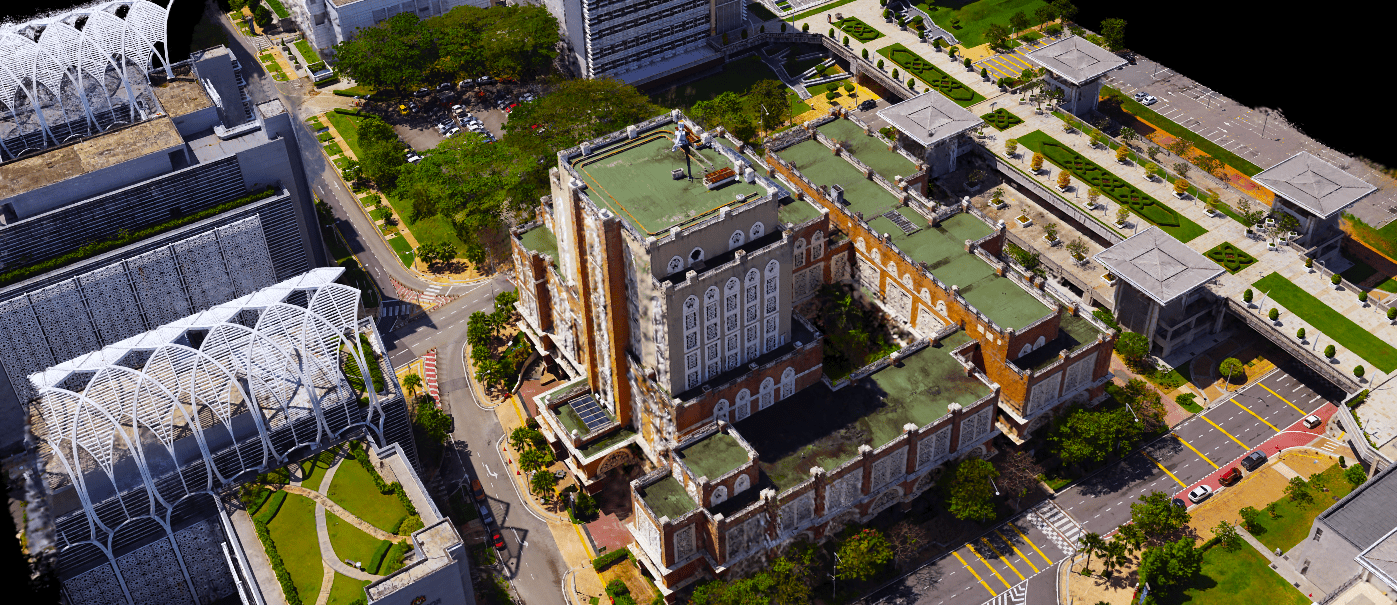
From Industry Buzz to Practical Workflow
Gaussian splatting has quickly become one of the most talked-about developments in 3D reconstruction. Known for its ability to create highly realistic, smooth-rendered scenes, the technique has sparked a central question across the geospatial industry: can it move beyond visualization and support real-world mapping workflows?
With the release of Correlator3D Version 11, SimActive is bringing that question into focus by integrating Gaussian splatting directly into its photogrammetry platform.
A New Layer of Visual Capability
Gaussian splatting represents 3D environments using dense collections of Gaussian primitives, producing continuous surfaces that often appear more natural than traditional mesh-based models. The results can be visually striking, particularly in complex environments where texture and depth perception matter.
In Correlator3D Version 11, this capability is now part of the core workflow. Users can generate splat-based models directly from imagery and work with them alongside standard photogrammetry outputs.
SimActive says the goal is to provide high-quality 3D visualization without disrupting established production pipelines. “Our team has integrated Gaussian splatting natively into Correlator3D,” said CTO Louis Simard. “Version 11 gives users a practical way to produce high-quality 3D content with stunning visual fidelity while maintaining full control within a familiar photogrammetric environment.”
Visualization vs. Measurement
The introduction of Gaussian splatting into professional software highlights an important distinction: visual quality is not the same as measurable accuracy.
Gaussian splatting excels at creating immersive, visually complete scenes. It can present environments in a way that is intuitive and easy to interpret, even when underlying data may be uneven or incomplete.
Photogrammetry, however, is designed for precision. It delivers georeferenced datasets, consistent geometry, and outputs that support engineering, surveying, and GIS applications. These characteristics remain essential for workflows where decisions depend on reliable measurements.
Rather than attempting to replace these outputs, SimActive’s implementation positions Gaussian splatting as a complementary layer.
Integrating Two Approaches in One Workflow
What distinguishes this release is not simply the addition of a new visualization method, but the ability to combine it with established photogrammetry processes in a single environment.
Users can now move from raw imagery to both accurate geospatial products and visually rich 3D models without switching platforms. This integration reflects a broader shift in the industry, where visualization is becoming an expected component of data delivery rather than a separate step.
Correlator3D Version 11 enables users to:
- Generate Gaussian splat models directly from image datasets
- Visualize scenes with enhanced realism and smooth rendering
- Edit and refine splat outputs within the same software environment
- Maintain access to traditional photogrammetry products for measurement and analysis
This unified approach allows teams to tailor outputs to different audiences, from engineers and analysts to stakeholders who need clear, visual context.
Where Gaussian Splatting Fits Today
Gaussian splatting is best understood as an enhancement to visualization rather than a replacement for measurement workflows. Its strengths are most apparent in applications where realism and clarity improve understanding, such as inspection, planning, and communication.
At the same time, traditional photogrammetry continues to provide the accuracy and consistency required for operational decision-making.
By combining both, SimActive enables users to benefit from each approach without compromise. Accurate data remains the foundation, while Gaussian splatting adds a new way to interpret and present that data.
A Practical Step Forward
The integration of Gaussian splatting into Correlator3D marks a practical step forward for the technology. It moves the conversation from experimentation to application, showing how new visualization methods can fit into established geospatial workflows.
For now, the roles are clear. Photogrammetry provides the measurable foundation, while Gaussian splatting enhances how that information is experienced.
Together, they point toward a future where accuracy and realism are no longer competing priorities, but part of the same workflow.
Read more:

Miriam McNabb is the Editor-in-Chief of DRONELIFE and CEO of JobForDrones, a professional drone services marketplace, and a fascinated observer of the emerging drone industry and the regulatory environment for drones. Miriam has penned over 3,000 articles focused on the commercial drone space and is an international speaker and recognized figure in the industry. Miriam has a degree from the University of Chicago and over 20 years of experience in high tech sales and marketing for new technologies.
For drone industry consulting or writing, Email Miriam.
TWITTER:@spaldingbarker
Subscribe to DroneLife here.

