


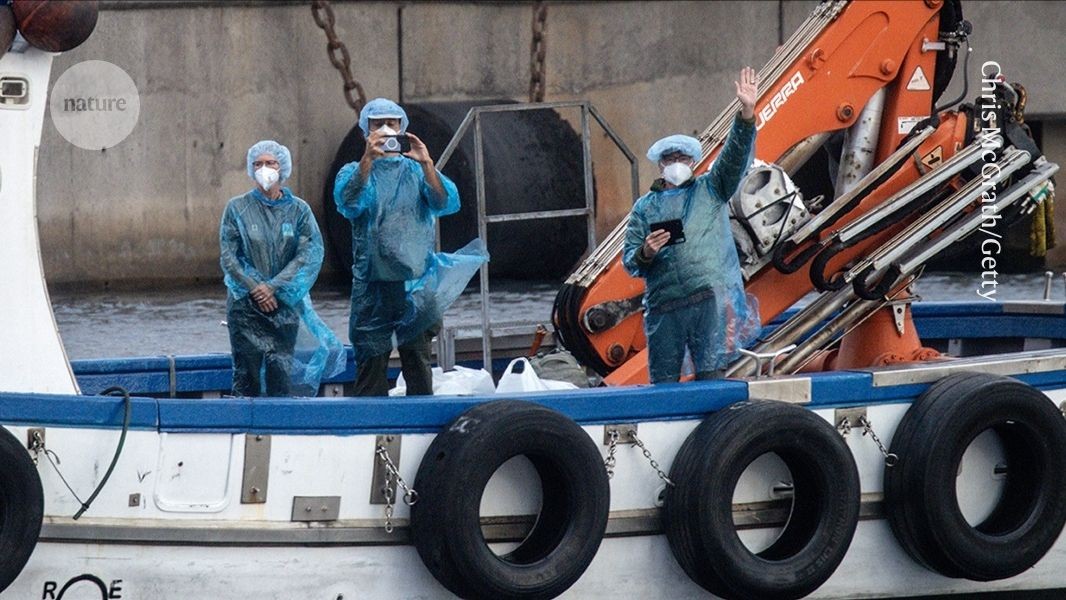
Passengers disembarked from the MV Hondius at the Canary Islands wearing personal protective equipment.Credit: Chris McGrath/Getty
Close to 150 passengers and crew members on the cruise ship MV Hondius struck by an outbreak of a deadly hantavirus have disembarked and are returning to their home countries, where they will quarantine. The way that will happen, however, will differ between countries, in part because outbreaks of the virus are rare and how it spreads between people isn’t well understood.
“It is kind of a real-time experiment happening in front of us,” says Vaithi Arumugaswami, a molecular virologist at the University of California, Los Angeles.
Passengers from Spain will spend one week of court-mandated quarantine at a military hospital, which might be extended as the situation develops. Those returning to the United States will be assessed on arrival at the University of Nebraska Medical Center in Omaha and can then choose to quarantine at the facility or at home for 42 days. Meanwhile, those returning to the United Kingdom will be monitored for 72 hours in hospital, then placed in isolation for 45 days at home or at a facility.
All passengers on the ship are considered high-risk contacts, according to the European Centre for Disease Prevention and Control in Solna, Sweden, and so should self-isolate, monitor for symptoms daily and undergo testing if they develop them. The World Health Organization (WHO) recommend people who have been exposed to the virus quarantine for 42 days.
That is based on the virus’s long incubation period, says Rhys Parry, a molecular virologist at the University of Queensland in Brisbane, Australia. Past research suggests that the time between exposure and appearance of symptoms can be anywhere from 9 to 40 days1. “Symptoms can appear several weeks after exposure, so the aim is to monitor people long enough to catch infections that are still incubating,” says Parry.
There will probably be a few more cases in the coming days, says Arumugaswami. “One French national has developed symptoms while being evacuated from the ship,” he adds. A US cruise-ship passenger travelling with the other US nationals from the ship on a non-commercial aeroplane to the United States has also tested positive for the virus, according to the US Department of Health and Human Services.
At least six people have tested positive for the Andes species of hantavirus and linked to the outbreak; another two passengers have suspected infections. Of those infected, three people have died. The WHO says that the virus probably passed between passengers after one was infected in Argentina, where there is an ongoing outbreak, before boarding the cruise ship.
Questions about transmission
Hantaviruses typically spread through the air on particles from rodent urine, droppings or saliva, but the Andes species can spread between humans who are in close contact. However, a lot is still unknown about how efficiently the virus passes between people, says Jennifer Angulo, a molecular virologist who studies the Andes species at the Pontifical Catholic University of Chile in Santiago.
Epidemiological data suggest that the chances of becoming unwell because of contact with another person infected with Andes virus remains relatively low. Transmission generally requires prolonged close contact, particularly during the early phase of illness when a person is exhibiting mild symptoms, says Angulo. The highest risk of infection is among sexual partners and people sharing a bed or bedroom with infected people, she says.

