


You have full access to this article via your institution.
Hello Nature readers, would you like to get this Briefing in your inbox free every day? Sign up here.

Credit: Claire Lamman/DESI collaboration
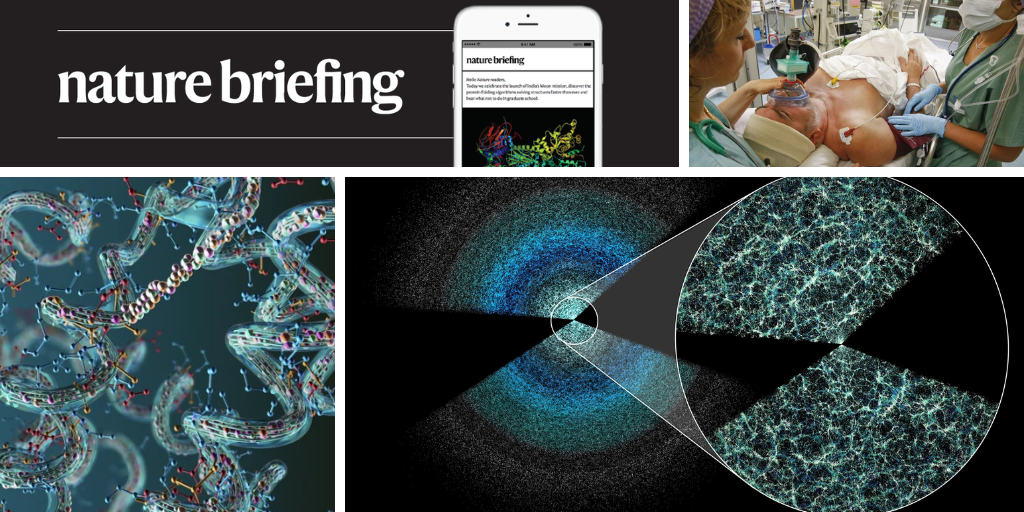
Last month, a cosmology project completed its initial five-year mission to create the most detailed 3D map of the Universe so far. The Dark Energy Spectroscopic Survey (DESI), based at the Kitt Peak National Observatory near Tucson, Arizona, has measured the precise distances of 47 million galaxies and quasars. Pictured is a thin slice of the map, with the Milky Way at its centre; the inset shows how galaxies form a web of clusters and filaments under the pull of gravity. DESI’s preliminary results hinted that the leading model of cosmic expansion could be wrong.
See more of the month’s sharpest science shots, selected by Nature’s photo team.
‘Dark’ portions of the genome, which weren’t thought to hold instructions for making working proteins, have mostly been excluded from research. Now thousands of the proteins encoded by these genes have an official, new name — peptideins — that marks their inclusion in major gene and protein databases used by the life-sciences community. Dark proteins tend to be very short in amino acid length and lack evolutionary relatives in other organisms, which is part of the reason they have been omitted. But some have been implicated in diseases including childhood cancers, as well as in basic cellular functions. “This is a major breakthrough,” says bioinformatician Christoph Dietrich. “These microproteins have the potential to really open up a new wave of research.”
Features & opinion
A growing community of synthetic biologists using biotechnology-led solutions — mostly microorganisms containing DNA tailored for a specific function — to tackle pollution ranging from microplastics and industrial waste to soils laced with heavy metals or explosive residues. But the field is held back by concerns around releasing genetically modified organisms into the environment, and the fact that current incentives make polluting profitable while cleaning up costs money.
This article is part of Nature Spotlight: Synthetic biology
Infographic of the week

“Much existing guidance on data visualization has contributed to improving technical aspects,” argues epidemiologist Ryosuke Fujii (藤井亮輔). “But they often overlook a broader question: how figures function within the communication process.” Fujii outlines a practical strategy for creating figures that communicate clearly across audiences and scientific contexts. (Nature Human Behaviour | 13 min read) (Ryosuke Fujii 藤井亮輔/Nature Human Behaviour)
Today I’m fully immersing myself in seabird serenity, thanks to the UK National Trust charity’s live feed from the puffin colony on the Farne Islands. I’ll pass on the same warning as the Trust: be prepared for scenes of fighting or mating (but at the time of writing, the birds are mostly waddling around, relaxing or, at most, doing a bit of stick collecting).
While I refresh my soul with views of wide Northumberland skies, why not send me your feedback on this newsletter? Your e-mails are always welcome at [email protected].
Thanks for reading,
Flora Graham, senior editor, Nature Briefing
• Nature Briefing: Careers — insights, advice and award-winning journalism to help you optimize your working life
• Nature Briefing: Microbiology — the most abundant living entities on our planet — microorganisms — and the role they play in health, the environment and food systems
• Nature Briefing: Anthropocene — climate change, biodiversity, sustainability and geoengineering
• Nature Briefing: AI & Robotics — 100% written by humans, of course
• Nature Briefing: Cancer — a weekly newsletter written with cancer researchers in mind
• Nature Briefing: Translational Research — covers biotechnology, drug discovery and pharma

