


From the moment of its discovery, the antagonistic relation between superconductivity and a magnetic field has provided a complex playground for experimentalists and theorists alike. The measurement of the critical field and the Meissner effect12 have anchored phase-transition theories13,14, and the trapping of quantized flux inside superconductors has provided direct evidence for the existence of Cooper pairs15. A hallmark of type II superconductivity in a magnetic field is the formation of Abrikosov vortices: regions of local gap suppression that interact to form lattices1. Vortex dynamics is detrimental for a wide range of applications15, causing heating, flux noise and magnetic hysteresis. However, pinned vortices enable quasiparticle trapping in their core, which enhances the critical current16 of superconducting films, improves micro-cooler efficiency17, boosts resonator quality factors18 and improves qubit coherence19,20. In all these cases, owing to the normal state core, vortices can be understood within semi-classical models.
Gap suppression in the vortex core stems from the crowding of supercurrent at its centre, a consequence of continuity in the superconducting medium. Recent work3 has proposed that in discretized systems, such as granular superconductors where non-superconducting regions separate superconducting islands, the vortex core can remain gapped and dissipationless; a closely related regime has also been predicted for strongly disordered superconductors, where emergent superconducting islands2 host vortices with insulating cores4. Although quantum behaviour has been revealed by tunnelling of vortices in long Josephson junctions8 and thin films9, or via the zero-point motion of pinned vortices10, direct evidence of coherent superconducting vortex states has yet to be observed.
Here we show that vortices trapped in a superconducting granular aluminium (grAl) microwave resonator form field-tunable two-level systems that behave like effective spins, strongly coupled to the resonator. They can therefore be regarded as quantum bits (qubits) that arise from vortex tunnelling in a field-modulated double-well potential formed between pinning sites. These vortex qubit (VQ) states exhibit microsecond coherence and energy relaxation times on the order of 102 μs, strikingly different from the dissipative dynamics of Abrikosov vortices. We find that VQs remain stable for weeks, enabling coherent control and quantum non-demolition readout within the framework of circuit quantum electrodynamics11.
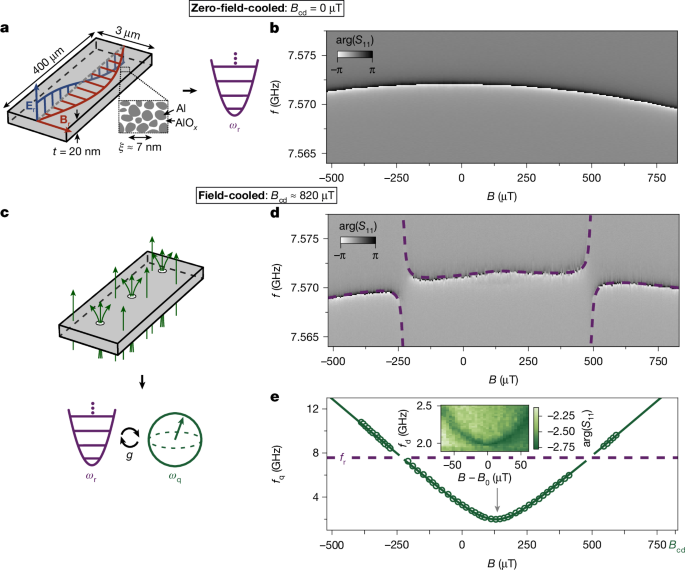
As schematized in Fig. 1, we use a grAl micro-stripline resonator, with resistivity ρ = 3,600 μΩ cm, chosen to be within a factor of 3 below the superconducting-to-insulating transition21. In this regime, the film consists of Al grains of 3–4-nm diameter separated by amorphous AlOx barriers, resulting in a coherence length ξ ≈ 7 nm and London penetration depth of λL ≈ 4 μm (refs. 5,22,23). The resonator is placed in a cylindrical copper waveguide (Supplementary Information section I) anchored to the 20-mK base plate of a dilution cryostat and measured in reflection. When cooled in zero magnetic field Bcd = 0 μT, the grAl resonator behaves as a weakly anharmonic oscillator24, with a fundamental frequency fr = 7.572 GHz, set by its dimensions (3 μm wide, 400 μm long; Extended Data Fig. 1). Figure 1b shows the frequency decrease with perpendicular magnetic field B, as expected with the increase in kinetic inductance25,26.

a, When cooled to 20 mK in perpendicular magnetic field Bcd = 0 μT, a λ/2 micro-stripline grAl resonator behaves as a quantum harmonic oscillator with resonant frequency ωr. The electric- and magnetic-field distributions are illustrated in blue and red, respectively. The grAl film has a thickness of t = 20 nm and a superconducting coherence length of ξ = 7 nm. b, Phase response arg(S11) of the resonator measured in reflection, as a function of perpendicular magnetic field B applied after cooling. The measured parabolic suppression of the resonance is given by the increase in kinetic inductance owing to screening currents25, and the field range is limited by the vortex penetration threshold26. c, When cooled in perpendicular magnetic field Bcd = 820 μT (see main text), vortices enter the grAl resonator and the system exhibits a behaviour akin to a flux qubit with a transition frequency ωq coupled to a readout resonator, as illustrated in d and e. d, The measured phase response of the resonator as a function of B reveals avoided level crossings, suggesting coupling to vortex states. The purple dashed line shows a fit to the asymmetric quantum Rabi model (equation (2)), yielding the coupling g/2π = 95 MHz. e, Extracted VQ frequency fq from two-tone spectroscopy (see inset) as a function of B. The green line corresponds to the joint fit of data in d and e to equation (2), and the purple dashed line marks the bare resonator frequency fr. Inset: two-tone spectroscopy in the vicinity of B0 corresponding to the minimum frequency of the VQ. The colour scale indicates the measured phase response as a function of the frequency fd of the second drive.
Following field-cooling, sweeping B reveals avoided level crossings in the grAl resonator response as illustrated in Fig. 1d, which we interpret as evidence of strong coupling with g/2π = 95 MHz to vortex states. To extract the mode’s spectrum, we sweep a second microwave drive while probing the readout resonator (Fig. 1e). We observe a minimum vortex mode frequency fq = 2 GHz at the sweet spot B0 = 128 μT (Fig. 1e, inset), with a slope of the hyperbolic field dispersion γ = 20 GHz mT−1, reminiscent of a flux qubit27. As the field approaches the sweet spot, the resonance narrows, pointing to magnetic-field fluctuations as dominant noise source28. From measured spectra across 32 field-cooling cycles in six different resonators, we extract values of g, fq, B0 and γ that are of similar order of magnitude but vary between cycles (Supplementary Information section II), suggesting different underlying vortex configurations. Repeated resonator reflection coefficient S11 measurements at the sweet spot reveal two distinct clusters in the quadrature plane (Fig. 2a), indicating that the vortex state has a lifetime well beyond the 1.2-μs integration time, thereby enabling single-shot state discrimination. As demonstrated in Fig. 2b, by driving at fq, we can calibrate a 20 ns π-pulse, which inverts its thermal population (see Supplementary Information section III for the Rabi oscillations). These signatures define the VQ states \(| \rmg\rangle \) (ground) and \(| \rme\rangle \) (excited). From their steady-state populations, we extract a 74-mK effective temperature. The VQ–resonator interaction induces a state-dependent dispersive shift \(\chi /2\rm\pi =f_\rmr,-\,f_\rmr,\). As shown in Fig. 2c, fitting the resonator’s phase response to the centres of in-phase and quadrature (IQ) clouds measured versus readout frequency yields χ/2π = −1.32 MHz (see Supplementary Information section IV for all measured IQ clouds).

a, Consecutive S11 measurements at the sweet spot show two IQ clouds in the complex plane. The relative occurrence of points in the clouds corresponds to the population of the \(| \rmg\rangle \) (ground) and \(| \rme\rangle \) (excited) states. The qubit excited state population Pq yields an effective qubit temperature Teff ≈ 74 mK. b, Measured IQ clouds following a 20-ns drive at fq calibrated to implement a π-pulse show a population inversion as expected for a two-level system. The black circles have a radius of 1.5 standard deviation. c, Resonator phase response arg(S11), obtained from the centres of the IQ clouds, measured versus readout frequency fRO in the vicinity of fr. A fit to the data (black solid line) yields a dispersive shift of χ/2π = −1.32 MHz. The dark red (\(| \rmg\rangle \)) and light red (\(| \rme\rangle \)) points correspond to the data in a at fRO = 7.5714 GHz (dashed line). d, Variation of χ with magnetic field B, shown as triangles, with the yellow triangle corresponding to the measurement in b. The dashed line indicates the expected values from the asymmetric quantum Rabi model equation (2) with gAQRM/2π = 92.5 MHz, and the dash-dotted line to the symmetric quantum Rabi model equation (1) with gSQRM/2π = 20 MHz. The solid green line represents the qubit frequency (right axis), similar to Fig. 1d.
For further insight into the nature of the VQ and its interaction with the grAl resonator, we measure χ versus field, as shown in Fig. 2d. We model it using the quantum Rabi model (QRM) for a spin S = 1/2 coupled via \(\mathcalH_\rmc=\hbar g(\hata^\dagger +\hata)\sigma _x\) to a harmonic oscillator with frequency ωr and Hamiltonian \(\mathcalH_\rmr=\hbar \omega _\rmr\left(\hata^\dagger \hata+\frac12\right)\) (Supplementary Information section V). Here \(\hata^\dagger \) and \(\hata\) are the resonator bosonic operators, ħ = h/(2π) is the reduced Planck constant and σx is the Pauli matrix for a spin S = ħ/2σ. The interaction energy between the spin and the magnetic field is \(\gamma \bfS\cdot (\widetilde\bfB+\bfB^\prime )\), where γ is the gyromagnetic ratio and the field consists of two contributions: a pseudo-field \(\widetilde\bfB\) that sets the VQ energy at the sweet spot, and the applied magnetic field \(| \bfB^\prime | =B-B_\) measured from the sweet spot. We compare joint fits of the measured VQ and resonator frequencies in field (Fig. 1d,e), using the symmetric quantum Rabi model (SQRM)
$$\mathcalH_\rmS\rmQ\rmR\rmM=\mathcalH_\rmr+\mathcalH_\rmc+\frac\hbar \gamma 2\sigma _z\sqrt\mathopB\limits^ \sim ^2+B^\prime 2,$$
(1)
and the asymmetric quantum Rabi model (AQRM)
$$\mathcalH_\rmA\rmQ\rmR\rmM=\mathcalH_\rmr+\mathcalH_\rmc+\frac\hbar \gamma 2\sigma _z\mathopB\limits^ \sim -\frac\hbar \gamma 2\sigma _xB^\prime \,.$$
(2)
Only the AQRM captures the non-monotonic dependence of χ with B. In contrast, the SQRM predicts a monotonically decreasing χ with detuning from the resonator. Moreover, using the coupling constant g from the joint fit in Fig. 1d,e, we obtain quantitative agreement for the measured χ, as shown in Fig. 2d. This suggests that the VQ, possibly consisting of persistent currents, arises from dynamics in a double-well potential, analogous to fluxon tunnelling through the Josephson junction of a flux qubit27. Within this model, the pseudo-field \(\widetildeB\) is given by the fluxon tunnelling amplitude7.
We complete the characterization of the VQ with time-domain measurements at the sweet spot. As shown in Fig. 3a, the fitted energy relaxation time is T1 = 186 μs, with values ranging from 40 μs to 300 μs across multiple VQ preparation cycles (Supplementary Information section VI). Relaxation times extracted from VQ quantum jumps (Supplementary Information section VI) fall within the temporal fluctuations observed in free decay, indicating a quantum non-demolition readout. Remarkably, the VQ exhibits quantum coherence, with a Ramsey time \(T_2^* =440\,\rmn\rms\), which extends to \(T_2^\rme\rmc\rmh\rmo=1.2\,\rm\mu \rms\) in Hahn-echo measurements, which suppress the low-frequency noise (Fig. 3b,c). The Ramsey fringes exhibit a beating pattern, corresponding to a toggling of the VQ’s frequency between two values separated by 1.9 MHz. This feature is sometimes also observed in superconducting qubits29, possibly indicative of charge noise or conductance channel fluctuations. The measured VQ lifetime T1 is competitive with superconducting flux qubits30,31, whereas the coherence \(T_2^* ,T_2^\mathrmecho\) remains more modest, in line with flux qubit devices realized entirely from disordered superconductors29,32. Away from the sweet spot, both \(T_2^* \) and \(T_2^\mathrmecho\) decrease (Supplementary Information section VI), consistent with flux-noise-limited dephasing in loop-based superconducting circuits and motivating a detailed comparison with established flux-noise mechanisms30,31,33. In future experiments, detailed noise characterization31, environment polarizability34, as well as susceptibility to in-plane magnetic33 and electric fields35 could shed light on the microscopic origin of the VQ and its environment.

a, Free energy decay measured after a 20-ns π-pulse applied selectively to the VQ measured in the ground state \(| \rmg\rangle \). The readout pulse has a duration τm = 1.2 μs. The excited VQ population as a function of wait time t is fitted with an exponential corresponding to T1 = 186 μs (solid line). b, Ramsey fringes exhibit a beating pattern, resulting from two frequencies separated by fbeat = 1.9 MHz. We extract \(T_2^* \) Ramsey coherence times of 440 ns. c, Spin Hahn-echo measurement with extracted \(T_2^\rme\rmc\rmh\rmo=1.2\,\rm\mu \rms\). For each panel, the corresponding pulse sequence is sketched at the top, and the insets show measured coherence times, with error bars indicating the standard deviation from the fit, over several hours.
To give a hypothesis for the origin of the double-well potential of the VQ, we consider the process of introducing vortices into the grAl resonator through field-cooling. Their formation and spatial arrangement depend on the value of the flux bias during cooling ϕ = Bcdw2/Φ0, where Φ0 = h/2e is the magnetic flux quantum, e is the charge of an electron, and w is the width of the resonator. In the Pearl limit36, where the thickness of the film t ≪ λL, the threshold for stable vortices is \(\phi _\rmS=(2/\rm\pi )\mathrmln(2w/\rm\pi \xi )\) (refs. 37,38,39), corresponding to ϕS = 3.59 for our geometry (Supplementary Information section VII). The Gibbs energy for vortices threading the film40,41 is
$$G_1(x)=\varepsilon _\mathrmln\left(\frac2w\rm\pi \xi \sin \left(\frac\rm\pi xw\right)+1\right)-\frac\varPhi _(B-n\varPhi _)\mu _\varLambda x(w-x),$$
(3)
where \(\varepsilon _=\varPhi _^2/(2\rm\pi \mu _\varLambda )\) sets the single-vortex energy scale, n is the density of vortices (n = 0 for the first vortex), \(\varLambda =2\lambda _\rmL^2/t\) is the Pearl length of the resonator, and x is the position of the vortex measured from the resonator edge. As B decreases from BS = ϕSΦ0/w2 to zero, the minimum of G1(x) vanishes (Fig. 4, baseline), and in the absence of pinning the vortex would be expelled.

Gibbs free energy G1 (equation (3), baseline) of a single vortex, shown with added pinning potentials modelled as Lorentzian dips, in units of \(\varepsilon _=\varPhi _^2/2\rm\pi \mu _\varLambda \approx \text2\,\mathrmTHz\). The vortex position is measured from the edge, as indicated by the coordinate axis. Colours represent different applied magnetic fields from BS = ϕSΦ0/w2 to −B0. Top inset: example of a double-well potential formed by the energy landscape of adjacent pinning sites separated by δLR and offset in energy by ϵ. The localized wavefunctions correspond to the two vortex positions \(| \rmL\rangle \) and \(| \rmR\rangle \), coupled by tunnelling amplitude Δ, with an energy splitting of ħωq. Bottom inset: at the sweet spot (B0, which can be higher or lower than BS; see Supplementary Information section II), the double well is degenerate, with VQ states forming symmetric and antisymmetric combinations of the localized wavefunctions, yielding ħωq = 2Δ.
To account for the measured stability of the VQ across magnetic-field sweeps (Fig. 1), we incorporate pinning potentials, presumably abundant given the disordered nature of grAl. They are modelled by adding Lorentzian dips \(V_\rmp\rmi\rmn=V_i(1+(x-x_i)^2/\sigma _i^2)^-1\) to G1(x), at random positions xi, depth Vi and width σi, sketched as the coloured energy landscapes in Fig. 4. A vortex tunnelling between pinning sites forms a double-well potential (Fig. 4, top inset), in which B tunes the relative pinning depths according to equation (3). At B0, the minima are degenerate and the vortex delocalizes, with \(| \rmg\rangle \) and \(| \rme\rangle \) given by symmetric and antisymmetric superpositions of \(| \rmL\rangle \) and \(| \rmR\rangle \) wavefunctions (Fig. 4, bottom inset).
This hypothesis is supported by the fact that typically measured gyromagnetic ratios γ/2π = 3–25 GHz mT−1 are consistent with flux tunnelling between pinning sites separated by tens of nanometres (Supplementary Information section VII), reminiscent of tunnelling through grAl nanojunctions29. Moreover, to leading order, a kinetic-inductance-mediated VQ–resonator coupling g/ωr ≈ 0.1–1% (Supplementary Information section VIII) is consistent with the observed avoided level crossings. Although single-vortex pinning can account for the observed VQ, it is well established that multiple vortices simultaneously enter the resonator once the threshold for entry is reached39, as illustrated by the set of Gibbs curves in the foreground of Fig. 4. We estimate the VQ–VQ interaction in the 10–100 MHz range (Supplementary Information section IX), suggesting that collective vortex dynamics is unlikely. Nevertheless, distinguishing between single- and multi-vortex dynamics, for instance, using imaging methods40,42,43,44,45, or by shaping the resonator width18, remains an important avenue for future research.
In conclusion, field-cooling a grAl micro-stripline resonator reproducibly generates VQ states that couple dispersively to the resonator and can be coherently driven. Our results demonstrate that superconducting vortices can harbour quantum coherence on microsecond timescales. Remarkably, the VQ energy relaxation times are on the order of hundreds of microseconds, comparable to those of engineered superconducting qubits11,30, and qualitatively distinct from the dissipation expected for Abrikosov vortex dynamics. This supports a picture of grAl as a three-dimensional network of Josephson junctions, expected to host gapful-core vortices once the coherence length ξ becomes comparable to the intergrain spacing ℓ, with a growing minigap for ξ ≲ ℓ (refs. 2,3). The observed dispersive shifts and spectra are accurately captured by an asymmetric quantum Rabi model, consistent with a two-level system in a double-well potential. Microscopically, this may arise from vortex tunnelling between pinning sites, modulated by the magnetic-field dependence of the Gibbs energy. This hypothesis, although consistent with our measurements, remains to be confirmed by future experiments such as scanning tunnelling or scanning superconducting quantum interference device (SQUID) microscopy.
Looking ahead, the measurement of quantum coherence in vortex states, along with their relative technological simplicity, opens several exciting avenues in quantum science. Disordered superconductors beyond grAl46,47 or engineered two-dimensional networks of Josephson junctions48 may host similar VQs, shedding light onto the complex physics in the vicinity of the superconductor-to-insulator transition49,50. Moreover, this would offer an embedded tool for material characterization at the microscopic level. In the same spirit, if the observed dynamics indeed stem from single-vortex tunnelling, VQs could be harnessed for nanoscale sensing. Ultimately, engineering the pinning landscape and device geometry, combined with noise spectroscopy and susceptibility measurements to magnetic and electric fields, will be crucial to enhance VQ coherence and possibly launch a vortex-based quantum information platform.

