


Samples
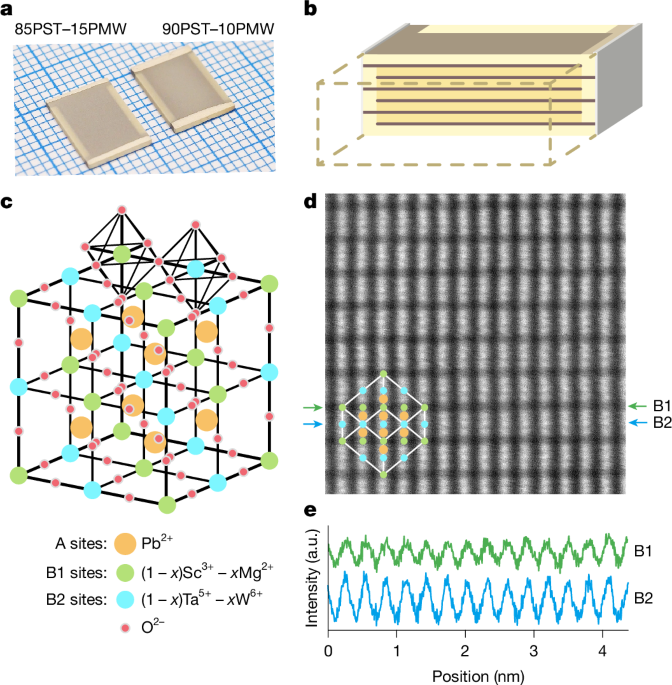
The active area of MLC1 of 85PST–15PMW was used for STEM. MLC1 of 85PST–15PMW and MLC1 of 90PST–10PMW were used for indirect EC measurements from which efficiency was evaluated and for direct measurements of EC temperature change that were converted to effective temperature change. MLC2 of 85PST–15PMW and MLC2 of 90PST–10PMW were crushed to form powders for XRD. MLC2 of 85PST–15PMW and MLC2 of 90PST–10PMW were used for zero-field calorimetry and direct measurements of EC heat. MLC3 of 85PST–15PMW and MLC3 of 90PST–10PMW were used for optical images. MLC4 of 85PST–15PMW and MLC4 of 90PST–10PMW were used for dielectric spectroscopy. MLC5 of 85PST–15PMW was tested for fatigue. MLC6 of 85PST–15PMW was used to measure leakage current.
MLC fabrication
Powders of high-purity Pb3O4, Ta2O5 and MgWO4 (Kojundo Chemical Laboratory Co., Ltd) and Sc2O3 (Shin-Etsu Chemical Co., Ltd) were weighed, ball-milled for 16 h in distilled water with balls of partially stabilized zirconia, dried and then pulverized. The powder mixture was then calcinated at 850 °C for 4 h in air. Subsequent ball-milling that used partially stabilized zirconia balls with an organic solvent and binder resulted in a slurry for casting green sheets using the doctor blade technique. These green sheets were sliced, electroded by screen-printing Pt paste, stacked, pressed and cut to obtain green MLCs. After burning off the binder at 500 °C for 24 h, the proto-MLCs were sintered at 1,250 °C for 4 h in a Pb-containing atmosphere. Terminals were formed by painting on a bespoke Ag paste and firing in air at 750 °C for 10 min.
MLC geometry
MLCs of 85PST–15PMW had external dimensions of 10.10 × 7.18 × 0.78 mm3, an active volume of 32.6 mm3 that comprised 19 layers of thickness 35 μm and area 49 mm2, Pt inner electrodes of thickness 2 μm and an active volume fraction of vactive = 58%. MLCs of 90PST–10PMW had external dimensions of 10.20 × 7.28 × 0.78 mm3, an active volume of 32.8 mm3 that comprised 19 layers of thickness 36 μm and area 48 mm2, Pt inner electrodes of thickness 2 μm and vactive = 57%.
Thermalization of active and inactive layers
Within the active area and away from the periphery, we identify |ΔTj| = f1|ΔT| = 0.85|ΔT| for both PST–PMW compositions by assuming complete thermalization between the 19 active PST–PMW layers (that would develop adiabatic temperature change |ΔT| if isolated) and the inactive layers that comprise two outer layers of PST–PMW and 20 inner Pt electrodes. The calculation assumes an off-peak volumetric heat capacity of c ≈ 2.5 MJ K−1 m−3 for PST–PMW at 273 K (Supplementary Note 4) and c ≈ 2.8 MJ K−1 m−3 for Pt.
XRD
We used a Bruker D8 Advance diffractometer with Cu-Kα radiation and a LYNXEYE EX detector that obviates the need for a monochromator. For MLCs crushed to a powder, we obtained 2θ–ω step scans with a 2θ step of 0.01°, a scan speed of 1.5 s step−1 and a fixed illuminated length that increases the effective scattering volume at higher values of 2θ. The diffraction profiles we present and analyse were corrected with DIFFRAC.EVA software to make the effective scattering volume constant. Lattice parameters of ac ≈ 8.13 Å (85PST–15PMW) and ac ≈ 8.14 Å (90PST–10PMW) were estimated from the positions of the 422 reflections generated by Cu-Kα1 radiation (Supplementary Note 2). The intensities of the unsplit 111 and 200 reflections, determined by fitting pseudo-Voigt functions, were used to calculate the B-site order between high-valence and low-valence cations (S111 ≈ 0.99 for 85PST–15PMW, S111 ≈ 0.97 for 90PST–10PMW) (Supplementary Note 2).
STEM
Following the protocol developed in ref. 43, a FEI Helios NanoLab DualBeam focused ion beam scanning electron microscope was used to prepare a cross-sectional lamella that was cut from the active volume of MLC1 of 85PST–15PMW and thinned below 30 nm for optimal atomic resolution. STEM characterization was performed at 300 kV on a Thermo Fisher Scientific Spectra 300 transmission electron microscope equipped with a high-energy-resolution extreme field-emission gun/mono monochromator. STEM-HAADF images were acquired using a beam current of 85 pA, a camera length of 58 mm, a convergence angle of 30 mrad, a dwell time of 5 µs and spatial sampling of 5 pm per pixel. Velox software was used to subtract backgrounds with a radial Wiener filter and generate intensity profiles.
Differential scanning calorimetry
We identified the zero-field volumetric heat capacity c(T) by experimentally determining dQ/dT on heating and cooling in a TA Instruments Q2000 DSC with a sapphire reference. The relative zero-field entropy \(S\rm\prime (T)=S(T)-S(T_)=\int _T_^Tc(T\rm\prime )/T\rm\prime \rmdT\rm\prime \) is identified with respect to the entropy S at T0 = 200 K (85PST–15PMW) or T0 = 219 K (90PST–10PMW). As shown in Supplementary Fig. 7, comparison of S′(T) with respect to the corresponding function derived from a sigmoidal baseline for c(T) yields thermally driven zero-field entropy changes of |ΔS0| = 13.4 kJ K−1 m−3 (85PST–15PMW) and |ΔS0| = 14.8 kJ K−1 m−3 (90PST–10PMW).
Highly isothermal measurements of EC heat
We used a bespoke differential scanning calorimeter. The MLC under test and a copper reference were attached with thermal paste (RS-GCS-SP50, RS Components) to 10 × 10-mm sense and reference Peltiers that were monitored using a Keithley 2110 Multimeter but the copper reference is redundant for our isothermal measurements. The Peltiers were superglued to a massive copper block and a copper lid created a closed air space. The resulting assembly was placed in a steel cup whose temperature was set using near-total immersion in a LAUDA Eco Gold 1050 temperature bath. Cling film over the steel cup prevented ingress of the oily fluid. A Pt100 resistance thermometer, inserted into a channel in the copper block and monitored using a Keithley 2110 Multimeter, was used to identify sample temperature given that block temperature and electric field were only varied slowly. The measured temperature was stable to |dT/dt| <0.01 K s−1. Electric field was varied using a Keithley 2470 SourceMeter that was connected to the MLC under test using 0.2-mm-diameter coiled copper wires and silver paste. Specifically, we applied and removed E = 21.4 V μm−1 at dE/dt = ±7.1 mV μm−1 s−1 (85PST–15PMW) and E = 20.8 V μm−1 at dE/dt = ±6.9 mV μm−1 s−1 (90PST–10PMW), such that the duration of each unidirectional field sweep (approximately 3,000 s) was two orders of magnitude larger than the 10 s thermal relaxation time for 1/e decay. This thermal relaxation time is as large as it is because the heat flowing between MLC and copper block passes through the intervening Peltier that is used to measure it. The field ramps resulted in a differential heat dQ/dt that was identified from the voltage difference measured between sense and reference Peltiers with the calibration given in ref. 41. After setting a repeatable unipolar branch by performing one of the field cycles described above, data were obtained on heating to temperatures that fell roughly every 4.9 K from 228 K to 356 K (85PST–15PMW) or roughly every 4.9 K from 238 K to 356 K (90PST–10PMW).
Set-up for highly adiabatic EC measurements at different set temperatures
The variable-temperature calorimeter that we used for highly isothermal measurements of heat was used here but not as a calorimeter. Instead, the sense Peltier functioned as a passive extension of the copper block. An assembly comprising the MLC under study and a thin copper plate, separated by two pieces of wooden toothpick on either side of the active area, was attached to the sense Peltier via the copper plate. The thus-mounted MLC showed a long thermal relaxation time of 33 s for 1/e decay. The MLC–toothpick connection was made using vacuum grease, the toothpick–copper plate connection was made using Loctite superglue (Henkel Adhesives) and the copper plate–Peltier connection was made using RS-GCS-SP50 thermal paste (RS Components).
Highly adiabatic measurements of electrical polarization
A Keithley 2470 SourceMeter was used to acquire bipolar measurements of polarization in ±600 V by setting constant-magnitude currents (250 µA) that were large enough to set the duration of each unidirectional voltage sweep to <1.3 s, which is much smaller (<4%) than the 33 s thermal relaxation time. These measurements were acquired on heating to nearby values of set temperature that fell roughly every 0.45 K from 225 K to 370 K (85PST–15PMW) or roughly every 0.48 K from 228 K to 370 K (90PST–10PMW).
Highly adiabatic measurements of EC temperature change
A Keithley 2470 SourceMeter was used to apply and later remove up to 750 V while limiting the magnitude of the current to a high value (10 mA). The resulting EC effects were driven during a field-change time of about 0.1 s. Temperature was measured using a K-type thermocouple (Therma Thermofühler GmbH) with junction diameter 400 μm and wire diameter 80 μm. The thermocouple was pressed onto the MLC face centre by means of its wires, held with a drop of black paint (Electrolube PNM400) and monitored at about 4.9 Hz using a Keithley 2110 Multimeter. After setting a repeatable unipolar branch by performing one of the voltage cycles described above, data were obtained on heating to set temperatures that fell approximately every 4.7 K from 235 K to 372 K (85PST–15PMW) and from 246 K to 376 K (90PST–10PMW).
Highly adiabatic measurements of fatigue
Using a Radiant Precision Premier II with a Trek 609E-6 amplifier, we applied a 10-Hz triangular pulse of magnitude 600 V (17.1 V μm−1) to MLC5 of 85PST–15PMW at a set temperature near which EC effects peak (264 K; Fig. 3d). Under this driving protocol, 5 × 10⁶ bipolar cycles were followed by 5 × 10⁶ unipolar cycles, such that 600 V was applied 1.5 × 10⁷ times. During a limited number of interruptions to the 1.5 × 10⁷ cycles, and after all 1.5 × 10⁷ cycles were complete, field-on and field-off measurements of |ΔTj| with |E| = 17.1 V μm−1 lay within 4% of the corresponding values measured at the outset.
Dielectric permittivity
Data for Supplementary Note 5 were measured using an Agilent 4294A analyser that was electrically connected to the MLC under test by means of two W needles that also served to mechanically connect the MLC via an electrically insulating glass coverslip and underlying thermal paste to a variable-temperature Linkam stage, which was heated and subsequently cooled at ±0.083 K s−1. MLC temperature was identified using a Keithley 2110 Multimeter to record the temperature of a thermocouple attached to the MLC face centre using a drop of black paint.
Steady-state high-field power dissipation
We employed two methods that yielded same order-of-magnitude values of power. While applying 21.4 V μm−1 to MLC2 of 85PST–15PMW at 297 K, the dissipated power was 8.15 μW, as deduced from our sensitive calorimetry (Supplementary Fig. 16c). While applying the same field to MLC6 of 85PST–15PMW at 295 K, the dissipated power was 30.3 μW, as deduced using a Keithley 2470 SourceMeter to measure for 1 h a steady-state leakage current of 40.4 nA (43.4 μA m−2). The resistance corresponding to this current is 18.6 GΩ (4.93 × 10⁷ μΩ cm).
Identification of the phase boundary
Inflection points in P(E) at measured values of set temperature Ts were plotted on (S′, E) axes (Fig. 2a–d) after converting Ts to S′ (main-text discussion of Fig. 2a) and smoothing the resulting phase boundary with a Savitzky–Golay filter. The phase boundary in T(S′, E) (Fig. 2d) gives the relationship between T and E that we use to identify the phase boundary on (T, E) axes (Fig. 2e,f).

