


You have full access to this article via your institution.
Hello Nature readers, would you like to get this Briefing in your inbox free every day? Sign up here.

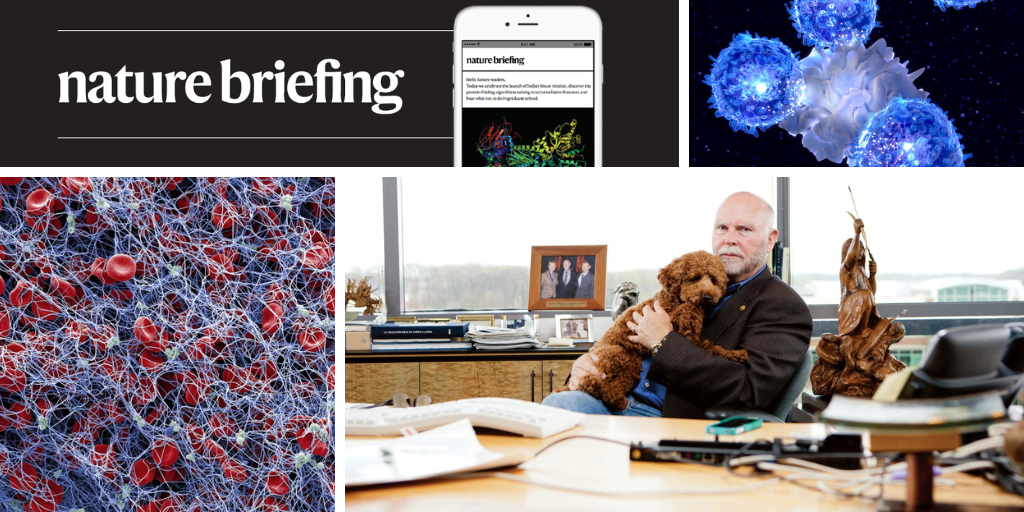
Craig Venter in his office with his dog, Darwin.Credit: Eli Meir Kaplan/For The Washington Post via Getty
Craig Venter — who led a race to decode the human genome, pioneered a genome-sequencing method still used today, created the first organisms with synthetic genomes and sailed around the world recording microbial diversity — died yesterday, aged 79. Venter is most well-known for leading a commercial effort to generate the first human genome sequence in the 1990s, racing against the US$3 billion global, publicly funded Human Genome Project. But Venter’s scientific legacy extended well beyond the ‘genome wars’, say scientists who knew, admired and competed with him. “He is a true pioneer and maverick who revolutionized genomics by enabling new sequencing methods and trying to create synthetic cells,” says Tae Seok Moon, a synthetic biologist at Venter’s research centre. “It’s a huge loss for all genomics and synthetic biology researchers.”
Read more: ‘I consider retirement tantamount to death’: a conversation with Craig Venter (Nature | 10 min read, from 2023)
Eating seems to prime immune cells for action, helping infection-fighting T cells proliferate more quickly in response to threats. “There’s the old adage: starve a fever, feed a cold. And we think that there’s some value in this,” says immunologist and study co-author Greg Delgoffe. He thinks that researchers should reassess how diet influences the immune response. “We don’t really ask, when have you eaten last and what did you eat?” he says. “But that may make a big difference.”
When mechanical engineer Jianyu Li looked at natural blood clots, he found them lacking: “They are mechanically very weak, and easy to rupture and detach, causing re-bleeding,” he says. So he and his colleagues harnessed a Nobel-prizewinning technique called ‘click chemistry’ to improve on nature’s clotting reactions. By attaching certain proteins to proteins in the membranes of red blood cells, the cells could snap together with another molecule like the ends of a seat belt, creating clots that formed faster than natural clots or a wound sealant already used in hospitals. When tested in rats, the engineered clots also promoted healing and tissue regeneration, causing less inflammation than the synthetic sealant did, the researchers found.
An analysis of ancient genomes from hundreds of burials in southern Germany reveal that the transition from Late Antiquity to the Early Middle Ages was more complex than the stereotype of northern ‘barbarians’ running roughshod over a Roman Empire in decline. Instead, the genomes point to gradual genetic and cultural shifts that occurred through small-scale migration and intermarriage. Shared patterns of DNA show that northern Europeans “haven’t arrived as mass invaders or hordes or big clans — these are individual families who are already four or five generations on Roman territory”, says population geneticist and anthropologist Joachim Burger, who co-authored the analysis. They probably saw themselves as Romans, he adds.
Vaginal bacteria appear to support early brain development in newborns. Babies can absorb beneficial molecules produced by bacteria through their skin, which is much more porous than the skin of adults. In baby mice, researchers found that a lipid produced by Lactobacillus crispatus and Bacteroides fragilis triggers some signalling between neurons and recruits proteins involved in gene expression and cell growth in the brain.
Reference: Cell Host & Microbe paper
Features & opinion
At the London Marathon last weekend, Jacob Kiplimo broke the men’s world-record time of just over two hours — and came in third. Both the winner, Sabastian Sawe, and the second-place finisher, Yomif Kejelcha, broke the two-hour barrier. Advances in running shoes and nutrition might have helped. But social anthropologist Michael Crawley and sports physiologist Geoff Burns think that Western sports science might need to get up to speed with the wisdom gained in places such as Ethiopia, which has produced many of the greats, including record-breaking female winner Tigst Assefa.
BBC | 8 min read & Aeon | 19 min read
What kinds of carbon removal should count towards corporations offsetting their emissions? The question has often pitted ‘nature based’ approaches, such as planting forests, against modern technologies that capture carbon dioxide directly from the air. This contest “is scientifically misleading and increasingly counterproductive”, argues Gabrielle Walker. “In my role advising companies on carbon removal, I have seen it muddy decisions at every level.” What actually matters is how various methods perform, when they can be scaled up and which specific climate problem they are meant to address, she writes.
Like artificial intelligence systems themselves, trust in AI is multifaceted and fast-moving, write four psychologists in a review of the state of play. While looking at when, why and how people trust machines, the authors consider whether researchers might be inadvertently helping to create systems that are more trusted without being more trustworthy. “For all the potential benefits of AI systems, blind trust in AI is not the right goal, and it is important that researchers avoid the trap of assuming that more trust is better,” they write.

