


New designation highlights growing focus on secure communications as a critical component in U.S. drone policy
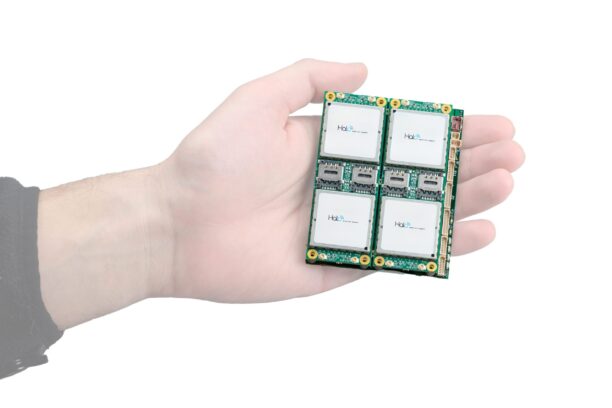
Elsight’s Halo connectivity platform has been added to the U.S. Department of War’s Defense Contract Management Agency (DCMA) Blue UAS List, marking a notable development in how the U.S. government evaluates and procures drone technologies.
The Blue UAS List serves as a pre-approved marketplace of NDAA-compliant, cyber-secure systems and components eligible for streamlined procurement. Inclusion allows military units and other government users to bypass lengthy acquisition cycles and deploy vetted technologies more quickly.
While the list has traditionally focused on complete drone systems, Halo’s inclusion as a standalone communications platform reflects a broader shift in how unmanned systems are defined and secured.
A Shift Toward Modular, Trusted Systems
Halo is not an aircraft. It is a beyond line-of-sight (BLOS) connectivity platform designed to ensure persistent, resilient communication between operators and unmanned systems. Its addition to the Blue UAS List suggests that the U.S. government is increasingly viewing drone systems as modular ecosystems rather than monolithic platforms.

As Yoav Amitai, CEO of Elsight, tells DRONELIFE: “Halo’s inclusion in the DCMA’s Blue UAS Clear list is a certain signal that the U.S. government is moving beyond evaluating only the unmanned device and is now considering certain subsystems, especially communications and data links, as mission-critical infrastructure.”
This shift aligns with broader trends in unmanned systems architecture. Modern platforms often integrate components from multiple vendors, including sensors, autonomy software, and communications layers. Certifying individual components allows for greater flexibility and supports a plug-and-play ecosystem.
Amitai notes that this reflects a deeper change in how trust is established. “In short, Halo’s inclusion isn’t just an exception, it’s a marker of a shift. The U.S. is starting to define ‘trusted UAS’ not as a single product, but as an ecosystem of vetted, interoperable components, with communications sitting at the center of that trust model.”
Communications as a Security Boundary
The growing emphasis on communications is not incidental. Data links are where command-and-control signals, telemetry, and payload data converge. They are also a primary point of vulnerability in contested environments.
Halo’s technology aggregates multiple communication links, including cellular, satellite, and peer-to-peer networks, into a single bonded connection. This approach enables continuous connectivity even in degraded or denied environments, such as areas affected by electronic warfare.
By certifying a communications platform independently, the Blue UAS framework acknowledges that secure connectivity is foundational to mission success. It also opens the door for companies that specialize in enabling technologies, rather than full drone systems, to participate directly in government programs.
Regulatory Clarity and Market Impact
Inclusion on the Blue UAS List carries implications beyond procurement. It also intersects with regulatory frameworks, particularly the Federal Communications Commission’s Covered List.
According to Amitai, the designation removes a key barrier to adoption: “Halo’s addition to the Blue UAS Cleared List materially changes the operating environment because it removes one of the biggest sources of regulatory ambiguity: the intersection between DoD approval and the FCC’s Covered List.”
This clarity has practical effects. It reduces hesitation among customers and integrators, simplifies compliance for system developers, and enables broader deployment across federal, state, and commercial markets.
Amitai adds: “In practical terms, the shift isn’t just about permission to operate. It’s about confidence to scale. It allows Halo to move from being a technically viable solution to a broadly deployable, procurement-ready component across the U.S. market.”
The Blue UAS designation also unlocks access to federal funding pathways and programs of record, expanding opportunities for adoption in defense, public safety, and critical infrastructure applications.
Meeting Blue UAS Standards as a Global Supplier
Elsight’s inclusion on the Blue UAS List is also notable because the global company is headquartered in Israel. Its approval demonstrates how allied suppliers can meet U.S. requirements for security, supply chain transparency, and data governance.
Amitai emphasizes the level of scrutiny involved: “Meeting Blue UAS standards as a non-U.S.-headquartered company comes down to demonstrating that country-of-origin risk is fully mitigated at the component, software, and data-flow level.”
The process required detailed validation of the supply chain, including mapping components to trusted vendors and eliminating sensitive dependencies. It also involved meeting defense-grade cybersecurity standards and demonstrating strict control over data flows.
This includes ensuring that data is not exposed to unauthorized access and that operators retain full control over how information is transmitted and stored.
Amitai highlights the broader significance: “What’s notable is that Blue UAS didn’t treat Elsight’s allied-nation origin as a barrier, but it did require proof, not assurances, that the platform behaves as a trusted component inside a U.S. mission environment. That sets an important precedent for other allied suppliers: the pathway exists, but it demands transparency and verifiable compliance at every layer.”
Implications for the Drone Industry
Halo’s addition to the Blue UAS List reflects several key trends shaping the drone industry.
First, it underscores the importance of communications as a core element of system design and security. As operations expand beyond visual line of sight and into more complex environments, reliable connectivity becomes essential.
Second, it reinforces the move toward modular architectures. By certifying individual components, the U.S. government is enabling a more flexible and competitive ecosystem.
Third, it highlights the role of policy in shaping market dynamics. Designations like Blue UAS not only influence procurement decisions but also signal trust to commercial users.
Finally, it demonstrates that allied companies can play a significant role in the U.S. drone ecosystem, provided they meet stringent requirements for transparency and security.
As unmanned systems continue to evolve, the definition of what constitutes a “trusted” platform is expanding. Increasingly, that trust will depend not just on the aircraft itself, but on the network of components that enable it to operate safely and effectively.
Read more:

