


You have full access to this article via your institution.
Hello Nature readers, would you like to get this Briefing in your inbox free every day? Sign up here.
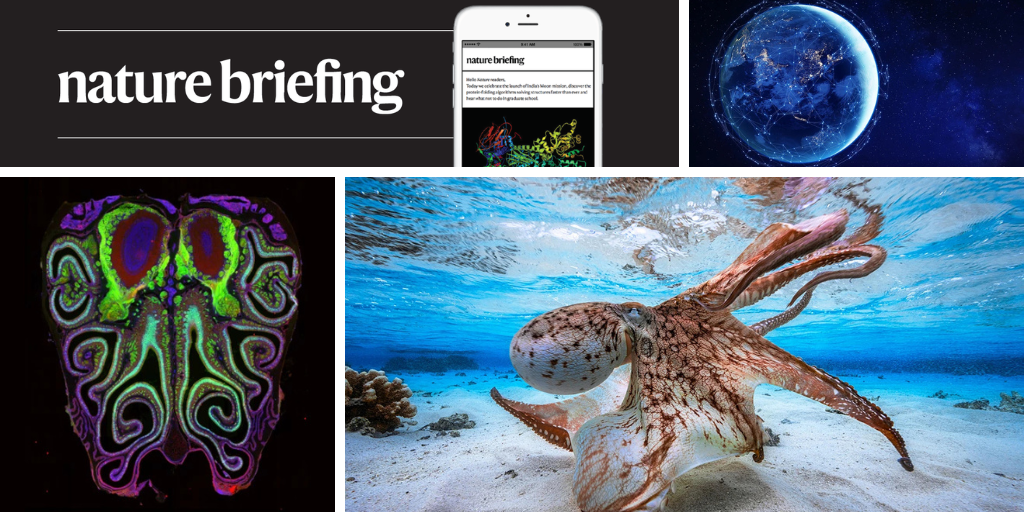
A microscope cross-sectional image of a mouse nose, showing the anatomical structure of the nasal epithelium. Credit: Datta Lab
The most detailed map ever of the olfactory receptors in the mouse nose transforms our understanding of the sense of smell. Instead of a handful of broad zones, in which receptors are essentially random, “each receptor adopts a particular position in the nose”, says neurobiologist and study co-author Sandeep Robert Datta. And the arrangement of receptors in the nose is mirrored in the part of the brain responsible for smell. “This means that the maps in the nose and the brain are not two separate problems the system has to solve, but two readouts of the same developmental logic,” says psychologist and experimental neuroscientist Johan Lundström. “This is a landmark paper that overturns one of the foundational textbook models of olfactory organization.”
Reference: Cell paper 1 & paper 2
As concerns rise about the environmental footprint of data centres, companies are starting to talk about putting the huge banks of computers in orbit. But the hurdles are significant, experts say. For example, data centres need to dissipate a lot of heat, and space, though cold, is a vacuum — so it keeps heat in like an insulated coffee cup. Space is also full of chip-zapping radiation, and Earth orbit is already crowded with satellites.
A sheet of papyrus found inside a Roman-era Egyptian mummy contains text from Homer’s Iliad. “This is not the first time we have found Greek papyri, bundled, sealed, and incorporated into the mummification process, but until now, their content was mainly magical,” says classicist Ignasi-Xavier Adiego. The segment is from the ‘Catalogue of Ships’ section of the epic poem, which would have already been considered a classic at the time of the embalming.
Scientific American | 5 min read
Features & opinion

Neuroscientists are studying octopuses (pictured) and other cephalopods because of their intelligence and large brains.Credit: Media Drum World/Alamy
Like us and our big-brained vertebrate relations, cuttlefish, squid and octopuses have excellent memories, use tools and are adept problem-solvers; they have a concept of time and are capable of delayed gratification. But they are not like us. “It’s hard to convey how different [the cephalopod brain] is,” says neuroscientist Cristopher Niell. “We just have no idea of how it functions.” Figuring it out could help us to understand where intelligence comes from. But working with a soft, flexible and wily creature — for which we have few ways to relieve pain — is a challenge for neuroscientists.
More than 100 independent advisory panels have been terminated by the administration of US President Donald Trump, finds a Nature analysis. The administration has also slashed the number of meetings open to the public and, at some agencies, the number of public reports. On some panels — such as in the prominent example of the Centers for Disease Control and Prevention’s vaccine advisory panel — the administration has replaced experts who disagree with its stance with people who agree. The White House says that it’s cutting costs, but scientists are concerned that the changes are making agencies less transparent and independent.

When it comes to space, “choices made now will shape what is possible for generations,” note a group of experts in space governance. “Scientific, commercial and security activities in space are often planned in isolation, even when they operate in similar orbits and use the same communications frequencies,” they note. “What is needed is space diplomacy.” The authors outline an approach which could be used in any science- or technology-driven domain in which many groups share fragile infrastructure — such as biosecurity, the high seas and artificial intelligence.
As someone who grew up near the ocean, the sound of seagulls always makes me happy. So you can imagine how much I enjoyed the annual European seagull screeching contest in Belgium.
While I look wistfully out to sea (or at least towards the Thames estuary), why not tell me what you think of this newsletter? Your e-mails are always welcome at [email protected].
Thanks for reading,
Flora Graham, senior editor, Nature Briefing
• Nature Briefing: Careers — insights, advice and award-winning journalism to help you optimize your working life
• Nature Briefing: Microbiology — the most abundant living entities on our planet — microorganisms — and the role they play in health, the environment and food systems
• Nature Briefing: Anthropocene — climate change, biodiversity, sustainability and geoengineering
• Nature Briefing: AI & Robotics — 100% written by humans, of course
• Nature Briefing: Cancer — a weekly newsletter written with cancer researchers in mind
• Nature Briefing: Translational Research — covers biotechnology, drug discovery and pharma

