


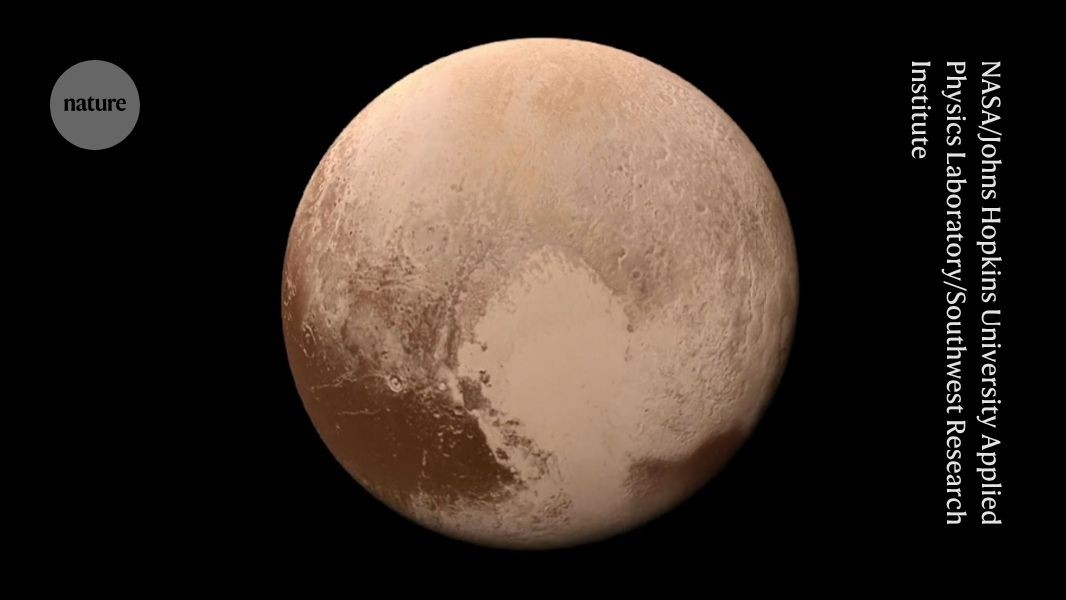

Will Pluto become a planet again?Credit: NASA/Johns Hopkins University Applied Physics Laboratory/Southwest Research Institute
Many of us are old enough to have grown up with nine planets orbiting the Sun. In 2006, however, a controversial decision within the astronomy community resulted in the official list being cut to eight, removing Pluto.
On Tuesday, responding to a question during a testimony to a US Senate committee, NASA administrator Jared Isaacman said he was firmly on the side of restoring Pluto’s lost planetary status, and that the agency was “working on some papers right now to escalate through the scientific community to revisit this”. It is unclear what papers Isaacman was referring to; NASA did not respond to a request for clarification.
Isaacman’s remark triggered debate among researchers with some backing the proposal and others being forcefully against it. “The question of whether or not we should call Pluto a planet distracts from the real scientific issues,” says Amanda Hendrix, a researcher at the Planetary Science Institute in Boulder, Colorado.
What has riled some astronomers was that Isaacman’s remark came at the end of a testimony in which he endorsed the United States Administration’s proposal to halve NASA’s science budget. Together with cuts at the National Science Foundation, many astronomers feel that their field is under siege. “It’s wild to ‘make Pluto a planet again’ while decimating the careers of those of us that study it,” planetary scientist Adeene Denton wrote on BlueSky.
Pluto probe offers eye-popping view of neighbouring star Proxima Centauri
David Grinspoon, an astrobiologist in at the Planetary Science Institute in Washington DC, was among those who had originally opposed to Pluto being demoted, and he still is. He says that there is still “a genuine debate” on this controversy and favours reopening the discussion.
However, he adds that NASA weighing in on the subject could be counterproductive because it’s a decision that should be taken at the international level. The real authority on what counts as a planet lies with the International Astronomical Union (IAU), the body that establishes official astronomical terminology.
“Even though I would like to ultimately see a better definition widely agreed upon, you can’t have NASA declare this,” says Grinspoon.
Distracting debate
The original rationale for reclassifying Pluto was the discovery of other, similarly sized bodies in the Solar System. Some, like Eris, discovered in 2004, are more massive than Pluto and would deserve to be called planets at least as much as Pluto does. By some estimates, there could be hundreds or even thousands of Pluto-sized objects in the Solar System, although in many cases their properties are poorly known.
In 2006, the IAU decided after a divisive debate that to qualify as a planet, an object must satisfy three criteria. It must have been made round by its own gravity; it must orbit the Sun rather than another planetary body; and it must have cleared the region around its orbit of other debris such as asteroids or dust. Pluto failed the third one, so was entered into the new category of ‘dwarf planet’.

