


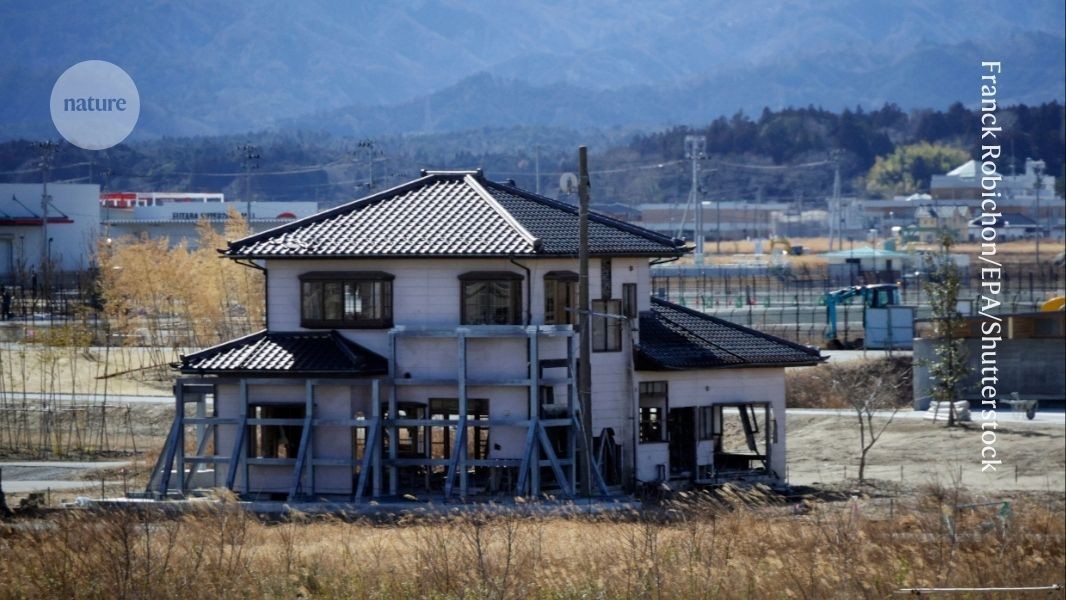

Radiation levels in roughly 2% of the Fukushima region, about 300 square kilometres, are unsafe for people.Credit: Franck Robichon/EPA/Shutterstock
Fifteen years after Japan’s worst nuclear-power accident, construction is under way in Fukushima for a research institute that will focus on robotics, agriculture, the medical uses of radiation and environmental recovery from nuclear disasters.
The Fukushima Institute for Research, Education and Innovation (F-REI) is being built in Namie, a small town that was evacuated because of concerns about radiation exposure following the 2011 accident at the Fukushima Daiichi power plant in Fukushima Prefecture.
In March of that year, a magnitude-9 earthquake off the coast of Japan’s main island triggered a massive tsunami that caused widespread devastation along the coastline, and damaged cooling infrastructure at the nuclear power plant. This led to the meltdown of three reactors and the release of radioactive isotopes, including caesium-137. Nearly 20,000 people were killed during the earthquake and tsunami, and about 164,000 people were evacuated owing to concerns about radiation exposure.
Since then, the Japanese government has been decontaminating areas exposed to radiation, progressively lifting evacuation orders as areas become safe to live in and rebuilding infrastructure. Evacuation orders are still in place for about 2% of the Fukushima region — an area of 309 square kilometres — where levels of radiation are still unsafe for people.
Building the institute provides an opportunity for scientists to engage with the local community and get young people interested in radiation and environmental sciences, says Jasmin Diab, a nuclear engineer at Global Nuclear Security Partners who is based in Perth, Australia.
Radiation levels in agricultural and residential areas not under an evacuation order in Fukushima are now comparable to those found in most cities, says Pradip Deb, a physicist at RMIT University in Melbourne, Australia.
Regional renaissance
The new research institute, announced in 2023, is part of the government’s broader strategy to revitalize the region. The institute is in an area where evacuation orders have been lifted. It is aiming to be fully open by 2030, according to government documents.
A spokesperson for F-REI says the headquarters and some other facilities should be open from 2028. The institute has already recruited 71 researchers — including local and international scientists — to work at the institute once it is open.
The government also hopes the research institute will help restore public confidence in the safety of the region. Only about 17% of the evacuated population has returned to Namie, according to government documents. Some forested areas in area are still being decontaminated. A survey of 1,500 registered residents of nearby towns, published in February1, revealed that more than half of those people had no intention of returning.
Diab says the institute could help to build trust. “Repurposing the area to become a scientific hub is a really nice way for academics who are specialists in the field to be able to work on the communication with the community,” she adds. But the trust-building process will take a long time, she says.

