


No sample size calculations were performed before the study. Sample sizes were determined to be acceptable based on the magnitude of effect size from previous or preliminary experiments. Experiments were not randomized. Investigators were not blinded to group allocation during data collection.
Mice
Mice were housed and bred under specific pathogen-free conditions, maintained on a 12–12 h light–dark cycle, controlled temperature of 20–26 °C and humidity of 30–70%, at the University of California, San Francisco (UCSF) Laboratory Animal Research Center. All experiments conformed to ethical principles and guidelines approved by the UCSF Institutional Animal Care and Use Committee, the National Institutes of Health and the American Association of Laboratory Animal Care. C57BL/6 (RRID: MGI:2159769), Ai6 (ref. 31) (mTmG), B6;129P2-Fcer1gtm1Rav/J (Fcer1g KO, RRID: MGI:2162818)32 and BALB/c (RRID: MGI:2161072) mice were purchased from The Jackson Laboratory or bred in-house. Both male and female mice ranging from 6 to 20 weeks old were used for experiments. Food and water were provided ad libitum.
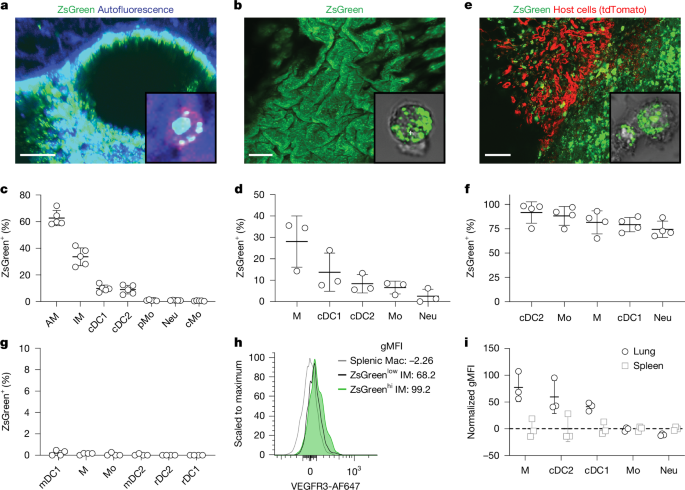
To generate ZsGreen reporter mice, Ai6 mice were crossbred with K14cre, Scgb1a1creERT2, Vil1cre or Actbcre mice. To induce ZsGreen expression in Scgb1a1creERT2;Ai6 mice, mice were fed tamoxifen-containing chow ad libitum for 2 weeks.
For tumour studies, B16-F10 melanoma cancer cells were resuspended in PBS and mixed at a 1:1 (v:v) ratio with growth-factor-reduced Matrigel matrix (BD Biosciences), and 100,000 cells in 50 µl volume were transplanted into the subcutaneous region of the mouse flank. On day 14 after tumour challenge, when tumours reached a size or volume of approximately 0.5 cm3, mice were euthanized, tumours were excised and processed for downstream analyses in accordance with the UCSF Institutional Animal Care and Use Committee.
Tumour cell lines
B16-F10 cells were purchased from the American Type Culture Collection (CRL-6475). B16-ZsGreen and B16-ZsGreen-minOVA cell lines have been previously described13. In brief, to make these cell lines, B16-F10 melanoma parental cells were genetically engineered through viral transduction with a ZsGreen or ZsGreen-minOVA construct. B16-GC3AI cell lines were genetically engineered to stably express the GFP-CASP3-activity indicator through viral transduction with an Addgene construct (78910). Cell lines were not authenticated. Cell lines were confirmed negative for mycoplasma using a MycoAlert Mycoplasma Detection kit (Lonza, LT07-118). Adherent cell lines were cultured at 37 °C in 5% CO2 in DMEM (Invitrogen), 10% FCS (Benchmark) and 100 U ml–1 penicillin, 100 mg ml–1 streptomycin and 2 mM l-glutamine, (pen–strep–glut; Invitrogen).
MEFs
MEFs were derived from Actbcre;Ai6 mice that were generated by crossing Actbcre mice (strain 033984, The Jackson Laboratory) to Ai6 mice (strain 007906, The Jackson Laboratory) as previously described33. In brief, day 13.5 embryos were collected from pregnant females, and the embryos were minced and digested with trypsin. The retrieved cells were washed and plated in DMEM (Invitrogen), 15% FCS (Benchmark) and pen–strep–glut (Invitrogen) for overnight culture at 37 °C in 5% CO2. The medium was aspirated after 24 h to remove any cells remaining in suspension and replaced with fresh medium. Cells were then grown to 70–80% confluency and cryopreserved.
Tissue digest and flow cytometry staining
Lung
Lungs were collected from mice after euthanasia by an overdose of 2.5% Avertin. Lungs were placed in 3 ml DMEM (Gibco) in C-Tubes (Miltenyi) and briefly processed with a GentleMACS dissociator (Miltenyi). Next, 2 ml DMEM with 0.26 U ml−1 Liberase (Roche) and 0.25 mg ml–1 DNase I (Roche) were subsequently added and samples were incubated at 37 °C in a shaker for 30 min and dissociated to single-cell suspensions by GentleMACS. Tissue homogenate was then passed through a 100 mm filter. Red blood cells were lysed with 3 ml RBC lysis buffer (155 mM NH4Cl, 12 mM NaHCO3 and 0.1 mM EDTA) per lung for 5 min at room temperature. Samples were then washed with FACS buffer (2% FBS and 2 mM EDTA in PBS) and resuspended in appropriate buffer for staining for flow cytometry or FACS.
Tumour
For tumour digests, tumours from mice were collected 14 days after injection. Tumours were minced and incubated in digestion buffer (100 U ml–1 collagenase type I (Roche), 500 U ml–1 collagenase type IV (Roche) and 200 mg ml−1 DNAse I (Roche) in RPMI-1640 (Gibco)) for 30 min on a shaker at 37 °C. Digestion mixtures were then pipetted repeatedly, followed by another 15-min incubation at 37 °C. Cells were quenched with RPMI-1640 (Gibco) plus 10% FCS, washed with FACS buffer and filtered through a 100 mm cell strainer before staining for flow cytometry.
LNs
Inguinal LNs were dissected from mice, cleaned of fat and digested as previously described14. In brief, LNs were pierced and torn with sharp forceps in 24-well plates and incubated for 15 min at 37 °C in 1 ml digestion buffer (100 U ml–1 collagenase type I (Roche), 500 U ml−1 collagenase type IV (Roche) and 20 μg ml–1 DNAse I (Roche) in RPMI-1640 (Gibco)). Cells were pipetted up and down repeatedly, followed by another 15-min incubation at 37 °C. After digestion, LNs were washed with RPMI-1640 (Gibco) plus 10% FCS, washed with FACS buffer and filtered through 70 μm Nytex filters before staining for flow cytometry.
Imaging sample preparation, image acquisition and image analysis
Two-photon imaging of mouse lung, skin, tumour and gut slices
Imaging of lung, skin, tumour and gut slices were performed using a custom-built two-photon setup equipped with two infrared lasers: MaiTai (Spectra Physics) and Chameleon (Coherent). The Chameleon laser was set to 950 nm for excitation of ZsGreen. Emitted light was detected using a ×25, 1.2 NA water lens (Zeiss) coupled to a 6-colour detector array (custom, using Hamamatsu H9433MOD detectors). Emission filters used were blue 475/23, green 510/42, yellow 542/27, red 607/70 and far-red 675/67. The microscope was controlled using the MicroManager software suite, and time-lapse z-stack images were acquired every 90 s with fivefold averaging and a z-step of 4 mm. Data analysis was performed with Imaris software (Bitplane).
For lung slices, mice were euthanized by anaesthetic overdose with 1 ml 2.5% Avertin and then intubated by tracheotomy with the sheath from an 18-gauge intravenous catheter. Lungs were subsequently inflated with 1 ml of 2% low-melting agarose (BMA) in sterile PBS at 37 °C. Agarose was then solidified by flooding the chest cavity with 4 °C PBS. Inflated lungs were excised, and the left lobe was cut into 300 mm sections using a vibratome. For skin, tumour and gut slices, mice were euthanized using CO2, obstructing fat was removed and tissue sections were embedded in 4% low-melting agarose in PBS before sectioning. Sections were mounted on plastic coverslips and imaged by two-photon microscopy at 37 °C in RPMI-1640 medium (Gibco, without Phenol Red) perfused with carbogen (5% CO2 and 95% O2) in a heated chamber.
Spinning disc confocal microscopy
Glass-bottom 96-well plates were coated in fibronectin and washed as described above. BMDMs, sorted ZsGreen+ BMDMs after antigenic transfer and unsorted antigenic transfer assays were imaged. Live imaging by spinning disc confocal microscopy was performed at 37 °C with 488 nm and 561 nm lasers at 40% and 50% laser power, respectively. For LAMP1 staining, cells were fixed with 4% paraformaldehyde at room temperature for 15 min, permeabilized with 0.5% saponin at room temperature for 15 min, incubated with blocking buffer (1% BSA, 0.1% saponin and 5% normal rat serum) at room temperature for 60 min and incubated with LAMP1-AF647 at 1:250 dilution in blocking buffer at 4 °C overnight. Fixed cells were imaged with 488 nm and 640 nm lasers at 25% laser power.
NSPARC imaging
Glass-bottom 96-well flat-bottom plates were coated with 50 µg ml–1 fibronectin in H2O at 37 °C for 1 h, or at 4 °C overnight, before use. Fibronectin-coated wells were washed twice with PBS before use. Next, 8 × 10³ tdTomato+ BMDMs were plated with 1.2 × 10⁴ ZsGreen+ B16-F10 cells or ZsGreen+ MEFs and spun at 1,500g for 5 min. Cells were incubated at 37 °C for 2 h before imaging. NSPARC imaging was performed at 37 °C with 488 nm and 560 nm lasers with 1.0% and 2.0% laser power, respectively.
Lattice light-sheet microscopy
In brief, 5 mm round coverslips were cleaned using a plasma cleaner and coated with 2 μg ml–1 fibronectin in H2O at 37 °C for 1 h, or at 4 °C overnight, before use. Fibronectin-coated coverslips were washed twice with PBS before use. Cells were plated onto fibronectin-coated coverslips 20 min before imaging with a 10-min spin at 1,400 rpm and 4 °C. Coverslip was immediately loaded into the sample bath with warmed imaging medium and secured. Imaging was performed at 37 °C with 488 nm and 560 nm lasers (MPBC). The exposure time was 10 ms per frame, which led to a temporal resolution of around 4.5. The lattice light-sheet microscope used was a homebuilt clone of a previously described microscope34 with a Nikon CFI Apo LWD ×25 W 1.1 NA 2 mm working distance objective, a Hamamatsu Orca flash 4.0 (v.2) camera and custom LabView acquisition software. This method was derived from previous work19.
Image analysis
All computational image analyses were performed in Imaris (v.9.9.1 or v.10.2.0, Bitplane) and Fiji (v.2.16.0/1.54p). Particle area analysis was performed using the Analyze particles function in Fiji with the following parameters: size (.027- infinity) and circularity (0.00–1.00). Post-processing raw data from lattice light-sheet images were deconvoluted using iterative Richardson–Lucy deconvolution as implemented in LLSpy. In brief, images were deconvolved with a known point spread function that was recorded for each colour before the experiment, as previously described19. A typical sample area underwent 15–20 iterations of deconvolution. For live-imaging experiments, photobleaching correction was applied in Fiji using the histogram-matching method. The tdTomato channel was scaled by a factor of 100 using channel arithmetic in Imaris before surface generation for NSPARC image analysis. Particle volume was measured using the object-object statistics function in Imaris from the separated vesicle in frames 13–18.
For ZsGreen colocalization analysis with LAMP1, Mander’s coefficients were calculated using the JACoP plugin in ImageJ35. Otsu thresholding was used to identify optimal thresholding for the phagocytosis condition. To account for the low fluorescence intensities of ZsGreen vesicles in the live-sampling condition, we opted for a manual threshold level of 550. Thresholding results were confirmed by comparing to ZsGreen– BMDMs.
Flow cytometry and FACS
A Zombie NIR Fixable Viability kit (423106; BioLegend), DAPI or propidium iodide was used for exclusion of dead cells. Surface staining was performed with anti-mouse Fc receptor antibody (clone 2.4G2, UCSF Hybridoma Core) in FACS buffer for 30 min on ice. Supplementary Table 1 lists all the antibodies referenced for flow cytometry and imaging experiments. Apoptotic cells were detected by staining with Annexin V AF647 (BioLegend, 649012) and 1 μg ml–1 DAPI in Annexin V binding buffer (BioLegend, 422201). For all experiments that involved intracellular staining, BD Cytofix/Cytoperm (554722) was used. Following fixation and permeabilization, cells were incubated with Fc block for 10 min on ice before the addition of intracellular stain. Flow cytometry was performed on a BD Fortessa instrument, and sorting was performed on BD FACSAria or BD FACSAria Fusion instruments. FacsDiva (v.9.0) and SpectroFlo (v.3.3) were used for collecting flow cytometry data, and FlowJo (v.10 software, BD Biosciences) was used for all analyses.
Generation of BMDMs
In brief, 6–12-week-old C57BL/6 mice were euthanized and their femurs and tibiae were excised. Bone marrow was crushed using a mortar and pestle. After pelleting the bone marrow, the red blood cells were lysed using RBC lysis buffer for 5 min at room temperature. Cells were washed with FACS buffer and filtered through a 100 mm cell strainer before seeding at 1 × 10⁶ cells per ml on a low-adherent cell culture dish in BMDM medium (DMEM supplemented with 10% FBS (Benchmark), 50 mM β-mercaptoethanol, pen–strep–glut (Invitrogen) and 20 ng ml−1 M-CSF (Peprotech)). Fresh BMDM medium was added on day 3–4 of culture. On day 6–7 of culture, BMDMs were collected and used for experiments.
In vitro antigen transfer assay
BMDMs were isolated as described above and co-cultured with target B16-ZsGreen cells or MEF-ZsGreen cells at a 1:1 ratio for 16 h before assays unless otherwise noted. Cells were plated in BMDM medium in tissue-culture-treated 96-well flat-bottom plates before staining and analysis by flow cytometry.
Drug inhibitor antigenic transfer assay
Antigenic transfer assays were performed as described above. For all experiments for which apoptosis was induced, B16-F10 cells or MEFs were treated with 1 μM staurosporine (Tocris Bioscience, 1285) and washed with PBS before antigenic transfer assays. For exosome and microparticle inhibitory experiments, 5-(N,N-dimethyl)amiloride hydrochloride (DMA, Sigma Aldrich, A4562) was plated at 0 h to a final concentration of 10 μM. For endocytic inhibition experiments, dynole 34-2 (Cayman Chemical, 34073) was plated at 0 h to a final concentration of 5 μM. Caspase inhibition was performed using zVAD-FMK (Invivogen, tlrl-vad) at a final concentration of 20 μM for B16-ZsGreen or 30 μM for MEF-ZsGreen at 0 h. Signalling and cytoskeleton inhibition were performed using 10 μM PP1 (Cayman,14244), 5 μM piceatannol (MedChemExpress, HY-13518), 10 μM GDC-0941 (Selleck Chemicals, S1065), 1.35 μM NAV-2729 (MedChemExpress, HY-112473), 25 μM NSC23766 (MedChemExpress, HY-15723), 10 μM ZCL278 (MedChemExpress, HY-13518), 200 μM CK-666 (Sigma-Aldrich, SML0006-5MG) or 5 μM SMIFH2 (MedChemExpress, HY-16931).
Drug inhibitor functional validation and cell toxicity validation
For exosome and microparticle inhibitor validation, target cells were cultured with DMA and supernatant was collected to quantify ZsGreen+ vesicles by small-particle flow cytometry. For endocytosis inhibitor validation, exosomes were isolated from confluent B16-ZsGreen cultures using an ExoQuick kit (System Biosciences, EXOA5A-1), and BMDMs were cultured with exosomes and dynole 34-2 or DMSO control. Exosome endocytosis was quantified by flow cytometry. For apoptosis inhibition studies, B16-ZsGreen or MEF-ZsGreen target cells were pre-treated with zVAD for 1 h before staurosporine treatment. The percentage of AnnexinV+DAPI+/− apoptotic cells was evaluated by flow cytometry. For toxicity studies, cells were treated with drug or vehicle control for 16 h and quantified by flow cytometry with CountBright beads (Invitrogen, C36950).
Supernatant–Transwell antigenic transfer assay
Medium was replaced for B16-ZsGreen cells and MEF-ZsGreen cells after reaching 80% confluency. After 48 h, supernatants were collected and used in antigenic transfer assays as described above. Transwell experiments were performed as described for the antigen transfer assays with a 3 μm pore Transwell insert separating BMDMs and ZsGreen+ target cells or supernatant.
Antibody opsonization and blockade
For opsonization experiments, B16-ZsGreen and MEF-ZsGreen target cells were pre-coated with 10 µg ml–1 Armenian hamster IgG (BD Pharmigen, 553969), 10 μg ml–1 rat IgG2ak (clone 2A3, invivoMab, BE0089), 10 μg ml–1 CD29 (eBioHmb1-1, eBioscience, 16-0291-85), 10 μg ml–1 anti-CD98 (RL388, BioLegend, 128202), normal mouse serum (Jackson ImmunoResearch, 015-000-120) or 500 μg ml–1 IgG from normal mouse serum at 37 °C for 30–60 min and washed with PBS before co-culture with BMDMs. IgG from normal mouse serum was isolated using Protein G Dynabeads (Invitrogen, 10003D) according to the manufacturer’s instructions and dialysed with PBS (Slide-A-Lyzer). The concentration of isolated IgG was quantified using IgG ELISA (Abcam, ab151276).
For antibody blockade, BMDMs were pre-treated with 10 μg ml–1 rat IgG2b (clone MPC-11, invivoMab, BE0086), CD16/32-blocking antibody (clone 2.4G2), CD11b-blocking antibody (clone M17/0, BioLegend, 101202, RRID: AB_312785), CD49e-blocking antibody (clone 5H10-27(MRF5), BioLegend, 103801, RRID: AB_313050), SIRPα-blocking antibody (clone P84, BioLegend, 144035, RRID: AB_2832516) or custom afucosylated mouse IgG2a monoclonal blocking antibody against TREM2 (provided by T. Courau, synthesized by Evitra) for 1 h before 16 h of co-culture antigen transfer assays.
CRISPR editing of primary BMDMs
CRISPR editing of primary BMDMs were performed as previously described36. In brief, single guide RNA (sgRNA) targeting Rosa26 (5′-ACUCCAGUCUUUCUAGAAGA-3′), Fcgr1 (5′-GAUCACCUUGCAGCCUCCAU-3′), Fcgr3 (5′-UGGUGAAACUGGACCCCCCA-3′), Fcgr4 (5′-GGUGAACCUAGACCCCAAGU-3′), Itgam (5′-GAAGCCAUGACACAAGGCUA-3′), Itgav (5′-UUGAAUCAAACUCAAUGGGC-3′, 5′-CCUGUUGAAUCAAACUCAAU-3′), Tlr2 (5′-UUGGCUCUUCUGGAUCUUGG-3′), C5ar1 (5′-CAUGGAUCCUAACAUACCUG-3′, 5′-GAUCCUAACAUACCUGCGGA-3′, 5′-AUGGCAUUCACCUCCCGAAG-3′), Cd93 (5′-CAGGAACAAACCAGUUGAGA-3′, 5′-AGAAGAAUGGCCAUCUCAAC-3′, 5′-CUGGUUUGUUCCUGCUGCUG-3′) and Snx27 (5′-GGAACGGCGUGAAUGUUGAG-3′, 5′-UGAGGGGGCGACACACAAGC-3′, 5′-GUGGUGGACCUGAUCCGAGC-3′) were ordered from Synthego or IDT and reconstituted to 100 µM in TE (IDT). sgRNA and Cas9 (6.5 mg ml–1) was complexed in a 2:1 molar ratio at room temperature for at least 10 min. At day 3 after initial plating, BMDM differentiation cultures were collected, and cells were washed with PBS before electroporation with ribonucleoprotein containing gene-targeting sgRNA complexed in P3 primary cell solution with electroporation code CM137 using a Lonza 4D Nucleofector. After an additional 4 days of differentiation, gene-edited BMDMs were either stained with antibodies for validation of protein knockdown or co-cultured with ZsGreen target cells for 16 h before evaluation by flow cytometry. For indel quantification with ICE, DNA was extracted using QuickExtract for PCR of the targeted locus with Phusion Plus Green PCR master mix (Thermo Fisher Scientific, F632S) and primers (5′-CCCCATCTTTCCCACATGCT-3′, 5′-ATTACTGTAGGCCACCCCCT-3′). Guide number and selection for targeting each gene were empirically determined based on protein knockdown or indel frequency.
NicheNet analysis to predict receptors
To identify potential BMDM surface proteins that mediate live sampling using NicheNet22, we used the following previously published datasets: BMDM datasets37, a B16 dataset38 and a MEF dataset39. The BMDM was set as the receiver population and B16 and MEF were set as sender populations. A threshold for expressed genes for each population was defined based on a Gaussian fit of gene expression, and BMDM receptors were prioritized if they were predicted to interact with both cell types, overlap with known phagocytic modulators and confirmed to be expressed at the protein level.
Vesicle flow cytometry
Sample preparation and sorting
In brief, 16 h before sorting, BMDMs were cultured with live target cells (trogocytosis) in a 1:1 ratio, with staurosporine-treated target cells (phagocytosis) in a 1:1 ratio or with supernatant derived from target cells (endocytosis). Cells were collected, washed with FACS buffer, stained with CD45-BUV395 with FcBlock for 30 min on ice, washed with FACS buffer and resuspended in FACS buffer with 1 mg ml–1 propidium iodide at 10 × 106 cells per ml. CD45+ cells were sorted on FACSAria and FACSFusion machines on ‘Purity’ into FACS buffer kept at 4 °C.
Surface biotinylation and lysis
Cells were washed 3 times in PBS, resuspended in PBS at 25 × 106 cells per ml then biotinylated with 80 µl of 10 mM EZ-Link Sulfo-NHS-SS-Biotin (Thermo Fisher Scientific, 21331) per ml of reaction volume for 30 min at 4 °C. Cells were washed 3 times in PBS, resuspend in at least 500 μl homogenization buffer (250 mM sucrose, 200 mM PMSF, 250 mM sucrose, 3 mM imidazole and 1× protease inhibitor filtered through a 0.1 µm filter) at a concentration of 10 × 106 cells per ml and drawn 15 times up and down through a 22 gauge needle. The cell homogenate was spun for 4 min at 150g and post-nuclear supernatant was spun at 3,000g for 5 min at 4 °C to collect vesicles.
Staining
All staining reagents were filtered using a 0.1 μm filter before use and vesicles were pelleted using spin speeds of 3,000g for 5 min at 4 °C for all steps. Vesicles were stained with 50 μM CellTraceViolet (Thermo Fisher Scientific, C34557) for 5 min at room temperature and washed once with PBS. Samples were fixed for 20 min at room temperature with fixation buffer (Invitrogen, 88-8824-00), washed with permeabilization buffer (Invitrogen, 88-8824-00) twice and stained in 50 μl of permeabilization buffer with 1% FCS with FcBlock for 30 min at room temperature. Vesicles were washed with permeabilization buffer and resuspend in 100 μl PBS for acquisition.
Sample acquisition and analysis
Aurora Cytek flow cells were soaked with contrad overnight with long clean before acquisition with filtered reagents. Calibration beads and samples were acquired on an Aurora Cytek with Enhanced Small Particle detection with SpectroFlo software.
T cell stimulation assays
ZsGreen+ BMDMs were sorted from BMDMs after 16 h of co-cultures with DMSO-treated or staurosporine-pre-treated B16-zsGreen-minOVA cells. To induce MHC-II expression on BMDMs, sorted cells were stimulated with 20 ng ml–1 IFNγ for 2 h and then washed before co-culture with T cells. OT-I and OT-II T cells were isolated from spleens of TCR transgenic mice after red blood cell lysis using either a CD8 or CD4 EasySep enrichment kit (Stemcell Technologies), respectively. T cells were labelled with CellTraceViolet (Thermo Fisher Scientific) at 37 °C in PBS for 15 min and washed in RPMI before use. T cell stimulation assays were performed as previously described14. In brief, sorted BMDMs and T cells were added to the wells of a 96-well V-bottom plate at a 1:3 ratio in RPMI (Gibco) supplemented with 10% FCS (Benchmark), pen–strep–glut (Invitrogen) and 50 mM β-mercaptoethanol (Thermo Fisher Scientific). Cells were collected for analysis 3 days later. Dilution of the cell-permeable dye CellTraceViolet and expression of CD69 were used as indicators of T cell stimulation.
Western blotting
Whole-cell protein lysates were obtained from BMDMs in Pierce RIPA buffer (Thermo Fisher Scientific, 89901) and ProteoGuard EDTA-free protease inhibitor cocktail (Takara, 635673). Lysates were extracted via sample agitation at 4 °C for 30 min, followed by 4 °C centrifugation at 16,000 rpm for 20 min. The protein concentration was determined using a Pierce BCA Protein Assay kit (Thermo Fisher Scientific). Lysates were denatured in NuPAGE LDS sample buffer (Invitrogen, NP0007) supplemented with NuPAGE sample reducing agent (Invitrogen, NP0009) by incubating at 95 °C for 5 min. Denatured samples were loaded onto a NuPAGE 10% (NP0302BOX) or 4–12% Bis-Tris (NP0323BOX) polyacrylamide gel (Thermo Fisher Scientific) with PageRuler Plus pre-stained protein ladder (Thermo Fisher Scientific, 26619) and electrophoresed in MES running buffer (Invitrogen). Gels were transferred to PVDF membranes using an iBlot 2 system (Invitrogen, IB21001), blocked with Pierce clear milk blocking buffer (Thermo Fisher Scientific, 37587) and incubated with primary antibodies according to the manufacturers’ directions. Primary antibodies, SNX27 (Abcam, clone: EPR218130-16, ab315897, 1:1,000), and β-actin (Invitrogen, PA1-183, RRID: AB_2539914, 1:5,000) were detected with goat anti-rabbit IgG HRP-conjugated secondary antibodies (Southern Biotech, 4050-05, RRID: AB_2795955, 1:1,000) and SuperSignal West Femot maximum sensitivity substrate (Thermo Fisher Scientific, 34095). Membranes were imaged using a Licor Odyssey XF system.
Quantification and statistical analysis
Unless specifically noted, all data are representative of >3 separate experiments. Experimental group assignment was determined by genotype or, if all wild-type mice, by random designation. Statistical analyses were performed using GraphPad Prism software. Error bars represent the s.e.m. calculated using Prism and are derived from triplicate or greater experimental conditions. Specific statistical tests used were paired and unpaired t-tests, and P < 0.05 was considered significant. For pairwise comparisons, unpaired t-tests were used unless otherwise noted. For statistical measures between more than two groups, one-way ANOVA, two-way ANOVA and mixed-effect models were performed unless otherwise noted. Investigators were not blinded to group assignment during experimental procedures or analysis.
Materials availability
Requests for resources and reagents should be directed to and will be fulfilled by the lead contacts, A.C.F. and M.F.K.
Reporting summary
Further information on research design is available in the Nature Portfolio Reporting Summary linked to this article.

