



Cholesterol-lowering statins are among the most widely prescribed drugs in the world. They can have side effects, however, including muscle pain that affects twice as many women as men. When Karen Reue, a geneticist at the David Geffen School of Medicine at the University of California, Los Angeles (UCLA), set out to discover why, she expected that the answer would lie in the sex hormones, such as oestrogen and testosterone, which are produced by the ovaries and testes.

The ‘crazy rule-defying’ genes that determine sex
But her data pointed to a different culprit: the X chromosome. Whether they had female or male gonads, mice with two Xs were more susceptible to statin-induced side effects1. “I was amazed when we got our results,” says Reue. “It was just clear-cut as could be.” A single gene on the X chromosome was the main contributor to the difference in how female mice respond to the drug. Her work has even pointed to a potential way to mitigate the side effects in women. Fish oil contains a fatty acid called DHA, which is depleted in women taking the drugs, and the supplement reverses some of the metabolic side effects of statins in female mice.
Reue’s findings are just one of a wave of discoveries showing that genes on the sex chromosomes, and how they are regulated, can have a substantial impact on health and disease. Women usually have two X chromosomes, men an X and a Y. In women, one of the X chromosomes is typically ‘silenced’ to ensure that both sexes have a roughly equivalent number of X-linked genes expressing proteins in each cell. But some genes manage to escape the silencing process.

Sex redefined
Although these escapees have been known about for a while, the fundamental nature of their influence is only now emerging, says Edith Heard, who studies X-chromosome inactivation at the Francis Crick Institute in London. Escape genes on the X chromosome — and Y genes as well — are revealing themselves to be key contributors to observed sex differences in conditions such as autoimmunity, cancer, cardiovascular disease, metabolic disease, dementia and autism and other neurodevelopmental disorders. These genes are also spotlighting the yawning gap in our understanding of women’s health. “Female biology has been neglected for so long,” says Heard. “Finally, we actually have the tools to find out what is different in an XX and an XY context other than just the hormones.”
The origins of X and Y
Human sex differentiation might look simple, but it is deeply complicated, emerging from the collective action of genes, sex chromosomes and hormones. Variations in any of these can mean that individuals might develop a mix of female-typical and male-typical traits, resulting in a spectrum of outcomes in the population. In individuals with typical development, some sex traits, such as gonad type, are a one-or-the-other affair, whereas others, such as gene-expression patterns or disease risk, appear in ranges that are biased towards one sex. And although some sex differences are permanent, others can change over time. Further complicating things is gender — the societal roles and expectations associated with an individual’s sex — and gender identity, which might not align with a person’s sex.

Why women’s brains are more resilient: it could be their ‘silent’ X chromosome
What is clear is that a main cause of sex differences stems from the unequal sets of genes on the X and Y chromosomes. According to the conventional view on sex differentiation, the presence or absence of a gene called SRY, which is found only on the Y chromosome, determines whether individuals develop testes or ovaries. Then the gonads take over, directing changes in the rest of the body through the secretion of hormones — before birth, during puberty and beyond.
But this focus on gonads has blinkered scientists’ understanding of sex differentiation, says Art Arnold, who studies sex-chromosome biology at UCLA. Over the past 20 years, it has become clear that sex differences are also being driven by the unequal effects of the other genes found on the X and Y. This imbalance exists, Arnold says, “because of evolutionary pressures that don’t really have to do with reproduction”.
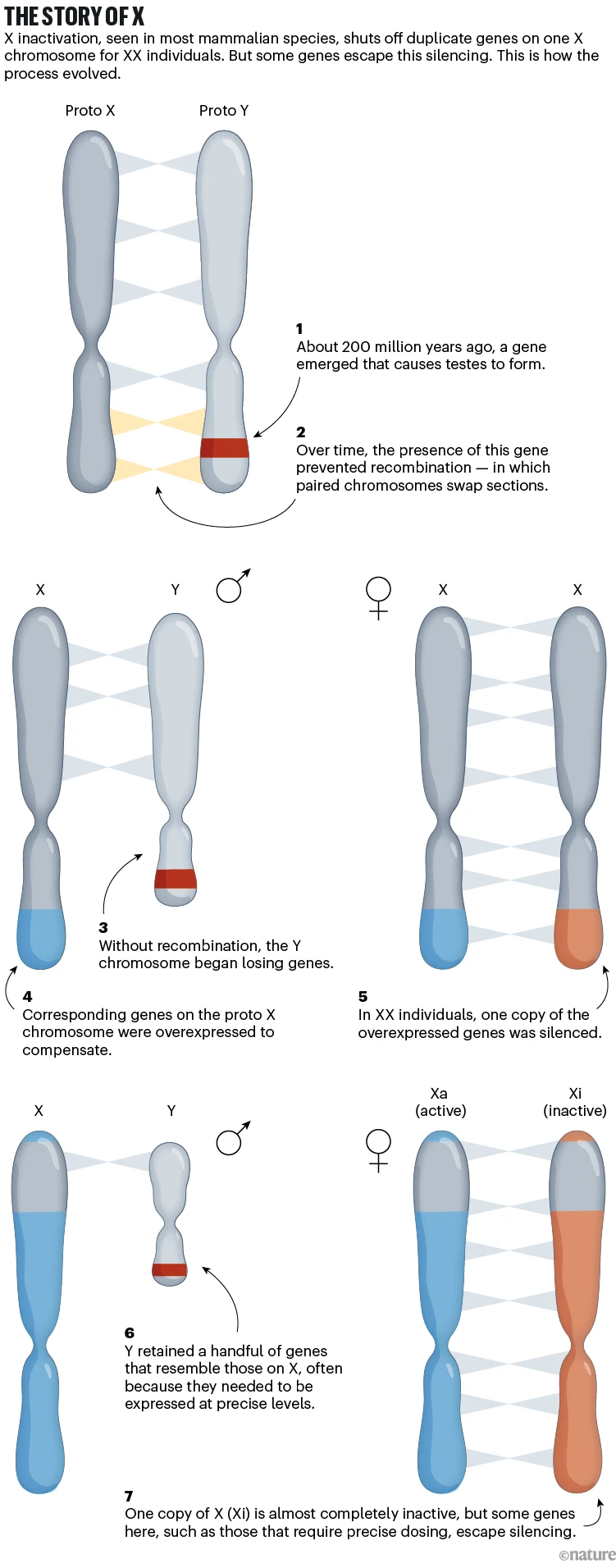
Before about 200 million years ago, the precursors of X and Y were an ordinary pair of chromosomes, or autosomes. But then, one of them acquired a hard-wired gonadal sex determination gene, SRY, and the once close-knit couple began to drift apart. The Y eventually lost large chunks of DNA, leaving it with a mere 27 distinct protein-coding genes, 17 of which have similar, but not identical, counterparts on the X. Its towering partner, the X, has about 1,000 genes.
Evolution came up with a solution to compensate for this difference in gene number (see ‘The story of X’). In males, gene activity, or transcription, is ramped up on the sole X to make up for the missing genes. In females, to balance out that ramped-up gene expression, one of the X chromosomes, Xa, stays active whereas the other (or others, if there is more than one other X), becomes inactive. This is called Xi.
Inactive lifestyle
X inactivation takes place early in embryonic development, and happens when copies of a large RNA molecule, called Xist, coat one X chromosome at random. This coating summons a set of proteins to shut down gene activity. But it would be misleading to call Xi inactive. In humans, the Xi is clearly crucial for survival: around 99% of embryos with a solitary X chromosome die. And individuals born XXY (Klinefelter syndrome) have an Xi and an elevated risk of developing certain conditions, such as autoimmune disorders that are associated with women.
Researchers are now getting to the bottom of how the number of X chromosomes someone has affects their health, says James Turner, who studies sex chromosomes at the Crick. “And I’d say there’s been huge amounts of progress.” At least 20% of Xi genes can escape silencing, and their expression can have profound effects on the rest of the genome. In Reue’s study on statin side effects, for example, the culprit was an Xi escape gene called Kdm5c. This extra bit of expression in XX mice made the biosynthesis of fatty acids, such as DHA, more prone to disruption by statin drugs1. Removing the sex difference by halving the number of Kdm5c genes in females reversed the side effects.
Xi escapees include some of the 17 genes that the X and Y still share. David Page, a geneticist at the Whitehead Institute in Cambridge, Massachusetts, and his team have shown that these genes can have a profound impact on the expression of other genes across the genome. They studied cells taken from people with unusual numbers of sex chromosomes — individuals with one, two or three X chromosomes, and zero to four Ys2. The researchers found that the presence of Xi and Y affects the expression of 21% of all genes expressed in the cell types tested. How the shared X–Y gene pairs, which closely resemble each other, create sex differences as well as similarities is not yet clear, but subtle differences in how they are regulated could be key.
Female mice grow testes after this single DNA tweak
Not all escapees are equal, either. Some escape in all tissues and all individuals, and are known as constitutive escapees. The other kind, the variable escapees, differ between individuals and between tissues. Even working out what counts as ‘escape’ is challenging, says Carolyn Brown, a geneticist at the University of British Columbia in Vancouver, Canada. There is a continuum from low to high expression, and conventional definitions set the cut-off at anything above 10% of expression from the corresponding Xa gene. Moreover, Page argues, the view of inactivation as the default state is clouding researchers’ understanding of escape genes. “It conjures up all kinds of incorrect ideas, as if there’s something illegal or roguish about these genes,” he says. Inactivation evolved gene-by-gene, Page says. “The genes that we describe as escaping X inactivation were never subject to X inactivation.”

