


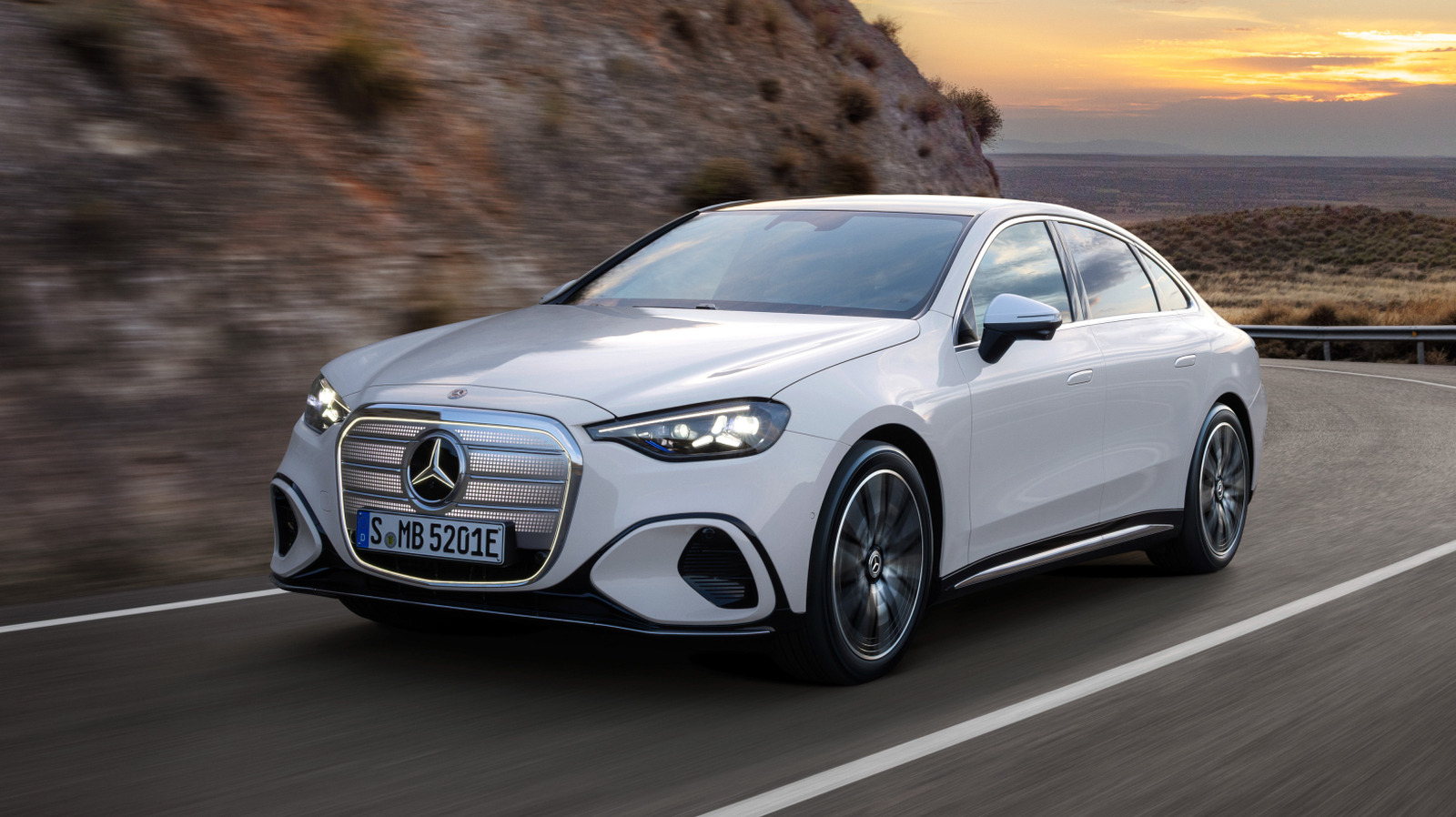
Though Mercedes-Benz has walked back its plan to go fully electric by 2030 and it’s sunsetting the controversial EQ subbrand, the automaker is still committed to introducing a lot of new EVs, with more traditionally Benz-like styling and less differentiation between electric models and gas-powered ones. (The silly “with EQ Technology” branding is also being dropped from the EVs’ names, finally.) Mercedes’ new electric GLC is about to go on sale, and now its sedan sibling has made its debut in South Korea: the 2027 C-Class.
Like with the GLC, Mercedes will continue to offer the existing internal-combustion C-Class, and both of those models will get a facelift within the next year, but also like with the GLC EV, this new electric C-Class is a totally different animal. The first model to launch in the U.S. in the first half of 2027 will be the C400 4Matic, which boasts a 3.9-second 0-to-60-mph time, somewhere around 400 miles of range, and all sorts of tech and performance features not seen on a C-Class before. It’s got a more love-it-or-hate-it design, too. Chairman and CEO Ola Källenius says “Customers will get exactly what they expect from this new version of the beloved model: the perfect blend of performance, comfort, dynamics, and intelligence.”
Launching with 482 horsepower
The C-Class rides on the same MB.EA platform as the GLC, a dedicated 800-volt electric architecture. In the C400 4Matic, the electric motor on the front axle activates when more traction or power is needed, but can instantly disconnect for better efficiency. The rear motor has its own two-speed transmission, with the first gear being for quick acceleration and the second for highway driving. Juiced up by a 94-kWh lithium-ion battery pack, the C400’s pair of motors make a combined 482 horsepower and 590 pound-feet of torque, and its 3.9-second 0-60 time is almost a second quicker than the current C43 AMG.
We don’t have EPA range figures yet, but on the European WLTP cycle the C400 has a range of 473 miles, about 40 miles more than a GLC400. In the U.S., that should work out to around 400 miles. It can DC fast charge at up to 330 kW, which can gain you over 200 miles range (WLTP) in 10 minutes and go from 10% to 80% in 22 minutes; Mercedes says the C-Class can go more than 1,000 kilometers with “just one brief charging stop,” like going from Berlin to Paris. There’s a standard DC converter so the car can also charge quickly at 400-volt stations, and a 9.6-kW onboard charger.
Fancy new features
The current W205 generation was the first C-Class to get optional rear-axle steering, and the EV almost doubles the angle the system offers. At low speeds the rear wheels can turn up to 4.5 degrees, versus 2.5 on the ICE model, and above 44 mph the rear wheels turn in sync with the front wheels up to 2.5 degrees. Combined with the rear steer in an Agility & Comfort package is Airmatic air suspension, which Mercedes says makes the C-Class as comfy as an S-Class. It will automatically lower the car in Sport mode and adjust the damping before a speed bump, and in addition to using Car-to-X tech to predictively react to road surfaces with data from other Benzes, it uses Google Maps to keep the car as low as possible for as long as possible to increase range. Says Mercedes, “Conventional ride height systems respond solely to speed, raising the vehicle whenever, for example, a construction zone or traffic jam causes the driver to slow down. The system, however, “knows” the vehicle is still on the highway and continuously maintains the low ride height setting.”
 Mercedes-Benz
One of the EQ models’ biggest paint points was their regenerative braking systems. Mercedes hadn’t gotten the hang of true one-pedal driving yet, and on early models the brake pedal physically moved under regen, which was unsettling at best. Hopefully, the braking will no longer be an issue. Mercedes says the C-Class has “a consistent, confident brake pedal feel at all times,” and almost all of the braking is done through recuperation, as it can handle up to 300 kW of recuperation. It’ll even regenerate energy when braking with ABS on an icy road. Speaking of ice, there’s a standard multi-source heat pump that needs a third of the energy as a normal one would, and a powerful climate control system:
The newly developed automatic climate control ensures a pleasant, comfortable cabin temperature in winter – even without pre-conditioning. For example, during a 20-minute journey in 19° F weather, the interior heats up twice as fast as models equipped with combustion engines – and thanks to the multi-source heat pump only requires about half the energy. The heating process begins automatically as soon as customers enter the vehicle. In addition, the automatic climate control dehumidifies and cools the interior only as much as necessary to maintain the desired interior temperature, helping to prevent dry eyes.
Sleek and slippery
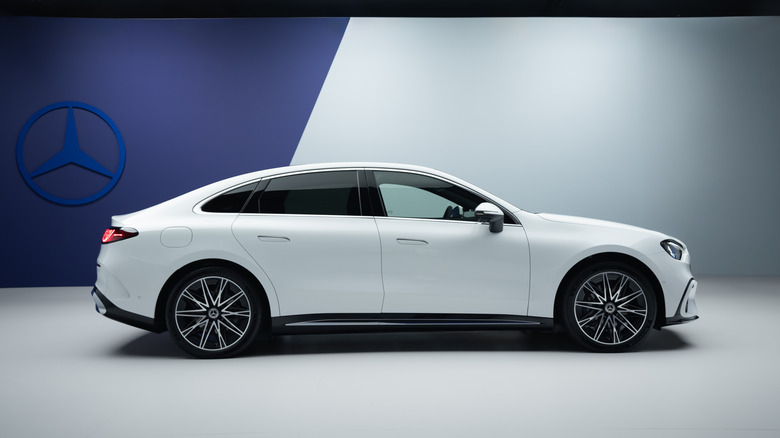
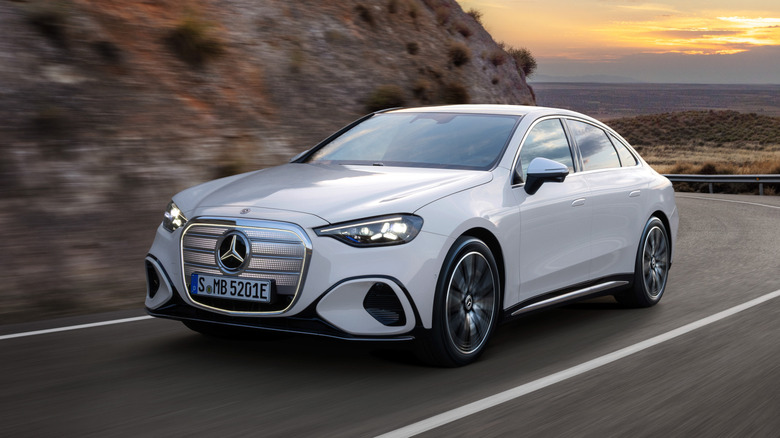
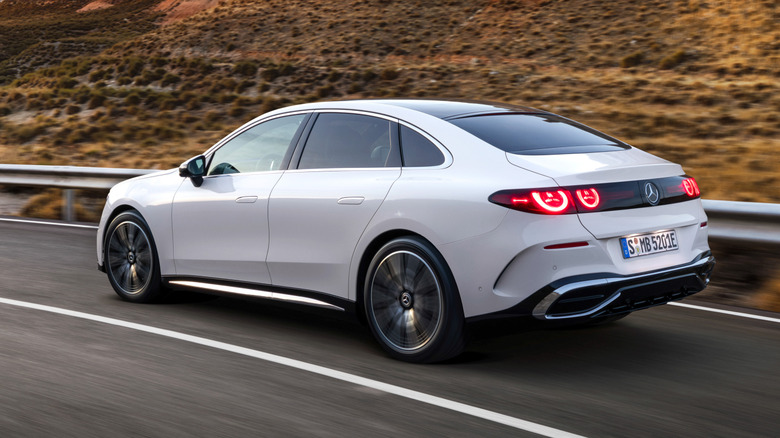
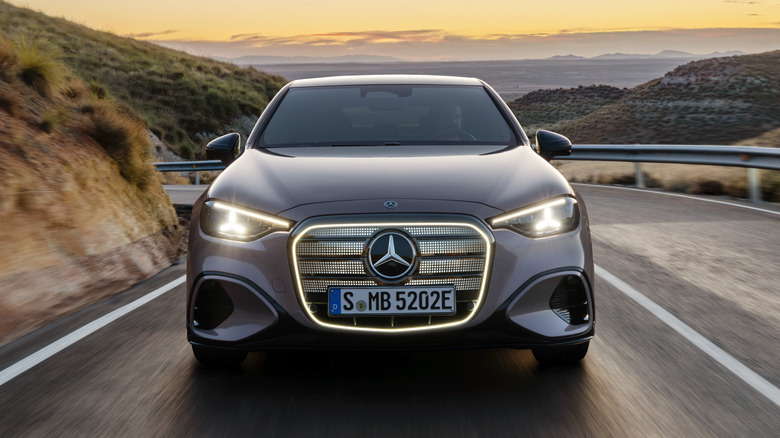
While not quite as extreme as the CLA or EQS, the electric C-Class has a much more coupe-like profile than past C-Classes. The EV is 5.2 inches longer overall with a 3.8-inch-longer wheelbase, which along with the sloping roofline and shorter overhangs give it a totally different look from a gas C-Class. Its front end is basically identical to the GLC EV, dominated by a chrome-framed grille with a large central logo and a square pattern that’s reminiscent of ’60s Benzes, except for the fact that all the little squares can be optionally illuminated. But aside from the complex lights and grille, the C-Class is mainly pretty restrained in terms of surfacing and detailing.
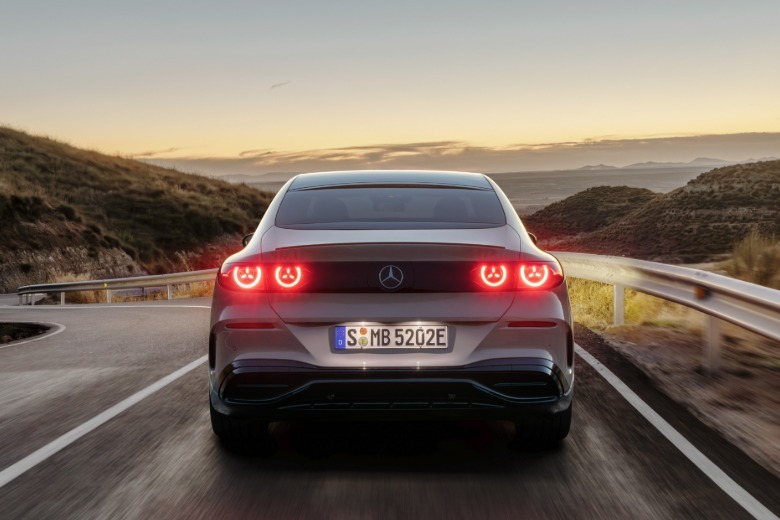
This is the first C-Class to have an additional quarter window behind the rear doors, another way the EV really feels different from others. Mercedes says it has a drag coefficient of 0.22, an improvement of 0.02 over the gas model and the same as an EQE. Though it looks like it should be a liftback, the C-Class has a normal sedan trunk with 16.6 cubic feet of capacity (a cube less than a gas C300), and under the hood is a small frunk. Grille aside, the rear end and its connected taillight design will probably be the most controversial part of the C-Class, but I’m into it.
This feels familiar
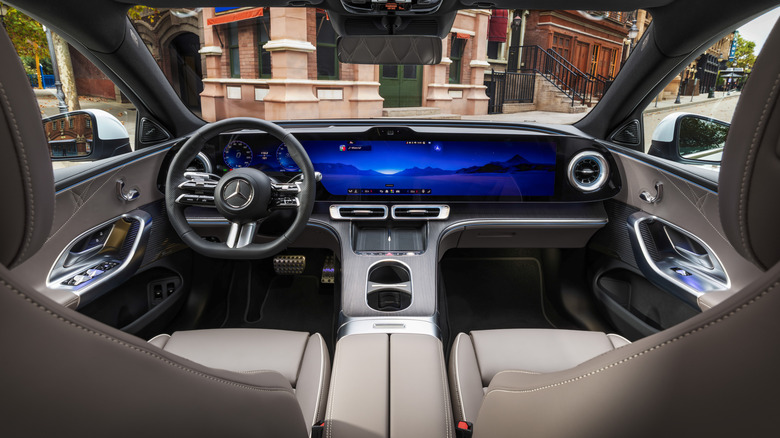
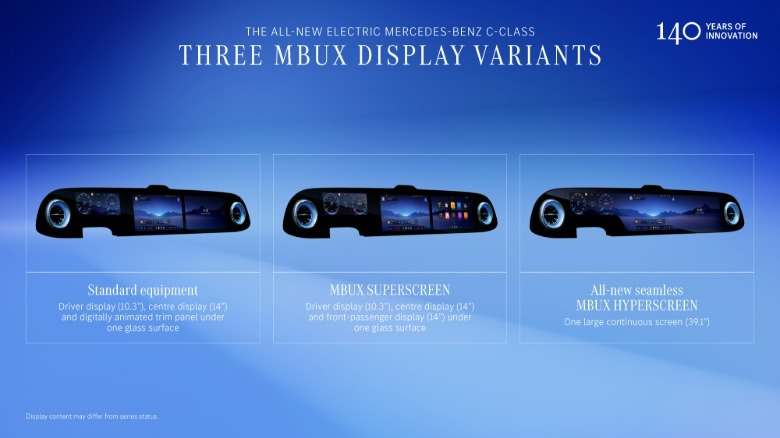
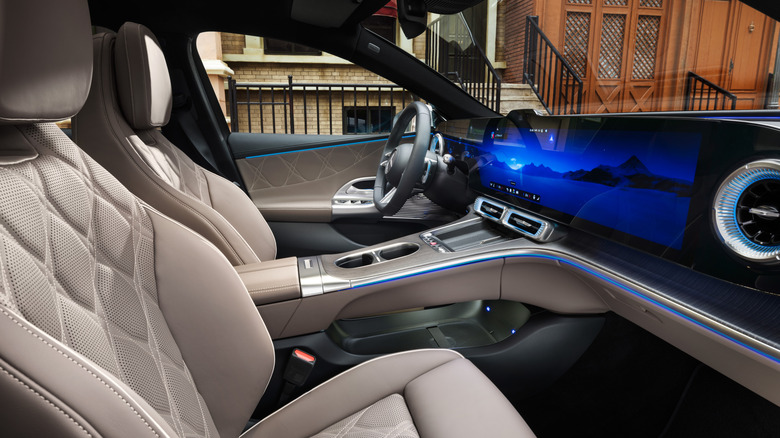
The C-Class’ dashboard and overall interior design is also pretty much the same as what’s in the GLC. No matter what amount of options you go for, there are three displays in the dashboard: a 10.3-inch gauge cluster, a 14-inch central touchscreen, and a 14-inch screen in front of the passenger. As standard the passenger display is basically a configurable animated screensaver, but get the Superscreen and it turns into a touchscreen for the passenger. What you really want is the Hyperscreen, which turns the whole panel into a 39.1-inch seamless screen. Say what you will about it, but I’ve actually gotten to use the seamless screen, and I think it (and Mercedes’ latest MB.OS software in general) is really fantastic.
 Mercedes-Benz
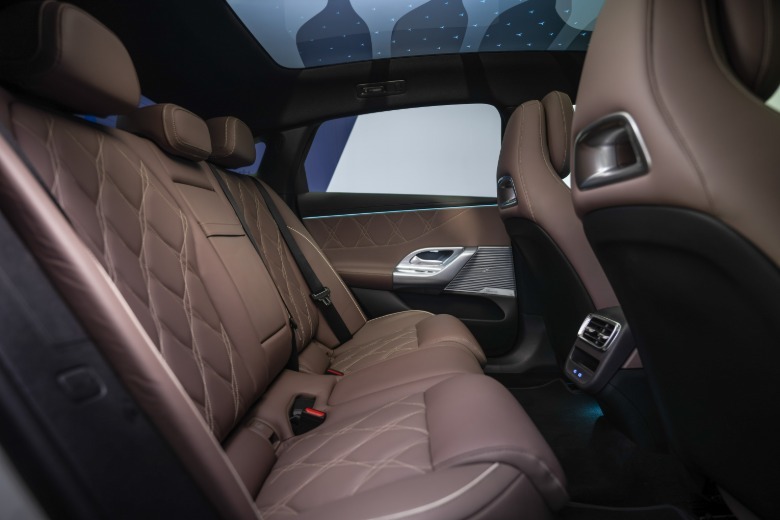
A standard panoramic sunroof gives front passengers 0.9 inches more headroom and rear passengers an additional 0.4 inches, and the two people up front also get half an inch more legroom. That sunroof can be had with a dimmable electrochromic coating and 162 illuminated stars. The GLC was the first car worldwide to offer “an independently certified vegan interior” and the C-Class is available with it too, but you can also get Nappa leather with a new Twisted Diamond design that adds very cool stitching to the seats and door panels.
Optional high-end front seats offer ventilation and massage “across the entire surface of the backrest,” while the also-optional AMG Line seats were apparently certified by the Organization for Healthy Backs because they’re so comfy over long journeys. If you get the Burmester 4D surround sound system, the active ambient lighting beats and changes color and intensity along with the music, and two body sound transducers are added to the front seats, along with speakers mounted closer to your ears.
Coming next year
The aerodynamics and body rigidity already make the electric C-Class really quiet, but Mercedes also gave it noise-insulated laminated front glass, “extensive” sound insulation, a new air conditioning system, specially designed electric motors, and “decoupling elastomer mounts between the suspension and body” to make it even quieter. There’s a smarter onboard virtual assistant with a “living” avatar, Google-based intelligent navigation with advanced EV route planning, lots of available apps and digital extras, micro-LED headlights with adaptive high beams in the U.S. for the first time, and an optional augmented reality head-up display.
 Mercedes-Benz
11 airbags are standard, including a front center airbag and front knee airbags, and there are new driver-assist features like a pre-safe curve function that will warn the driver and tighten seatbelts if it thinks you’re approaching a corner going “significantly too fast.” While not available at launch, the C-Class will get the City Pro feature for the MB.Drive Assist Pro system that will allow for hands-free point-to-point driving in cities.
We don’t know how much the C400 will cost when it goes on sale in the first half of 2027, but I expect it will come in between the $51,000 C300 and $66,300 EQE320, probably around the $60k mark. I would guess a cheaper rear-wheel-drive model will come later, and we know Mercedes is working on an AMG version with 900 horsepower. When the electric C-Class does hit the streets, it’ll immediately be facing stiff competition in the form of the new BMW i3.

