


You have full access to this article via your institution.
Hello Nature readers, would you like to get this Briefing in your inbox free every day? Sign up here.

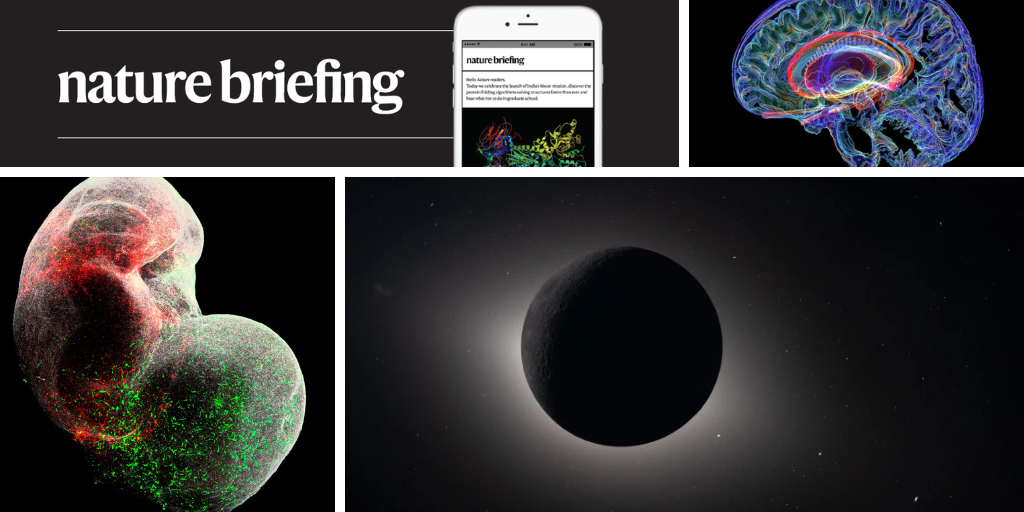
Psychedelic drugs boost some of the crosstalk between brain regions.Credit: K H Fung/SPL
Five psychedelic drugs have a strikingly similar effect on brain networks. Researchers saw this ‘signature’ pattern of brain activity in the brain scans of people who had taken mind-altering substances such as psilocybin, LSD and ayahuasca, despite these drugs having a different chemical make-up. A better understanding of how psychedelics affect the brain could inform their potential use in treating conditions such as depression, anxiety and addiction. Such a large study, which combines data from 11 brain-imaging studies, is the first step towards that understanding, experts say.
Reference: Nature Medicine paper
Researchers have identified hundreds of thousands of proteins that bacteria might use to fend off viral invaders. Two research teams developed machine-learning algorithms that screen bacterial genomes to catalogue the microorganisms’ defensive arsenals. Their analyses estimated that, on average, 1.5% of a bacterium’s genes correspond to antiviral proteins — three times more than previous estimates. The teams hope that their findings could lead to the next generation of molecular tools, with applications such as genetic engineering. “This is a treasure trove for any biochemist,” says microbiologist José Antonio Escudero.
Reference: Science paper 1 & paper 2
Fresh approaches to drug design are bringing researchers closer to effective cancer treatments that target KRAS — a protein that, when mutated, fuels some of the most lethal tumours. Mutant KRAS was once considered to be ‘undruggable’, but a new type of drug that tags the protein for destruction by the body’s ‘waste disposal’ has shown signs of success in a clinical trial. Another four trials are also exploring a separate drug that inhibits several different mutant forms of KRAS. In combinations, such treatments could create a regimen that KRAS-mutant cancers cannot escape, says gastroenterologist Dieter Saur.
For the second year in a row, US President Donald Trump has proposed significant cuts to the budgets of major US science agencies. The 2027 budget would increase funding for the military by more than 40%, to US$1.5 trillion, compared to current levels. Meanwhile, the budgets of the Environmental Protection Agency and the National Science Foundation would fall more than 50%. Congress rejected a similar plan last time; negotiations for this one could last for months.
Features & opinion

Neurons (green) migrate inside a laboratory-grown brain model called an assembloid, made by fusing organoids.Credit: Sergiu Pasca’s Lab, Stanford University
Brain research using organoids is snowballing: these tiny, functional models of parts of the brain are being used to probe development, model neurodevelopmental conditions such as autism and schizophrenia, and test new treatments for brain diseases. And, as scientists make organoids that are longer-lived and more complex — and even connect them together into assembloids — the approach promises to teach us even more about our most important organ.
As organoids advance, so does the urgency of the ethical challenges that they create, argues a Nature editorial. “Perhaps most crucial for this field is the concern that emergent properties, such as consciousness, might arise,” says the editorial.
Nature | 16 min read & Nature editorial | 7 min read
To test how easy it is to poison the information spewed out by AI-powered search results and chatbots, medical researcher Almira Osmanovic Thunström and her team uploaded two fake studies to a preprint server in early 2024. They included plenty of red flags: the results even say “this entire paper is made up”. But soon after, systems such as Copilot and ChatGPT were telling users all about ‘bixonimania’ as if it were real, although they sometimes expressed skepticism.
Reference: Fake preprint 1 & fake preprint 2, plus a peer-reviewed paper (now retracted) that cited them
Image of the week

The Moon fully eclipsed the Sun during the Artemis II fly-by.Credit: NASA
Breathtaking photos are coming down to Earth from NASA’s historic Artemis II mission, after its four astronauts flew around the far side of the Moon on 6 April. In the above image, the Moon fully eclipses the Sun during the fly-by.
See more of the first photos from Artemis II, including the stunning ‘Earthset’ and more. (NASA)
Today I’m giggling about Huxley, a raven that does a pitch-perfect imitation of his human friend’s sneezing. Huxley can’t fly, and so has spent his life at a corvid rescue in Canada run by the very-allergic Dayna Slater.
Thanks for reading,
Flora Graham, senior editor, Nature Briefing
With contributions by Jacob Smith
• Nature Briefing: Careers — insights, advice and award-winning journalism to help you optimize your working life
• Nature Briefing: Microbiology — the most abundant living entities on our planet — microorganisms — and the role they play in health, the environment and food systems
• Nature Briefing: Anthropocene — climate change, biodiversity, sustainability and geoengineering
• Nature Briefing: AI & Robotics — 100% written by humans, of course
• Nature Briefing: Cancer — a weekly newsletter written with cancer researchers in mind
• Nature Briefing: Translational Research — covers biotechnology, drug discovery and pharma

