


By Dronelife Features Editor Jim Magill
The Palm Springs, California Police Department is taking its Drones as First Responders (DFR) program to the next level, by jointly working with other cities and communities to integrate UAV dispatching operations into a region-wide system.
Launched in December, the Coachella Valley Real-time Intelligence Center (CVRIC) pools the technological resources of the cities of Palm Springs, Cathedral City, Desert Hot Springs, Indio, and the Agua Caliente Band of Cahuilla Indians to monitor and coordinate emergency responses to incidents in the region in real-time.
“It’s a regional approach with multiple agencies,” Lt. William Hutchinson, director of the Palm Springs P.D. drone operations, said in an interview.
Palm Springs currently has four drone docking stations placed throughout the city with future plans to substantially increase the number of drone docks and UAVs. The nearby town of Cathedral City is currently operating three drone docking stations which are part of the Intelligence Center dispatch program.
The cities of Indio and Desert Hot Spring are also expected to ramp up their own DFR resources and place them under the central dispatch system, Hutchinson said.
Incorporating DFR programs under a centralized dispatch system is part of a larger regional strategy known as real-time policing.
“That’s really bringing all of your assets in, including things like live 911 calls, intersection cameras and multiple siloed databases that get funneled into one big crime-analysis platform, and then drones that are able to respond to emergency calls for services,” he said.
“The goal is to increase apprehension rates with improved de-escalation, improved situational awareness and improved response times and case closure rates.”
By combining all of these high-tech policing and emergency response tools into one central hub, the participating agencies hope to be able to provide the digital assets needed by first responders to increase their situational awareness and allow them to operate more efficiently and safely.
Although regional emergency response is not a new concept in emergency response – other agencies throughout the country have similar joint-agency cooperation programs – Hutchinson said he believes the CVRIC project is unique in its approach.
“I think we’re the only city in the nation that’s doing this, bringing in multiple 911 calls to the center from different dispatch centers,” he said. By acting as a data hub for incoming emergency calls, the Intelligence Center will help ensure that the emergency responses of the participating agencies don’t conflict with one another.
Because each agency maintains its own dispatch center, the various departments don’t normally talk to one another while handling routine calls. “And so, Cathedral City may be dispatching assets to the same call as Palm Springs, and the two of them don’t know they’re dispatching assets to the same incident. That’s where the Real-Time Intelligence Center plays this critical role, because we can see and hear all of the calls from all of these different agencies,” Hutchinson said.
DFR Program Launched in December
Ultimately the developers of the Intelligence Center hope to have all the drones from the participating agencies dispatched from the central hub. However, because the center is not yet set up to operate on a 24-7 basis, supervisors at the individual law enforcement agencies can still order the launch of drones from their own agency’s dispatch centers if the need arises.
“The goal is certainly to get them to do it all from this one Intelligence Hub where all the drone pilots will be and all of the staff working in the real-time intelligence there. It just makes it far more efficient if we operate that way,” Robinson said.
Palm Springs P.D. launched its DFR program last December, after a months-long development and testing phase. The city currently operates four drones and hopes to soon expand its program, adding four to six new UAVs to its fleet in the near future.
Currently, the city deploys drones and docking stations produced by DJI, and despite the security concerns raised by federal agencies over the use of unmanned aerial systems built by that company and other China-based entities, Robinson said Palm Springs has no plans to switch to another drone provider any time soon.
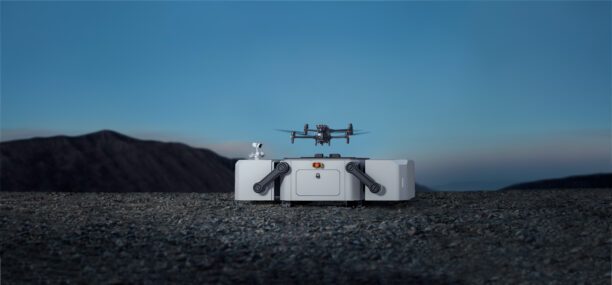
Palm Springs’ police department does not face any issues of its confidential data being captured by the Chinese government, as some opponents of the use of DJI products have alleged might be in danger of happening, Hutchinson said.
“We’re not flying over any critical infrastructure and things of that nature. All of our stuff stays on in-house servers. It’s not going out to any Chinese servers and nothing’s being stored in those servers,” he said. “I think what we’re more concerned about is the ability to save lives and the ability to do that with fiscal responsibility.”
Hutchinson said there is a big cost differential in operating a DFR system with DJI products, compared with one the relies on American-made drones and equipment.
“I can spend $30,000 on a DGI Dock and I can fly each drone for $2,600 a year,” he said. “My cost as a city is $15,000 annually to fly that in total.” He compared this cost to another city whose DFR program he’s familiar with, which operates a three-drone program, using American-made drones and docks at a cost of about $774,000 per year.
“We’re way off the mark right now with these costs. And the quality of American-made drones just isn’t there yet. It’s getting better. We are seeing that tech is growing, it’s getting better, but it’s still not there.”
Game-Changer in Emergency Response
Hutchinson said that as drone use becomes more prevalent in society, public emergency response agencies are continually adapting their response to take advantage of the rapidly evolving technology. “I think that the biggest thing is that drones are playing such a critical role in our everyday operations and drone as first responder programs are really some of the greatest, most advanced initiatives in probably three decades in law enforcement,” he said. “And it’s really changing the game. It’s really changing how we operate as a police and fire department.”
He cited a recent example of the role that drone technology plays in de-escalating a potentially dangerous situation. A police dispatcher had received a report of a man possibly firing a rifle in a public park. Instead of armored vehicles and officers armed with high-powered weapons rushing to the scene, a drone dispatched to the park instead relayed images of a young man armed only with a BB-gun.
“Instead of taking this young man down at gunpoint and potentially getting involved in a shooting, it became a community contact. So, things like that are just invaluable and show the intangibles of what could have happened or what didn’t happen as a result of this technology.”
Read More

