


Michalet, R. et al. Competition, facilitation and environmental severity shape the relationship between local and regional species richness in plant communities. Ecography 38, 335–345 (2015).
Bertness, M. D. & Callaway, R. Positive interactions in communities. Trends Ecol. Evol. 9, 191–193 (1994).
Callaway, R. M. et al. Positive interactions among alpine plants increase with stress. Nature 417, 844–848 (2002).
Kalyuzhny, M., Lake, J. K., Wright, S. J. & Ostling, A. M. Pervasive within-species spatial repulsion among adult tropical trees. Science 381, 563–568 (2023).
Michalet, R., Le Bagousse-Pinguet, Y., Maalouf, J. P. & Lortie, C. J. Two alternatives to the stress-gradient hypothesis at the edge of life: the collapse of facilitation and the switch from facilitation to competition. J. Veg. Sci. 25, 609–613 (2014).
von Humboldt, A. & Bonpland, A. Essai sur la Géographie des Plantes: Accompagneé d’un Tableau Physique des Régions Équinoxiales, Fondé sur des Mesures Exécutées, Depuis le Dixième Degré de Latitude Boréale Jusqu’au Dixième Degré de Latitude Australe, Pendant les Années (Levrault, 1805).
Willig, M. R., Kaufman, D. M. & Stevens, R. D. Latitudinal gradients of biodiversity: pattern, process, scale, and synthesis. Annu. Rev. Ecol. Evol. Syst. 34, 273–309 (2003).
Sabatini, F. M. et al. Global patterns of vascular plant alpha diversity. Nat. Commun. 13, 4683 (2022).
Sutherland, W. J. et al. Identification of 100 fundamental ecological questions. J. Ecol. 101, 58–67 (2013).
Pianka, E. R. Latitudinal gradients in species diversity: a review of concepts. Am. Nat. 100, 33–46 (1966).
Jablonski, D., Royand, K. & Valentine, J. W. Out of the tropics: evolutionary dynamics of the latitudinal diversity gradient. Science 314, 102–106 (2006).
Condamine, F. L., Sperling, F. A. H., Wahlberg, N., Rasplus, J. Y. & Kergoat, G. J. What causes latitudinal gradients in species diversity? Evolutionary processes and ecological constraints on swallowtail biodiversity. Ecol. Lett. 15, 267–277 (2012).
Davidowitz, G. & Rosenzweig, M. L. The latitudinal gradient of species diversity among North American grasshoppers (Acrididae) within a single habitat: a test of the spatial heterogeneity hypothesis. J. Biogeogr. 25, 553–560 (1998).
Colwell, R. K. & Hurtt, G. C. Nonbiological gradients in species richness and a spurious rapoport effect. Am. Nat. 144, 570–595 (1994).
Roesti, M. et al. Pelagic fish predation is stronger at temperate latitudes than near the equator. Nat. Commun. 11, 1527 (2020).
Janzen, D. H. Herbivores and the number of tree species in tropical forests. Am. Nat. 104, 501 (1970).
Schemske, D. W. & Mittelbach, G. G. ‘Latitudinal gradients in species diversity’: reflections on Pianka’s 1966 article and a look forward. Am. Nat. 189, 599–603 (2017).
Pontarp, M. et al. The latitudinal diversity gradient: novel understanding through mechanistic eco-evolutionary models. Trends Ecol. Evol. 34, 211–223 (2019).
Zvereva, E. L. & Kozlov, M. V. Latitudinal gradient in the intensity of biotic interactions in terrestrial ecosystems: sources of variation and differences from the diversity gradient revealed by meta-analysis. Ecol. Lett. 24, 2506–2520 (2021).
Ricklefs, R. E. Community diversity: relative roles of local and regional processes. Science 235, 167–171 (1987).
Cornell, H. V. & Lawton, J. H. Species interactions, local and regional processes, and limits to the richness of ecological communities: a theoretical perspective. J. Anim. Ecol. 61, 1–12 (1992).
He, F., Gaston, K. J., Connor, E. F. & Srivastava, D. S. The local–regional relationship: immigration, extinction, and scale. Ecology 86, 360–365 (2005).
Song, X. & Corlett, R. T. Enemies mediate distance- and density-dependent mortality of tree seeds and seedlings: a meta-analysis of fungicide, insecticide and exclosure studies. Proc. R. Soc. B 288, 20202352 (2021).
Hülsmann, L. et al. Latitudinal patterns in stabilizing density dependence of forest communities. Nature 627, 564–571 (2024).
Michalet, R., Delerue, F., Liancourt, P. & Pugnaire, F. I. Are complementarity effects of species richness on productivity the strongest in species-rich communities? J. Ecol. 109, 2038–2046 (2021).
Coomes, D. A., Kunstler, G., Canham, C. D. & Wright, E. A greater range of shade-tolerance niches in nutrient-rich forests: an explanation for positive richness–productivity relationships? J. Ecol. 97, 705–717 (2009).
Michalet, R., Nemer, D. & Delerue, F. Canopy buffering effects against climatic extremes of deciduous broad-leaved forests are higher on calcareous than siliceous bedrocks. Oikos 2023, e09755 (2023).
Zhang, J., Huang, S. & He, F. Half-century evidence from western Canada shows forest dynamics are primarily driven by competition followed by climate. Proc. Natl Acad. Sci. USA 112, 4009–4014 (2015).
Brooker, R. W. et al. Facilitation in plant communities: the past, the present, and the future. J. Ecol. 96, 18–34 (2008).
Xu, H. et al. Do N-fixing legumes promote neighboring diversity in the tropics? J. Ecol. 107, 229–239 (2019).
Xu, H. et al. Soil nitrogen concentration mediates the relationship between leguminous trees and neighbor diversity in tropical forests. Commun. Biol. 3, 317 (2020).
Menge, D. N. L. et al. Patterns of nitrogen-fixing tree abundance in forests across Asia and America. J. Ecol. 107, 2598–2610 (2019).
Germain, S. J. & Lutz, J. A. Shared friends counterbalance shared enemies in old forests. Ecology 102, e03495 (2021).
Birch, J. D., Simard, S. W., Beiler, K. J. & Karst, J. Beyond seedlings: ectomycorrhizal fungal networks and growth of mature Pseudotsuga menziesii. J. Ecol. 109, 806–818 (2021).
Montesinos-Navarro, A., Valiente-Banuet, A. & Verdú, M. Mycorrhizal symbiosis increases the benefits of plant facilitative interactions. Ecography 42, 447–455 (2019).
Bennett, J. A. et al. Plant-soil feedbacks and mycorrhizal type influence temperate forest population dynamics. Science 355, 181–184 (2017).
Tedersoo, L., Bahram, M. & Zobel, M. How mycorrhizal associations drive plant population and community biology. Science 367, eaba1223 (2020).
Zhong, Y. et al. Arbuscular mycorrhizal trees influence the latitudinal beta-diversity gradient of tree communities in forests worldwide. Nat. Commun. 12, 3137 (2021).
Wiegand, T. et al. Latitudinal scaling of aggregation with abundance and coexistence in forests. Nature 640, 967–973 (2025).
Fichtner, A., Forrester, D. I., Härdtle, W., Sturm, K. & von Oheimb, G. Facilitative-competitive interactions in an old-growth forest: the importance of large-diameter trees as benefactors and stimulators for forest community assembly. PLoS One 10, e0120335 (2015).
De Frenne, P. et al. Global buffering of temperatures under forest canopies. Nat. Ecol. Evol. 3, 744–749 (2019).
Körner, C. Plant adaptation to cold climates. F1000Res. 5, 2769 (2016).
Blumstein, M., Gersony, J., Martínez-Vilalta, J. & Sala, A. Global variation in nonstructural carbohydrate stores in response to climate. Glob. Chang. Biol. 29, 1854–1869 (2023).
Allesina, S. & Levine, J. M. A competitive network theory of species diversity. Proc. Natl Acad. Sci. USA 108, 5638–5642 (2011).
Åkesson, A. et al. The importance of species interactions in eco-evolutionary community dynamics under climate change. Nat. Commun. 12, 4759 (2021).
Pinsky, M. L. Species coexistence through competition and rapid evolution. Proc. Natl Acad. Sci. USA 116, 2407–2409 (2019).
Schemske, D. W., Mittelbach, G. G., Cornell, H. V., Sobel, J. M. & Roy, K. Is there a latitudinal gradient in the importance of biotic interactions? Annu. Rev. Ecol. Evol. Syst. 40, 245–269 (2009).
Brooker, R. W. & Callaghan, T. V. The balance between positive and negative plant interactions and its relationship to environmental gradients: a model. Oikos 81, 196–207 (1998).
Pugnaire, F. Positive Plant Interactions and Community Dynamics (CRC, 2010).
Detto, M. & Pacala, S. Integrating conspecifics negative density dependence, successional and evolutionary dynamics: towards a theory of forest diversity. Commun. Biol. 7, 1572 (2024).
Wiegand, T., Gunatilleke, C. V. S., Gunatilleke, I. A. U. N. & Huth, A. How individual species structure diversity in tropical forests. Proc. Natl Acad. Sci. USA 104, 19029–19033 (2007).
Kraft, N. J. B. & Ackerly, D. D. in Ecology and the Environment Vol. 8 (ed. Monson, R.) 67–88 (Springer, 2014).
Mittelbach, G. G. & Schemske, D. W. Ecological and evolutionary perspectives on community assembly. Trends Ecol. Evol. 30, 241–247 (2015).
Maestre, F. T. & Cortina, J. Do positive interactions increase with abiotic stress? A test from a semi-arid steppe. Proc. R. Soc. Lond. B 271, S331–S333 (2004).
Loreau, M. & Hector, A. Partitioning selection and complementarity in biodiversity experiments. Nature 412, 72–76 (2001).
Wright, A. J., Wardle, D. A., Callaway, R. & Gaxiola, A. The overlooked role of facilitation in biodiversity experiments. Trends Ecol. Evol. 32, 383–390 (2017).
Barry, K. E. et al. The future of complementarity: disentangling causes from consequences. Trends Ecol. Evol. 34, 167–180 (2019).
Center for Sustainability and the Global Environment. Atlas of the Biosphere. University of Wisconsin-Madison https://sage.nelson.wisc.edu/data-and-models/atlas-of-the-biosphere/ (2026).
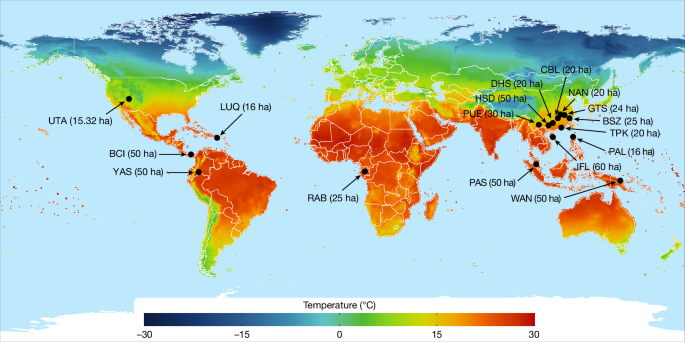
Anderson-Teixeira, K. J. et al. CTFS-ForestGEO: a worldwide network monitoring forests in an era of global change. Glob. Chang. Biol. 21, 1365–2486 (2015).
Global Soil Data Task Group. Global Gridded Surfaces of Selected Soil Characteristics (Oak Ridge National Laboratory, 2000).
van den Hoogen, J. et al. Global soil temperature code and data. Zenodo https://doi.org/10.5281/zenodo.4558663 (2021).
ESA Climate Office. Soil Moisture. ESA https://climate.esa.int/en/projects/soil-moisture/ (2026).
Jump, A. S., Mátyás, C. & Peñuelas, J. The altitude-for-latitude disparity in the range retractions of woody species. Trends Ecol. Evol. 24, 694–701 (2009).
Macarthur, R. & Levins, R. The limiting similarity, convergence, and divergence of coexisting species. Am. Nat. 101, 377–385 (1967).
Barnes, D. K. A. Polarization of competition increases with latitude. Proc. R. Soc. Lond. B 269, 2061–2069 (2002).
Adler, P. B. et al. Competition and coexistence in plant communities: intraspecific competition is stronger than interspecific competition. Ecol. Lett. 21, 1319–1329 (2018).
Detto, M. & Muller-Landau, H. C. Stabilization of species coexistence in spatial models through the aggregation–segregation effect generated by local dispersal and nonspecific local interactions. Theor. Popul. Biol. 112, 97–108 (2016).
Detto, M. mdetto / Positive-Interactions. GitHub http://github.com/mdetto/positive-interactions (2026).
Detto, M. The relative importance of competition and facilitation in explaining latitudinal gradient of tree diversity. Code Ocean https://codeocean.com/capsule/4844196/tree (2026).

