


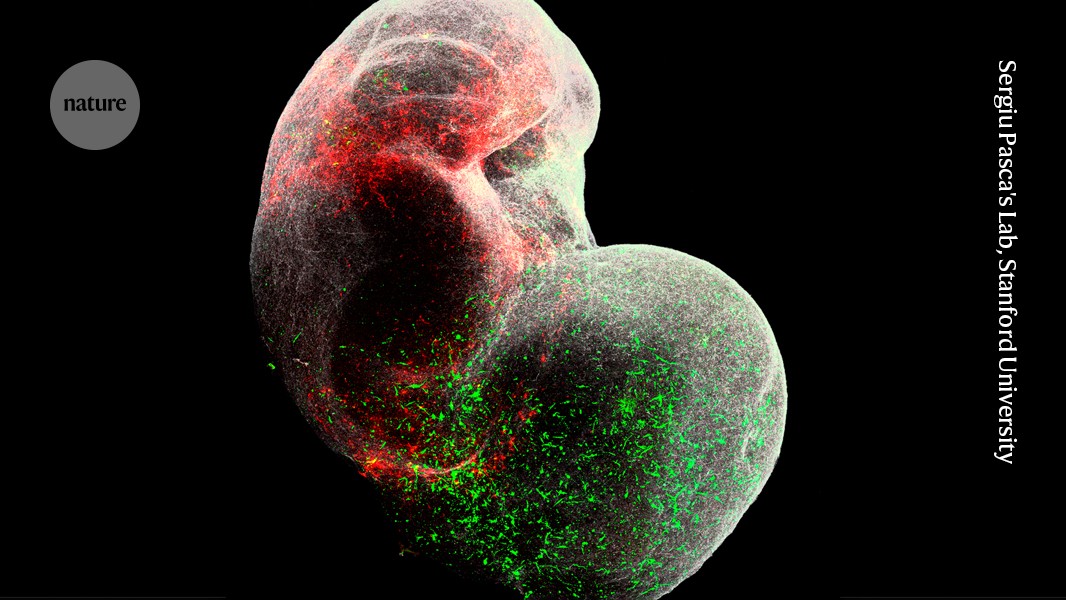
The development of the human brain, with its extraordinary range of cognitive abilities, is an awe-inspiring feat of evolution. Each of its tens of billions of cells must be born at precisely the right time, migrate to the correct locations, differentiate into as many as 3,000 distinct cell types, and form exquisitely specific synaptic connections with one another. Most of this happens before birth, but development continues for nearly three more decades.
None of this is easy to study. Conventionally, scientists have relied on animal models and scarce human brain tissue. But the advent of tiny laboratory-grown models of human brains called organoids has transformed their options.
Brain organoids are a transformative technology — but they need regulation
First created more than a decade ago, these organoids started off as very simple models. But in the past few years, scientists have refined the technology to grow more-intricate systems that represent more brain regions. Research has snowballed as scientists have used organoids to probe brain development, model neurodevelopmental conditions such as autism and schizophrenia and test new treatments for brain diseases. These tiny spheres are helping researchers to get at difficult-to-answer questions such as why the human brain develops so much more slowly than other mammalian brains do.
And this year, researchers are hoping to run the first clinical trial of a brain-disorder treatment developed entirely in organoids.
“The field is at an inflection point,” says developmental biologist Jürgen Knoblich at the Institute for Molecular Biotechnology in Vienna.
But organoids are not without their limitations. It’s hard to sustain them in the lab for more than a few months, for instance. And they lack complexity.
Looking ahead, there are also questions about whether properties such as sentience or even consciousness could emerge as technologies improve. “This is not remotely feasible at the moment,” says molecular neuroscientist Giuseppe Testa at the University of Milan in Italy, “but at some point, we may need to start scrutinizing for the emergence of more complex behaviour in a dish.”
The neuron’s journey
The first structure that will become the human brain starts to develop just three weeks after conception. It’s a hollow tube made up of the earliest neural progenitor cells.
This starter population will eventually give rise to all of the brain’s diverse neurons and support cells, as the tube expands into sections and the production of neurons ramps up — at its peak, to around 250,000 per minute. Some of these neurons provide a scaffold to help others climb to their correct positions.
Axons and dendrites extend from the neurons, connecting distant brain regions. Next begins the production of glial cells, which support and insulate neurons, and after that, at around seven months of gestation, the brain begins to generate coordinated electrical activity.
Brain tissues, assemble! Inside the push to build better brain models
Brain organoids can’t duplicate the fiendish tangle of the real human brain. But they do develop in a surprisingly similar way.
They are made with induced pluripotent stem (iPS) cells — adult cells reprogrammed back into an early developmental state. Given the right signalling molecules, iPS cells differentiate much like natural neural progenitors, according to a species-specific blueprint and timetable; human cells differentiate at the stately pace of a human pregnancy, mouse cells as speedily as a mouse pregnancy.
Researchers began by culturing the cells to form 2D rosette shapes that approximate the neural tube.
“We learnt a lot from these cultured cells and continue to do so,” says Pierre Vanderhaeghen, a developmental neuroscientist at the Catholic University of Leuven (KU Leuven) in Belgium. But what neuroscientists really wanted was something that better mimicked the complex spatial aspects of fetal development. By 2008, neuroscientists had worked out how to coax neural progenitors into 3D1.
The first organoids
The next breakthrough was what developmental biologist Madeline Lancaster, now at the University of Cambridge, UK, calls a “semi-accident”. She had joined Knoblich’s lab as a postdoc in 2010, intending to culture mouse rosettes as a research tool. It didn’t go well. Her cells tended to clump together. But examining the clumps under the microscope, she was astonished to see that they comprised tiny spheres that bore a striking resemblance to the embryonic mouse brain.
“It was a life-changing moment,” she says.
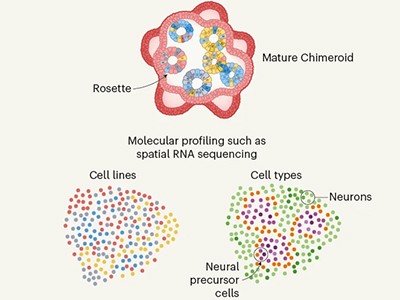
Chimeric brain organoids capture human genetic diversity
Urgent lab meetings ensued. Lancaster immediately decided to use human iPS cells to make organoids, letting them follow their own internal genetic instructions. “I thought, an embryo knows how to build itself without external directions.” Her system created a mixture of organoids representing various parts of the brain, from cortex to retina.
The next surprise was that human organoids just kept growing. Mouse organoids were done with making neurons within nine days. Human organoids continued for 200 days, growing into 4-millimetre spheres with orders of magnitude more cells — ”an unbelievably massive difference,” says Lancaster.
But what most excited Lancaster was the presence of a newly discovered type of progenitor cell called outer RG cells in human cortical organoids. Only primates have these cells in significant numbers — and humans have many more than do non-human primates. Scientists think that they drive the expansion of humans’ disproportionately large brains.
The team immediately saw the relevance to studying human disease and made an organoid model of a condition called microcephaly, in which the brain size is reduced. The organoids didn’t grow as large as normal human organoids because, the team found, their neural progenitors differentiated into neurons before they had multiplied themselves into a suitably large progenitor pool2.
The field explodes
There followed a flood of papers using brain organoids. Neuroscientists created them from many individual brain regions and the spinal cord; from human cells and those of non-human primates to compare across species; and from clinical samples to study diseases. A 2016 study, for instance, showed how the Zika virus — then circulating in Brazil — causes microcephaly by preferentially infecting neural progenitor cells3. Alysson Muotri at the University of California, San Diego, has even created a library of organoids that represent extinct hominin species, such as Neanderthals (Homo neanderthalensis), by swapping out modern and ancient genes in human-derived organoids.

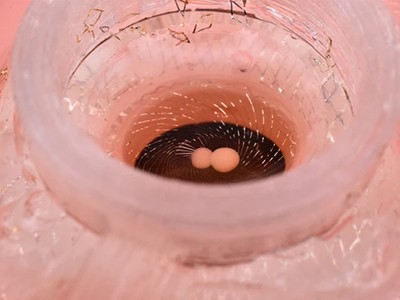
Some brain organoids can live for months or even years in the lab.Credit: Timothy Archibald
Organoids have already proved essential to addressing questions about how a human brain develops and why it has more cognitive power than do those of other species.
In particular: how exactly do neural progenitor cells control their pace of differentiation and why is the human pace so slow? Human neurons take around ten times as long to mature as those of mice, and each step towards maturity is protracted. Organoids have helped scientists to identify some species differences that might contribute to the delays.
Muotri, for example, found that swapping a modern human gene that is important for neural maturation with a slightly different version from Neanderthals led to smaller organoids with neurons that proliferated more slowly4. And several groups have identified a range of other suspects: slowed metabolism5, alterations in particular signalling pathways6 and changes in expression of certain genes. Scientists have also identified molecules that put the brakes on the maturation of neurons by dampening down the epigenetic processes by which genes are turned on or off7.
“Most likely the special features of humans will be down to hundreds of low-impact changes involving just a small tuning up or tuning down of expression of a particular gene in a particular brain area,” says Alex Pollen, an evolutionary geneticist at the University of California, San Francisco.
Piecing it together
One active frontier of organoid research studies how neurons connect across brain regions, and how this might be different in people with neurodevelopmental disorders such as schizophrenia and autism. Several research teams are refining the technology to address this.
Sergiu Pașca found one solution. He first learnt how to create various regional organoids during his postdoctoral studies at Stanford University in California — but then had the idea of putting them together into constructions called assembloids. That process turned out to be unexpectedly easy — “they fused overnight,” he says.
Neurons sent out long-range projections to their newly fused neighbour organoids, formed synapses and generated coordinated activity across regions. “That showed that a surprising amount of the information needed to assemble human neural circuits is embedded in developmental programmes,” says Pașca. “So now we can begin to extract the rules that guide circuit formation.”
His first assembloid8 involved two regions of the forebrain — the cortex and the subpallium — with different proportions of excitatory neurons, which activate other neurons, and inhibitory neurons, which dampen activity. Inhibitory neurons from the subpallium migrate into the cortex during development, and the right balance between excitatory and inhibitory circuits is crucial: disruptions to the balance have been linked to neurodevelopmental disorders.
Once the cortex and subpallium organoids were joined, the inhibitory neurons began to point towards and then move into the cortical organoids — exactly like they move in the embryonic brain. “They would literally jump 30 microns at a time,” says Pașca, who is now a Stanford faculty member. “We were mesmerized and would watch the movies for hours in lab meetings.”

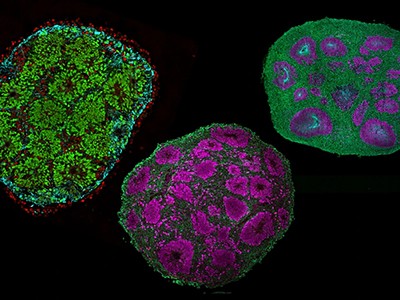
A cross-section through a human brain organoid, showing neural progenitor cells (green) and neurons (magenta).Credit: Sandra Schepers, Knoblich laboratory, IMBA, Vienna Biocenter
He and his team went on to make dozens of assembloids, joining various brain areas together. They fused spinal, cortical and muscle organoids and found that the muscle organoid visibly contracted when they electrically stimulated the spinal organoid. They have used the assembloids to model paralysis in a dish, for instance showing that poliovirus infects particular spinal-cord cell types and stops the muscle contraction9.
The researchers also constructed a four-part assembloid to represent pain processing in the nervous system10. Pain signals travel from sensory receptors through the spinal cord and the thalamus to the cortex where the perception of pain is produced. When the team stimulated the sensory organoids with the chilli-pepper chemical capsaicin, they measured an electrical response in the cortical organoids. The system might enable scientists to observe the impact of pain-related mutations or drugs on the entire circuit and aid the discovery of better painkillers, says Pașca.

