


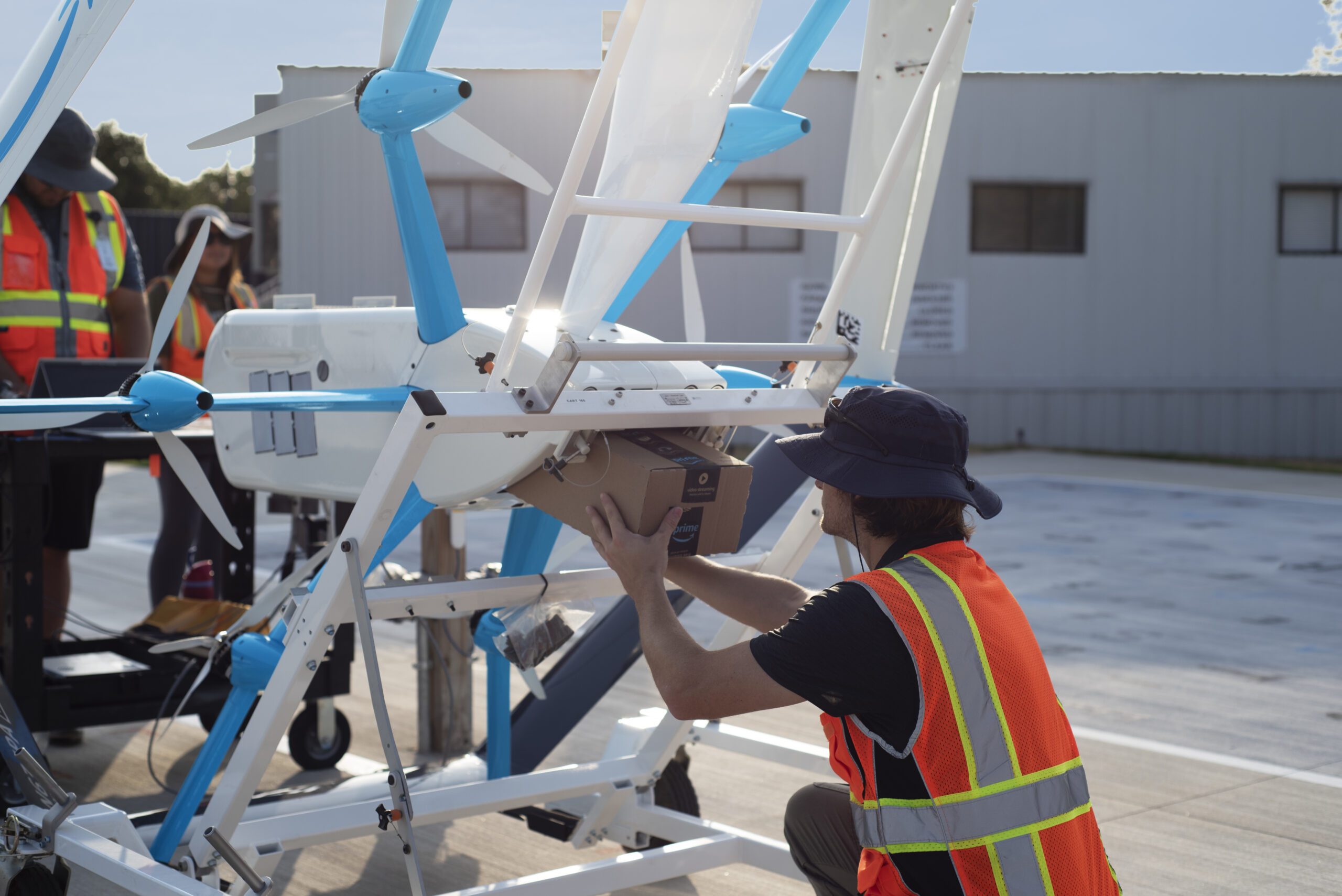
After rocky start in Texas city, Amazon Air service flying high
By DRONELIFE Features Editor Jim Magill
After only a few months of operation, following noise complaints from residents and the crash of one of its UAVs into a building, Amazon Air has agreed to changes in its drone delivery operations in the Dallas suburb of Richardson, Texas.
The drone delivery company has worked with city officials to ease the concerns of residents over the operation’s neighborliness and safety, after a problematic start of its service in the city.
At a meeting of the Richardson City Council last month, Sam Bailey, senior manager of economic development policy at Amazon, addressed several of the issues that residents had raised. He said the company had agreed to increase the minimum height its drones would attain before starting vertical flight over a residential area and to take other measures to decrease negative impacts of the delivery service’s operations to nearby residents.
In an interview with DroneLife, Richardson City Manager Don Magner said the changes that Amazon had agreed to would likely alleviate residents’ concerns and pave the way for the company’s continued harmonious operations within the city.
“I think that as long as they continue to operate in accordance with these approvals, that they have the right to do that. I do appreciate their willingness to work with us to try to change those things about their operations that would help with their relations with the neighborhoods that are adjacent to it,” Magner said.
Last June, the City Council approved a zoning change to allow Amazon to begin making drone deliveries within a 7.5-mile radius of its facility in the city. The company commenced drone delivery services in December.
On February 4, a Prime Air drone crashed into a Richardson apartment building, and fell to the ground within several feet of a sidewalk. No one was injured and the apartment building sustained minimal damage. The company said it took steps to ensure that any necessary repairs were made to the building.
“Following this incident, we investigated what happened, provided all appropriate agencies with the relevant information, and immediately apologized to the impacted community members for the inconvenience,” an Amazon spokesperson said in an emailed statement.
Bailey had addressed the incident at the Council’s March 9 meeting saying the size of the building had created interference with the drone’s GPS system. As a result of the accident, Amazon removed larger multifamily buildings from its drone delivery service in the city and Bailey promised that the company’s engineers would work to address the initial cause of the problem.
Magner said the accident apparently occurred after the drone had delivered a package in a small open area in from of the apartment home. The drone apparently struck the gutter of the building as it ascended after completing the delivery. The FAA has conducted an investigation of the incident.
“It perhaps had something to do with the drone trying to deliver in a very confined area at one of the apartment buildings. Obviously, when they’re delivering to single-family homes or townhomes or duplexes, the yards are much larger,” he said.
The accident raised a great deal of worry among city residents over the safety of the recently launched delivery service.
“I think there was some concern that, that under the right circumstances somebody could have been walking there and potentially been injured, or another six or so feet to the west, it would’ve hit a car that was parked in a parallel space along the street,” Magner said. “I’ve encouraged people not to rush to judgment. Let’s see what the FAA report says about the crash and see what lessons can be learned as a result of that.”
Noise, frequent flights over houses raise issues
Magner said city officials began hearing complaints from residents of a neighborhood close to the Amazon distribution center shortly after the service had begun. The residents had complained of the noise the delivery drones made at takeoff as well as the frequency of UAV flights over their homes.
City officials reached out to the company, which proved to be responsive to the issues and together officials with Amazon and the city formulated a three-point plan to address the residents’ concerns. Amazon agreed that on their initial ascent the drones would climb to an altitude of 225 feet – as opposed to 200 feet previously – before starting their vertical flight over the nearby neighborhood.
The company also agreed to designate the airspace above a church next to the Amazon operation center as a no-fly zone and to redirect some outbound flights to a route that would initially take them over a commercial area before flying over the residential area to make their deliveries.
“As far as I know, Amazon is continuing to be open to refining that plan in an attempt to try to strike a balance that would be acceptable for the community. And I feel like we’ve managed to address both the citizens’ concerns and the interest of the homeowner,” Magner said.
He said the feedback that he has gotten from residents has generally been positive since the proposed changes have been implemented.
“But there’s still interest in the community particularly the neighborhoods that are directly in that flight path. I think there’s still interest in having perhaps the minimum altitude raised even more to try to help with some of the sound,” he said.
“And of course, anything that Amazon could do to continue to diversify the flight patterns and take some percentage of the flights and reroute them so that the launch and the climb of the drone wasn’t over the same neighborhoods repeatedly,” Magner said. “That’s desirable, and I think the neighborhoods would appreciate that.”
Amazon has reportedly made more than 15,000 package deliveries in Richardson since the start of its service. Magner said this total shows that the city’s residents largely support the service, despite the bumps in the road that it has encountered.
“I think even the residents that have a concern with it at this point, I don’t know necessarily think that they’re against the drone delivery service,” he said. “I think they just want to see it operated in what they would consider a more neighborhood-friendly way.”
Read more:
 Jim Magill is a Houston-based writer with almost a quarter-century of experience covering technical and economic developments in the oil and gas industry. After retiring in December 2019 as a senior editor with S&P Global Platts, Jim began writing about emerging technologies, such as artificial intelligence, robots and drones, and the ways in which they’re contributing to our society. In addition to DroneLife, Jim is a contributor to Forbes.com and his work has appeared in the Houston Chronicle, U.S. News & World Report, and Unmanned Systems, a publication of the Association for Unmanned Vehicle Systems International.

