


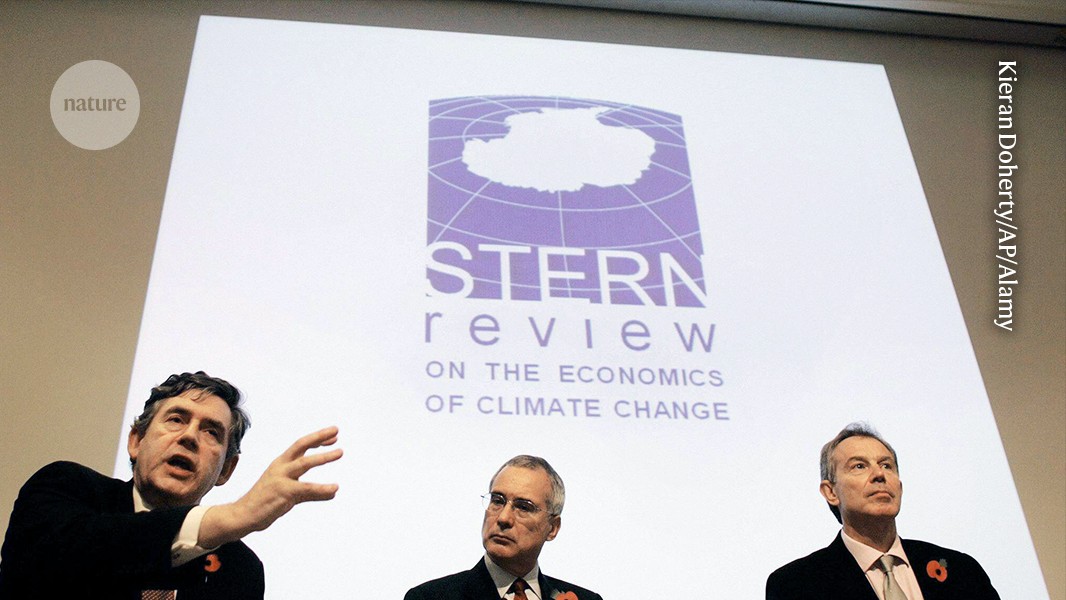

Nicholas Stern (centre) produced his 2006 report on the economics of climate change with the support of then UK chief finance minister Gordon Brown (left) and Prime Minister Tony Blair.Credit: Kieran Doherty/AP/Alamy
Few economists have managed to command the attention of so many world leaders in so short a space of time as Nicholas Stern did almost 20 years ago. As head of the UK Government Economic Service in academia, he was commissioned by the government of prime minister Tony Blair to review the research on the economics of climate change. The conclusions ricocheted around the world, uniting environmental, business and policy communities and imbuing them with a new urgency.
‘Yes, we can’: a blueprint for a clean economy and healthy society
One of the overarching messages of the 600-page The Economics of Climate Change: The Stern Review was that failing to invest in mitigating climate change would exact an alarmingly high price (see go.nature.com/47wkguf). Stern estimated that the cost of paying for damages from extreme storms, protecting coastal communities from rising sea levels, dealing with unliveable heat in many parts of the world and the like would cost between 5% and 20% of global gross domestic product (GDP) per year. By contrast, the costs associated with reducing planet-warming emissions were projected to be just 1% of GDP annually.
Last November, Stern published The Growth Story of the 21st Century, a reflection on the original review and the huge impact that it has had. It comes at a time when the leaders of many high-income countries are, to varying degrees, retreating from their promises of climate action. The Stern Review shows how strong research that integrates the natural and social sciences can make a tangible difference to policy when allied with political will. This is a mindset that the world must rediscover, and fast.
Policy lag
By 2006, nearly two decades of urgent scientific enquiry and environmental activism had finally pushed the realization that human activities were causing climate change into policymaking. An international agreement — the Kyoto Protocol, which came into force in 2005 — meant that richer countries were starting to take steps towards reducing their greenhouse-gas emissions. But, outside the circles of climate scientists and environmental activists, urgency was lacking.
A key problem was that the responsibility for climate policy lay mainly with environment ministries, which generally sit well below those responsible for finance and trade in the hierarchy of government ministries. People with expertise in environmental economics knew the costs of inaction on climate change, but they had little access to those holding the purse strings.

Climate loss-and-damage funding: how to get money to where it’s needed fast
The impetus for the Stern Review was, in part, the UK government’s failure to persuade leaders at a meeting of the G8 group of industrialized nations that it had chaired in Gleneagles, UK, in 2005 of the urgency of dealing with climate change. In response, the nation’s finance minister at the time, Gordon Brown, commissioned Stern to lay out what was known for the benefit of the public, policymakers and industry.
The UK government put a lot of effort into communicating the review beyond government circles. Stern was supported by the nation’s diplomatic and cultural-relations offices as he embarked on something of a world tour. He was invited to speak to heads of state at the annual meeting of the African Union in Addis Ababa. He also spoke at the US Capitol and at the Toronto Stock Exchange in Canada alongside environmental campaigner David Suzuki, among other events.
The review has, without doubt, become an enduring legacy. Along with spurring other international treaties, such as the 2015 Paris agreement, it has helped to provide the foundations for legislation that mandates cuts to greenhouse-gas emissions, including the United Kingdom’s landmark Climate Change Act 2008. Similar legislation followed in other countries.
Prescient predictions
The review was not without controversy. Some economists criticized its methodology — saying, for example, that the ‘discount rate’ applied to the calculations was too low, leading to an overestimation of the future value of making investments in climate-change mitigation. Loading the costs onto future generations would reduce the overall costs of action, they said, because economies would continue to grow in the meantime.
‘Loss and damage’ – the most controversial words in climate finance today
This view assumed, however, that climate change was a static phenomenon, when it was, and still is, worsening. Delaying action brings further costs as temperatures continue to rise. Some critics also said that the review’s projections of the extent of climate damage were exaggerated because Stern’s figures were not in line with those of the Intergovernmental Panel on Climate Change. Fast-forward 20 years, and the projections have turned out to be conservative.
Today, climate change commands the attention of government agencies in most parts of the world, and not just in those all-powerful finance ministries. Yet many higher-income countries are seriously backsliding on their promises, with some politicians viewing investments that aim to reach ‘net zero’ emissions as an expensive folly at a time of economic turmoil. Two decades on from the Stern Review, one key lesson is clearer than ever: delaying action only increases the costs for future generations. But another is that those in possession of the evidence must get out there and communicate it. Without action, the risks — and costs — will continue to rise.

