


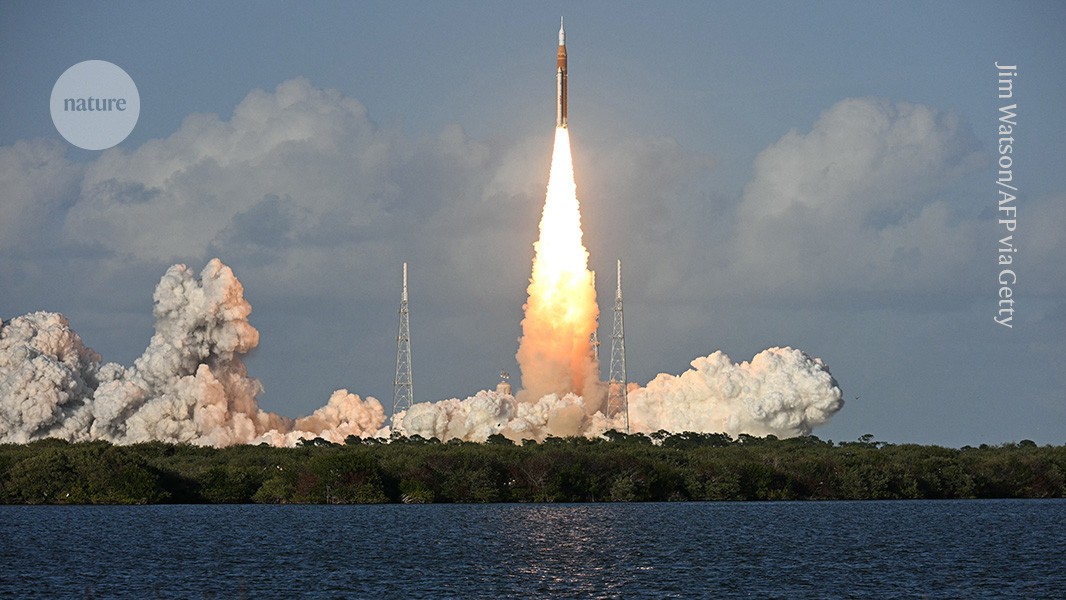
Four people are on their way to the Moon — for the first time since Apollo astronauts stepped off the lunar surface more than 50 years ago. They launched successfully this evening from Cape Canaveral, Florida, on NASA’s Artemis II mission, and, if everything goes to plan, they will travel farther from Earth than any human has before.
“Humanity’s next great voyage begins,” said NASA launch commentator Derrol Nail as the rocket cleared the launch tower.
The astronauts will now orbit Earth for about 24 hours to perform checks on their spacecraft, and then fire their rocket engines to set them on course for the Moon. The voyage there will take three days, the lunar surface growing ever larger in the capsule’s windows as they approach. On arrival, they will slingshot around the Moon’s far side, glimpsing lunar regions no human has ever seen by eye, and then make the three-day journey back home (see ‘Artemis II trajectory’).

Jasiek Krzysztofiak/Nature
Artemis II is the second in a series of US missions aiming to put humans back on the Moon, before China does. The goal of this flight is to test how well the Orion capsule, which is around the size of a small camper-van, keeps the astronauts safe as they travel beyond Earth’s protective magnetic field and through the radiation-heavy environment of deep space (see ‘Orion spacecraft’).
“Artemis II is absolutely critical in that pathway of getting back to the lunar surface,” says Gordon Osinski, a planetary scientist at Western University in London, Canada.
On their journey, the Artemis II astronauts — NASA’s Reid Wiseman, Victor Glover and Christina Koch, and Jeremy Hansen from the Canadian Space Agency — will conduct a range of scientific experiments, including studying how space flight affects human health, and observing the lunar surface in unprecedented detail. Glover will become the first person of colour, Koch the first woman and Hansen the first non-American to travel beyond Earth orbit.
The flight is analogous to 1968’s Apollo 8 mission, in which three astronauts flew around the Moon in preparation for later Moon landings. The Artemis missions were named after Apollo’s twin sister in Greek mythology, who was associated with the Moon.
Most of the scientists and engineers working on Artemis “were not around during Apollo”, says Juliane Gross, a lunar scientist at NASA’s Johnson Space Center in Houston, Texas, who is on the mission’s science team. “I’m so excited about this.”
Moon scepticism
Not everyone is as exhilarated, however. A 2023 survey by the Pew Research Center, a think-tank based in Washington DC, found that only 12% of US adults thought that sending humans to explore the Moon should be a top priority for NASA; poll participants said that the agency’s time would be better spent monitoring asteroids that threaten Earth, and studying our planet’s climate system. NASA has spent more than US$50 billion developing the systems now being used for Artemis II, much of it on the enormous Space Launch System (SLS) rocket needed to send the astronauts into space. In 2021, NASA estimated that each launch of the SLS rocket and Orion capsule costs $4.1 billion.

Artemis II astronauts (from left: Reid Wiseman, Victor Glover, Christina Koch and Jeremy Hansen) stand in front of the Orion crew module at an event in 2023.Credit: Chandan Khanna/AFP via Getty
In the 1960s, the US public generally disapproved of the Apollo programme’s enormous cost — an estimated $257 billion expenditure, in inflation-adjusted dollars, that culminated with Neil Armstrong and Buzz Aldrin walking on the Moon in July 1969. NASA wound down the Apollo missions in 1972, and instead focused on building the space shuttle, as a reusable way to get to low-Earth orbit and to the International Space Station (ISS). (The shuttles flew 135 times between 1981 and 2011, and the ISS has been staffed by astronauts since 2000.)
US President Donald Trump initiated the current push to get back on the Moon in 2017, during his first term in office.
China rising
During Trump’s current term, NASA administrator Jared Isaacman and some members of the US Congress have cast Artemis as the United States’s entry in a race against China to get humans to the lunar surface. China has developed a successful robotics programme that landed probes on the Moon four times and brought back surface samples twice — including the first ever samples from the Moon’s far side. The country has also announced plans to land taikonauts (the Chinese term for astronauts) on the Moon by 2030.
Twice this year, Isaacman has rejigged NASA’s long-term Artemis plans to try to increase momentum. “The better this mission [Artemis II] goes, the more we can keep up the pace,” says Linda Godwin, a former NASA astronaut and a physicist at the University of Missouri in Columbia. Current NASA plans call for astronauts to head to low-Earth orbit and test crucial Moon-landing equipment on Artemis III, as early as next year.

NASA chief Jared Isaacman at the launch pad in Cape Canaveral, Florida.Credit: Miguel J. Rodriguez Carrillo/AFP via Getty
The following mission, Artemis IV — targeted for 2028 — would be the first crewed landing on the Moon. Dozens of robotic and crewed landings could follow in the next few years, with the goal of building a US Moon base. That is perhaps easier said than done: Since 2018, NASA has been trying to get to the Moon more cheaply by funding a series of payloads for robotic landers built by private companies. Only one of that programme’s four launches has been an unqualified success.
Isaacman has said he is confident that NASA has the money it needs to pull off the full ambitions of the Artemis programme, in part thanks to an extra $10 billion that the US Congress gave the agency last year. That’s even as the Trump administration has pushed to cut many of the space agency’s other science programmes.
“I admire the vision” of a moon base, says Clive Neal, a planetary scientist at the University of Notre Dame in Indiana. But “the devil will be in the details” — including whether the White House will propose additional significant funding for Moon plans in its budget request for 2027, which should be released soon. Isaacman has said he wants NASA to spend $20 billion on Moon base plans spread over the next seven years.

