


Holly Newson 00:00
Welcome to Working Scientist, a Nature Careers podcast. I’m Holly Newson, and in this series, you’ll hear from authors who can help you in your career.
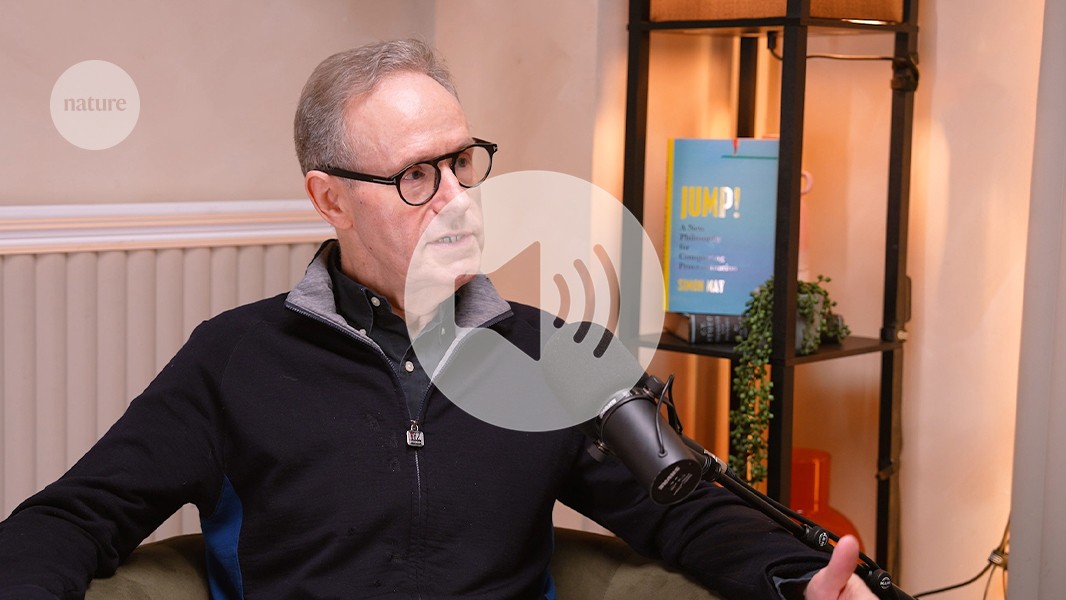
In this episode, I am joined by Simon May, visiting professor of philosophy at King’s College London, and the author of Jump, a New Philosophy for Conquering Procrastination, a book that helps you understand what’s holding you back from getting on with your biggest, deepest goals, and how procrastination forms part of the human experience.
Simon, thank you so much for joining me. (Great pleasure).
So to start off with, I wanted to ask, you mention the cult of work in your book. What is that?
Simon May 00:37
So, the cult of work is the idea that our identity is our work, is fundamentally our work.
Of course, there are other things that contribute to our identity, some of them extremely important, but that without work, we’re, in a sense, an empty shell.
And the cult of identity, I trace back to the 16th-17th century, essentially to the birth of Protestantism in Europe.
And I mean, I need to emphasize, I’m really talking about the West here, so I don’t want to presume to know about, you know, all the other rich cultures in the world.
It essentially, I trace it back to the rise of Protestantism, when work became a form of godliness, of devotion.
So that godliness was no longer confined, say, to charitable acts, to proper procedures of, you know, church worship. But the amount of work you did, which you did for the sake of God made you, in some sense, helped you, as it were, towards salvation. (Okay).
I mean, in those days, obviously, it had this very religious purpose.
That got secularized, you know, with the Enlightenment in the 18th century, and then with its development in the 19th century.
So that, you know, work became, in the words of several people in the 19th century, a sacred duty.
In our day, work has become reduced in many ways, not entirely, but there’s a big element of that to a sort of treadmill of productivity, so that we ourselves value ourselves by our outputs. And even the very word outputs is a bit like a factory, yeah.
And so work has become, in some ways, what would be the word. Depersonalized, cold, mechanical production line, spirit.
And I trace one of the causes, (and I go through a number of causes of procrastination) to that.
So that it’s extremely frustrating, as on the one hand, we’re gripped by the cult of work, so that, you know, if we are our work, it’s tremendously important other people value us based on our achievements, our outputs and so on.
You know, the maximum number of scientific papers we can churn out, sometimes writing the same paper in different ways twice. And some of the philosophers do this too. Many academics do this. Because output, you have a number of papers, you have on your on your CV, in some ways you know, will determine your career and your future.
So, and I’m saying paradoxically, it’s a tremendous motivator, of course, but it’s also a tremendous inhibitor.
Holly Newson 03:25
Yeah. And so, in what ways does it make procrastination worse, the fact that work is now such a part of our identity?
Simon May 03:34
Well, really, as I was just suggesting, it makes it worse.
Because, you know, if something becomes cold and alienating and simply production-oriented, it ceases to engage, you know, our real. It sees, it leaves, it becomes cold, and we don’t respond to, you know, when we engage in processes that we see as essentially cold and alien and from which we’re alienated, but which we feel compelled to do, you know, we lose a certain amount of motivation.
Above all, we lose the motivation to really invest ourselves in it. It just becomes, look, I need to churn this out. I need to get this out by Monday morning. I need to, you know, my, my, you know, my competitor in the next lab has produced three papers this year. I’ve only produced one. I better get on with it.
It’s a, it’s a sort of, it’s not just the competitive element. It’s the coldness that the process acquires.
Holly Newson 04:35
And in terms of career procrastination on the largest scale, what can that look like in terms of someone’s life if they are putting maybe their biggest goals and their biggest hopes off?
Simon May 04:49
Well, what it can look like, ultimately, and I go into this in my book, is that you actually put off the very career, the very vocation that you’re actually deeply devoted to. (Mmm).
And I mean, the stakes are so high, in the sense, you’ve got so far to fall if it doesn’t work. And of course, we never know in advance if it’s going to work, if anything’s going to work. You know, relationship, a marriage, a career, a vocation, whatever, that we can actually avoid an entire vocation, so we, in a sense, procrastinate on our life, not just on, you know, on that particular, on becoming a scientist or or becoming a philosopher, or becoming whatever it is, a gardener, whatever it is.
I mean, that’s what really motivated me in this book, is not why do I put off, you know, trivial tasks like cleaning up the lab or, you know, getting my tax return in on time and so on, which a lot of books about procrastination deal with.
You know, why do I keep putting off these things I need to do? But why do I put off my life? Why do I put off what I’m really devoted to. And I’ve personally known, you know, people who have done that, and the very, very gifted people, and you know, they can be very good at their displacement activities, that’s the point.
So you can spend your whole life doing something. I mean, I don’t want to name any particular professions, but it just happens that one particular person I’m thinking of, you know, became an investment banker.
I’m not knocking investment banking at all, but it wasn’t their true love. But it was, in a sense, the path to, it enabled them to avoid what they really wanted to do, which was pottery, believe it or not.
You know, you never know whether you’re going to make any money, whether you’re going to succeed, whether you’re going to buy your products and so on. And this was a way to more easier status in a sense, or more readily available status, money, a clearly established career hierarchy.
And they, they actually did return to their first love, you know, but it was only in their 60s, and that’s okay. I mean, one of the wonderful things about today is that we do not frown anymore, society doesn’t frown anymore, on people who change their minds throughout their lives.
But you know, it’s very different if you do it in your 20s than if you do it in your 60s.
I mean, you just have less time and perhaps less energy, and so on.
So I think that’s an example. That’s the sort, of kind of procrastination, you know, that I find really fascinating, and it can extend in many other fields, putting off the relationship you think is the right one, and knowingly marrying the wrong person, and all this sort of thing.
Holly Newson 07:33
So tell me a bit more about what role fear plays in procrastination.
Simon May 07:39
Well, fear is fundamental to it, because everything I’ve spoken about is a kind of, it’s something you’re frightened of, (yeah), you know, you’re frightened of, above all, not succeeding.
You’re frightened of not getting status. You know, just being hidden away somewhere, doing your thing, but no one’s recognizing you.
So you choose a career path which is clearer, where there are clear levels, you know that they’re clear promotions, you get promoted to whatever it is, B3 then B1 then A10, or whatever it is, and it’s more predictable.
So fear is, I mean, fear is a very interesting thing, because, of course, you can have….so I’ve really been alluding to fear of failure.
But then, of course, there’s the other thing which is very well known, which is fear of success.
Holly Newson 08:31
Why does fear of success exist? It sounds like such a counterintuitive thing.
Simon May 08:37
It does. And it’s a it’s a very difficult, it’s a very mysterious.
I mean, I can’t say I’ve, you know, got to the bottom. I know I have it myself to some degree. Not that I’ve been that successful.
And I think there are a number of factors to it. One is the fear of death, and I’ll come to that. And the other is the fear of becoming real to yourself.
This is a very difficult thing, and maybe some of our viewers might think, what the hell is he talking about?
And maybe they’re both linked. In a sense, becoming real, well, firstly, it’s nice to exist in the eyes of other people, so recognition, as we know from, you know, social media sites and so on. I mean, we do have a deep hunger for other people to recognize. Almost more important than recognizing ourselves, which is somewhere crazy because we don’t have any control over whether other people…and their recognition of us might be very fleeting.
I mean, they’ve got lives to get on with. They haven’t got time to be, you know, focused on us, unless we’re incredibly famous, and even then, we can go out of fashion.
So to me, the nub of it is there’s a, is the fear of death. Because there is a certain sense…I remember that when I was a teenager, I was terribly afraid of getting married, (okay), which I did in the end, but I was and the reason was that I thought, once I’ve made that choice, that will be for life. I mean, that’s, you know, the way what I thought.
And once I’ve made a choice for life, my whole life is determined. I’m then on a path towards whenever it ends. Whereas if I keep my options open, (this is my teenage sort of intuition). If I keep my options open, if I don’t commit myself, and that could apply to a career, to anything, then I’ve always got a chance to kind of live life again.
I don’t know if that makes any sense, (it does make sense).
So fear of success to come back to that is, in a sense, something very similar.
It’s, it’s, it’s not that I’m always moving towards some horizon as it were, that I never attain. I’m remaining slightly vague about also my self definition, because success, if I’ve achieved a goal, you know, I’m helping to, as it were become real to myself. I mean, right? (You become defined) by becoming defined exactly.
And the fear is of we all want definition, but I think we don’t want too much definition, such that we become so defined to ourselves, that there’s a possibility of becoming who we are, of becoming real to ourselves. I can only allude to this, and I only allude to it in the book, yeah.
But I think fear of success is a deeply, deeply powerful thing.
And it’s, and it’s, you know, its origins are very mysterious. I mean, I’ve been speculating just based on my own experience, but others might, you know, have other explanations for it.
Holly Newson 11:39
Yeah. And this book in general, I mean, it’s titled A new Philosophy for Conquering Procrastination.
Why did you want to write something that was slightly different to other books about procrastination or time management?
Simon May 11:53
So essentially, most books, especially more in this sort of self-help genre, will say the key to overcoming procrastination is to formulate clear priorities, to break them down into tasks so that they’re not too intimidating. Well also say you have a road map, and then to give you wrapped deadlines around those tasks.
And I’m saying, no, but the real problem of procrastination is where you have life priorities.
So I want to become a potter, or I want to become an engineer, or I want to become whatever it is, a scientist, but I avoid doing it.
So it’s not that I don’t have the priority. I do have the priority.
And, you know, for example, my first chapter on the solutions have these seven proposed solutions.
But one of them is, you know, actually, sometimes we need to downgrade the stakes of our priorities, because we can get so intimidated by what really matters to us that we don’t do it.
Holly Newson 12:57
Yeah, and so on that point, how, how do you go about making something that’s so important to you feel less important?
Make the stakes feel lower. How do you go about that? I suppose, mental shift?
Simon May 13:09
Yeah, so that’s exactly right.
At the heart of I mean, the key to it is changing your perspective on things.
And as I say, one way of doing it would be to imagine your most important task is actually your displacement activity.
Now this works for me.
So I find, for example, when I’m starting a book that really matters to me, I can just get paralyzed by the importance of it.
So I’ll do something else. Even writing, I don’t know, a paper or something that’s more career-oriented. I just want to get another to get another paper out or, you know, is not that crucial to me as a way of avoiding what’s frightening me.
So (and I’ve tried all this out on myself imaginatively), I can simply say No, what I’m doing now is my way of is my infidelity, so to speak. I mean, I’m talking now about work, you know, to give me a sense of play, of something that doesn’t matter so much of.
And I was struck once, and I put this in the book when I was supposed to go to a conference in the States, and I couldn’t go for various reasons. And I suddenly found myself with this entire week, which is what the whole trip would have taken, which with, you know, no plan.
I mean, it was completely free time. And instead of floating around, you know, in the void, I powered ahead with with the thing I really wanted to do precisely because it was the thing I wasn’t supposed to be doing at that time, if you see what I mean? (Yeah).
So that’s one thing, and that might, I’m not saying this will work for everybody, but it’s it works for me and other people you know seem to feel it works for them.
The second thing is that I’ve actually alluded to, which is the question of recognition.
We all need recognition, but it can become paralyzing again, because of the fear of not getting it.
So, you know, rather than worrying about whether people are going to like it, whether people are going to, you know, whether we’re going to get in some way rewarded for it by the praise of other people, we should try to minimize this need for that. We do it because we’re motivated to do it.
Holly Newson 15:27
Yeah, that feels like an easier said than done, just because recognition in our society is so praised.
Simon May 15:36
Well it is, and it’s a natural human desire to have recognition.
But you know, we can become completely inauthentic.
And the Enlightenment philosopher Jean Jacques Rousseau already said this, and is very big on this.
You know, we start to live through the priorities of others, or through the hope of others, you know, seeing us, and we lose ourselves. It’s a two edged sword.
On the one hand we need a modicum of it. We need a certain amount of it, definitely.
But if we live excessively for it, it becomes paralyzing. So we have to find a way of reducing it.
I include there, by the way, you know, leaving a legacy post mortem recognition.
I’m, I’m very big in my own mind, on the actual complete pointlessness of that.
Because for 99.999% of us, it’s not going to happen.
At least, you know, maybe our families will remember us for a generation, maybe for two. Then we’ll be forgotten.
It’s honestly a pretty pointless venture. It’s again, very fundamental to human beings. You know, the ancient Greek heroes sought a lasting legacy, just as much as people do these days.
But I think it’s essentially pointless. You can only live your best life here and better enjoy the journey than worry about the, you know, the destination long after you’ve gone
Holly Newson 17:09
Yeah, and tell me about procrastination, when we’re doing things for our own individual gains versus for the collective or the community. How does that seem to shift things?
Simon May 17:22
So when I say, you know, for yourself, I don’t mean selfishly, for your own gain, only at all.
If you’re giving to others, working for the community, so to speak, transcending yourself again. Hopefully we’re doing that out of our own spirit of generosity, not to win brownie points? (Yeah)
That’s the distinction.
Holly Newson 17:44
And if we think about that collective in a slightly different way, say we’re talking about a team at work in a lab, whatever it might be, from what you’ve researched, do people procrastinate less on, you know, their big goals, if it’s a shared big goal, versus if it’s a person, just a personal big goal. Do, have you sort of seen anything there?
Simon May 18:07
I think the answer is probably yes. I mean, obviously, I’ve never done a properly controlled experiment on this. I wouldn’t know how to do it.
But I think. yes, I think when we’re involved in collective goals, you know, providing the community at work is really a cohesive one, in which everyone is, you know, given their due and indeed their recognition.
As I say, I’m not slamming recognition, only its success.
I think, you know, if it’s a genuine community where people aren’t trying to undermine the other and, you know, backbiting and trying to exclude people and so on, then I think, yes, it can certainly be facilitated by community, without doubt.
Holly Newson 18:52
And talk to me about boredom. How can boredom at work or in anything we’re doing actually be a good thing when it comes to procrastination?
Simon May 19:02
Okay, so, I mean, obviously procrastination itself, you know, if it goes on and on and on, is a source of boredom.
You’re just not making progress.
Now, boredom obviously can paralyze. I mean, boredom is paralyzing.
But at the same time, boredom can be an absolutely crucial if you listen to it properly.
You really need to listen to it, rather than just escape from it and do something else. It can be a crucial wake-up call that you’re on the wrong path in life.
I mean, there are often good reasons to be bored. Of course, you can be bored in your work, you can be bored in your marriage, you can be bored in all the important things.
You can be bored in your country, you can be bored in anything that is a central anchor of your life.
So when we’re bored, we shouldn’t let it just paralyze us.
We need to often just go into it, as it were, you know, sink into it. Listen to it. Actually listen. The word listen is crucial.
And see. See if it’s telling us that we’re on the wrong path or and or that we’re pursuing the right path in a sort of sterile way, in a kind of mechanical way, we’re not really investing ourselves in it.
And that can also, obviously happen a lot. So I think boredom can be a phenomenal wake-up call.
Holly Newson 20:17
What’s the alternative to, if we were to realize I’m pursuing the right thing, but in a sterile way. As you say, What? What is the alternative to change that?
Simon May 20:26
Well, I mean, I think, you know, you need to, that’s what I mean. You need to listen to what this boredom.
I mean, boredom is a general word for a sort of losing motivation, losing interest.
You need to listen, as it were, beneath the surface of boredom.
You know, you need to experiment. I mean, experimentation is crucial to getting out of procrastination generally.
You need to, you know, fantasize, imagine alternative ways of doing something. Perhaps you need to seek inspiration in other people’s work.
I mean, say you’re writing something, you get stuck.
You get bored with your own thoughts. You get bored with your own work. Sometimes it can help, you know, to just think through an entirely new framework for what you’re doing, to, you know, to read other people’s work.
I mean, there are all kinds of ways that are common sensical.
All I’m saying is, I don’t think you should immediately escape from boredom and think, well, that’s the end of this. I mean, I’m just not, you know, I can’t make progress with this.
I think it’s telling you something. And I say the same thing about regret.
So I think regret is the other great teacher.
Again, regret is something you should be listening to.
And I think those two, boredom and regret are actually what makes procrastination potentially very creative.
Because it, you know, it’s a kind of wake up call that that, as I say, you’re either on the wrong path altogether, or you’re on the wrong path with what you care about.
Holly Newson 22:00
And so do you think that we, a very general we, are overly concerned with procrastination as humans? Is it something that actually we should be just more accepting of?
Simon May 22:13
Yes, I think we’re overly impatient with it.
I mean, it’s an incredibly important signal about something which is really fundamental in life, that, as I keep saying, am I on the right path?
Are my ends in life. you know, those are the best suited to my abilities, and, you know, talents and character and so on.
And, you know, although procrastination is a relatively modern word, (I think it was coined in the 16th or 17th century).
It goes back to ancient times, and the ancients were obsessed with this. Plato was obsessed with this. So was Aristotle.
So were many ancients. So was the whole, you know, religious tradition, for example, the Christian religious tradition.
It’s not just a modern thing, by any means. We often think it is, yeah, in answer to your question.
It’s really a very ancient, a very, very ancient concern, and there’d be many explanations for it,
Holly Newson 23:08
And you’ve mentioned bits of this as we’ve spoken, but I wondered what role procrastination has played in your own career, or plays I don’t know, as an academic, and as a writer?
Simon May 23:21
Well, it’s played a crucial role. That’s why I was motivated to write about it. I mean….
Holly Newson 23:28
In what ways does it affect you on a yearly or day to day?
Simon May 23:32
It affected me first of all with my entire vocation. So, you know, going into philosophy, I simply didn’t believe I was so intimidated. I’m always fascinated by it, even as a child or teenager, early teenager, but and I read my I read quite a lot. But absolutely fascinated by the questions.
But, you know, it just seemed like such a mountain to climb to ever do it. And I thought, I’ll never be able to write anything, because how on earth do you write a whole book and all that sort of thing.
That I did actually put it off.
And, I mean, I put off, I mean, not for that long, but, you know, I did my PhD later than I would have done, so to speak, caused a lot of pain, a lot of anguish.
You know, I thought maybe I should do something else, I should go into business, or, you know, do something. Again, as I said before, that has a more reliable series of steps and gains, the status and income and so on.
And I procrastinated with the, I mean, it’s quite personal, but with the relation, you know, with the relationships that have most mattered to me.
So, you know, yeah. I mean, I’ve put off, or indeed avoided altogether, you know, to my lasting regret.
And so, yeah, I mean, I procrastinate on some of the biggest issues in life.
I, um, and I, you know, I deeply care about, and I’m very aware of life’s limitations.
And, you know, we will, we all think we’re going to live to at least 70 or 80. But no idea.
So, you know, you don’t know. It could end anytime. So, yeah, I mean, I’m very invested in the subject, yeah. And I just felt, you know, whenever I read the literature, I just felt, you know, the stuff about priorities and deadlines and so on just didn’t cut it for me.
And it wasn’t addressing those kinds of really important things that I was procrastinating on.
Holly Newson 25:38
Yeah, completely. And so as we come to the end of this chat, I wanted to ask, is there anything about procrastination and maybe in the work sense that we haven’t talked about, that people could maybe have a think about, or maybe might want to change their perspective about?
Simon May 25:56
I’ve mentioned one
Just straight off, which is the mirage of fulfillment.
So we often say we have this great thing we want to do, whatever it is. You know, I mean, for me, it’s often writing books.
I mean, say, if I’m just talking about careers, yeah. Then we achieve it, and then we go, so what? This hasn’t really changed anything.
And we become discouraged through that.
The illusion, and I give in the book The example of one of the greatest writers ever, Tolstoy, who gets to his midlife he had a massive midlife crisis.
I mean at 50, and he’d written Anna, Karenina and his, you know, and War and Peace and so on, his great novels, he already was world famous, and he had a massive crisis because he said, so what? What does this all add up to? I don’t feel fulfilled.
Most of us probably would feel pretty fulfilled if we’d achieved that, both what we care about, and fame.
But he had this crisis in which he completely lost motivation.
And at the very heart of that was that he was expecting, you know, and he says it, I was expecting some kind of clear sense of, I’ve reached, if not the pinnacle of everything I can achieve.
I’ve reached, you know, something deeply and lastingly important to me.
And he goes, I don’t feel that way. And what’s more, I’m going to die. And what does it all matter then?
So I would say, you know, one other thing is to avoid this sense that the destination that is the key, that once I’ve reached the destination, I’m going to feel this sense of lasting fulfillment.
But actually the key, as so many sages have said, is, in a sense, the journey and even the moment in the journey always informed by your ends.
So we’re not just talking about watching sunsets or just mindfulness, so to speak.
But that’s the absolute key, is the pleasure in the process, whether it’s something that’s totally for yourself or whether it’s to help other people.
Again, this, I’m not, this could be totally devoted to other people.
And one thing that goes with it, if I can just add that, is getting away from the idea that we have a potential to be fulfilled.
In other words, that there’s a clear end goal somewhere that we can measure our steps towards.
You know that, how many, how many steps towards it we’ve successfully taken.
And that we’ll kind of know when we’ve reached it. I don’t think we can ever know that. You know, we just keep going on what we’re passionate about until we die.
And you know, that’s also because one, if you believe in the myth of potential that’s waiting to be fulfilled. And many great philosophers have, I mean, Aristotle, for example, was one of them.
But I think it’s an error, because I don’t know. I mean, what is it? And how would I ever know what it is? And how would I ever know when I fulfilled it?
I mean, there’ll be more. And that was also, you know, part of Tolstoy’s problem, so to speak.
And these kind of assumptions are so deeply built into us that unless we examine them, we kind of don’t even know where we hold them.
So I would say that would be a final and very important cause of procrastination that you know, can be surmounted by a change of perspective in the way I just suggested.
Holly Newson 29:21
Yeah, I think that’s a very, very nice way to end.
I think it’s, I think it’s something that everyone can reflect on within themselves and remind themselves that actually, whilst having the goal is excellent, it’s not the fulfillment of that specific goal that is going to solve everything, make a feeling that lasts forever.
It’s it’s in the doing exactly, doing exactly, well.
Simon, thank you so much. It’s been so rich. Chat to you. Really appreciate it.
Simon May 29:51
Great pleasure. Much enjoyed it. Thank you.

