


General scales
For more than a century, psychology has introduced many constructs with explanatory and predictive power about human behaviour, from conscientiousness to metacognition. On the basis of experimental data and theories of human cognition, these constructs are usually organized into hierarchical taxonomies, such as the Cattell–Horn–Carroll structure of human cognitive abilities51 or the Big Five personality traits52. In principle, we could build a similar taxonomy for artificial cognition, based on theory and experiments about machine behaviour4. However, as the base population of machines is much more arbitrary and changing than those of humans, it makes more sense to devise a taxonomy that could encompass any kind of natural and artificial intelligence, by considering capabilities that are meaningful for more general theories of cognition53. Under this paradigm and by integrating and generalizing taxonomies from human psychology, comparative cognition and AI53, a general taxonomy of 14 capabilities was designed54 and later extended with corresponding 14 rubrics by Tolan et al.55 for the study of AI and human capabilities in the workplace. These rubrics assigned the presence or absence of the need for each capability in generic tasks extracted from worker surveys, occupational databases and AI benchmarks.
This taxonomy serves as a basis to construct a catalogue of capabilities following these four criteria: (1) the capabilities are general rather than specific, enabling the characterization of a wide range of tasks usually present in human activities; (2) the capabilities represent concepts that are understandable to humans (and LLMs), enabling their levels to be expressed through rubrics in plain natural language; (3) there is no a priori assumption of correlation or orthogonality in these capabilities as observed in humans or LLMs, to accommodate various present and future AI paradigms (rather than overfitting to a specific state of the art of AI); and (4) two capabilities are considered distinct as long as many tasks could conceivably require a high level of one but not the other. Following criteria (1) and (2), we use capabilities that are familiar in human and non-human cognition and AI practice (see Supplementary Information Section 1.1 for a coverage of taxonomies in humans and AI). Despite these inspirations, we follow (3) to ensure that the catalogue does not replicate human intelligence hierarchies or taxonomies derived from populational methods. But we do not look for a middle ground either: we do not assume that humans and AI systems share a common capability structure. Finally, ensuring (4), we consider two dimensions to be different (for example, metacognition and logical reasoning) if it is possible to conceive tasks that require one but not the other, independently of whether they are correlated in human or AI populations. Indeed, we include dimensions that may not be the most discriminative ones for the population of benchmarks or LLMs we use in this paper but can be useful to detect emergent properties in the future. This population independence is especially critical in the present era in which benchmarks and models get replaced every few months: for instance, for models without chain-of-thought, dominant until 2024, the set of reasoning capabilities we use may not have been very discriminative; however, with the advent of models with reinforcement learning and integrated chain-of-thought in 2025, reasoning capabilities become more informative. If our catalogue had not included them, we would have been unable to detect this shift, and the same applies for capabilities that may not be discriminative now but can be conceived of as different from others and may be informative in the future. As we may nevertheless miss some capabilities that will become relevant, the catalogue is expected to expand to include new dimensions in the future, provided they are understandable to humans.
As mentioned, our work builds on that of Tolan et al.55. First, we extend the taxonomy by including both knowledge and extraneous dimensions. Second, we develop new scales and rubrics in a quantitative range between 0 and 5+, with 0 representing absence of demand, values 1–4 representing increasing demand levels of the capability and 5+ representing 5 or above. For instance, the famous Sally–Anne false-belief task assesses understanding of an individual’s false belief about the properties of an object if those properties change while they are not looking (Sally will look for her marble in the basket where she left it, even though Anne moved it to the box when Sally was away). This may be level 4 for dimension MS (Mind Modelling and Social Cognition) but may be level 0 for dimension QLq (Quantitative Reasoning). Similarly, the question “if all A are B, some B are C, no C are D, and all D are E, what can be inferred about the relationship between A and E?” may be level 4 for QLl (Logical Reasoning) but level 0 for MS (Mind Modelling and Social Cognition).
Extended Data Table 5 shows the set of dimensions we have included in the first version of the DeLeAn rubric set (DeLeAn v1.0). We adapt seven broad capabilities from Tolan et al.55, applicable to LLMs (for example, ‘auditory processing’ was discarded), and refine a subset of them hierarchically with subdimensions, making them a group of 11 ‘proper’ cognitive capabilities that we call ‘elemental’; by ‘elemental’, we mean that these capabilities are not derived from others, as opposed to the knowledge dimensions, which are more acquisitive. These ‘elemental’ subdimensions were included after several rounds of discussions about whether some of the original seven broad subdimensions could be carved into finer, but still general, subdimensions that are conceptually distinct. Beyond the capabilities, we also include new dimensions accounting for domain ‘knowledge’, separated into five subdimensions (KNn, KNs, KNa, KNf, KNc) covering large branches of human knowledge, and three ‘extraneous’ ones, AT (Atypicality), VO (Volume) and UG (Unguessability), to account for elements that make the task more challenging independently of elemental capabilities or knowledge demands.
In particular, Atypicality deals with contamination56,57 and other familiarization effects leading to capability overestimation because similar data were seen during training. An AI system may simply succeed because it has memorized the instance. This dimension can be used to explain and predict performance, by identifying AT as a confounder with the other demands. The second extraneous dimension, Volume, represents the use of ‘collages’ to make instances more difficult. For instance, if we put ten simple additions in an exercise and we score whether all of them are correct, then we have increased the difficulty greatly, but the quantitative reasoning demand is the same. We call this phenomenon amalgamation and it is a recurrent trick to make instances more difficult, either in benchmarks of increasing hardness46,58,59 or in adversarial testing60. There is a correlation between the size of the questions (and the answers) and the difficulty you can achieve with it46 (Figs. 3 and 4). In the end, amalgamation produces an underestimation of the capabilities, because the subjects fail at tasks that are incorporating many simple things. The chances of error accumulate, even if the cognitive load is not necessarily increased61,62. Finally, Unguessability captures the very usual funnelling effect to make a question more amenable for scoring but, at the same time, reducing its difficulty. The obvious case is the use of multiple-choice questions, which have become predominant in most AI benchmarks, despite its issues63. Reducing or increasing the number of options has been a common practice to change the ‘difficulty’ of a task without modifying its cognitive demands35. In general, these three extraneous dimensions will account for an important proportion of the predictability in LLM success and including them helps clarify these confounding effects.
Although we have 19 dimensions in total, only the first 18 correspond to proper capability demands (11 elemental, five knowledge and two extraneous) that may be met by the subject or not, with Unguessability being a special extraneous dimension reflecting the funnelling in the item design (for example, multiple-choice questions). Because of that, it is the only dimension expressed between 0 (the correct answer is trivially determined by the question) and 100 (unguessable, that is, a good open-ended question). Each of the other 18 demand rubrics includes a general description of the construct to be annotated, followed by a description of each of the levels, from 0 to 5+, with three ‘anchor’ instances each. By following Supplementary Information Section 2, we can better understand the trade-offs in the construction of the rubrics.
It is important to highlight that the catalogue is not definitive and is meant to be extended in the future using the same criteria of dimensions being general and conceptually distinct. We use the term ‘catalogue’ instead of ‘taxonomy’ to better emphasize its non-definitive nature. This is also why we call the rubrics and battery DeLeAn v1.0 and ADeLe v1.0, respectively, with the vision of incorporating new capabilities and propensities in the future. This will also include considering safety, fairness and values64,65 and not only performance (correctness) as the variable to predict.
Ratio scales
We deliberately design the demand scales as ‘ratio’ scales66, with an absolute zero(no demand) and differences that are comparable across the scale. In the social sciences, a common interest lies in understanding differences, as no human has zero capabilities, and an ‘interval’ scale with negative capabilities makes sense (as in IRT) or as percentiles of a normal distribution (as IQ scores). We argue that for AI, we should aim for the top level in Stevens’s topology of measurement67: the ratio scales. Ratio scales have all of the properties of the previous scales: intervals and differences are meaningful but so too are ratios. Given the flexibility with which we can regulate compute and time use in AI, it makes more sense to set an absolute zero (no compute) on the demands and build the scales in such a way that ratios are meaningful. We wish to say that instance xi at level 6 doubles the demand of an instance xj at level 3. Taking into account that we fit logistic functions, this can be understood in terms of the log odds of being correct halving when moving 2x in the scale and doubling when moving x/2 in the scale68.
For this first version of the scales, we decided to choose levels (0, 5) of the full range (0, ∞) for practical reasons. With a single rubric, it is hard for humans and LLMs to refine beyond five ordinal values—this is why Likert scales are so popular. Note that the rubrics only show cases in an ordinal scale between 0 and 5 and the annotations are discrete, never generating non-integer values. This is convenient for avoiding the need of binning for the curves and the demand histograms, but the values become fully continuous when estimating the abilities. In any case, it is usual to consider originally ordinal scales as interval or ratio scales when the number of levels is 5 or more69. Indeed, the magnitudes between 0 and 5 should not be interpreted as a mere rank. The way the scale increases depends on what the demand represents, but the pace of increase, the actual scale, is chosen in such a way that all scales are commensurate. For instance, for knowledge dimensions (applied sciences, customary everyday knowledge, formal sciences, natural sciences and social sciences and humanities) we thought of levels corresponding roughly to elementary, middle, high, undergraduate and graduate education. By looking at the attainment rates of some statistical data of education level rates (for example, Organisation for Economic Co-operation and Development (OECD) data70) and the specialization of domains as the educational level increases, we noticed that the questions of level l were usually sufficiently advanced to have roughly one person in 10l−1 solving it correctly. Then we extend this criterion as a rule of thumb for all scales, although future work could perform a proper calibration and see that the base of each dimension corresponds with the correct proportions. By using the same base, we achieve ratio scale consistency and commensurate scales across dimensions. In general, an item is at level l if l is the highest number such that, in at least 95% of samples of n = 10l individuals, there is at least one correct response. The levels we have defined are 0 (None), 1 (Very low), 2 (Low), 3 (Intermediate), 4 (High) and 5+ (Very high), with n going from 1 to 100,000.
We could have calibrated some dimensions using procedurally generated examples. For instance, in reasoning, we could have increased the components of reasoning processes71 to see whether the levels increase accordingly, but each of these ‘scales’ would have been incommensurate with each other and not sufficiently general.
The 18 rubrics were crafted following the above criteria, using several iterations while testing with human and AI annotators. The final rubrics can be found in Supplementary Information Section 2. Once the rubrics were settled, we conducted the experiments, annotating tens of thousands of instances using a LLM, scalably and rapidly. Five annotation examples are illustrated in Extended Data Fig. 3.
Dissecting the demand-ability space
Annotating instances using these general scales allows us to compare what makes them easy or hard and provides the same lens of analysis independently of where the instance comes from: human test, AI benchmark or new item design. We can discard or combine instances to build a specific test profile. Although this is not new in psychology or AI72, the scales can be applied to any task, test or collection of benchmarks; DeLeAn v1.0 is instantiated to consider only textual modality for now and to be extended in the future. By using the same scales in a standardized way, the comparison of the vast space of tests and benchmarks becomes possible for the first time.
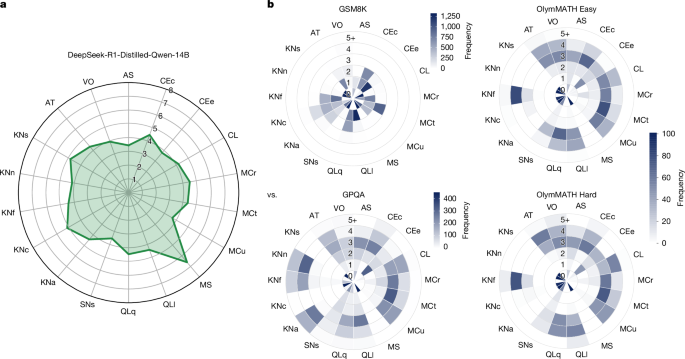
For instance, in this paper, we applied DeLeAn to 16,108 instances from 63 tasks from 20 benchmarks, curated from the 2024 proceedings of six AI conferences and other venues, while ensuring both data quality and diversity (details in the section ‘Benchmark battery: instance selection and curation’). This is unprecedented, as all of these tasks are now represented within the same 19-dimensional space of 18 general cognitive demands (plus unguessability). After the annotation, these 16,108 instances constitute the ADeLe battery (Supplementary Table 28). We can observe the distribution of the demand levels for each dimension, the demand profile, represented as a polar histogram. Exploring this for each benchmark in ADeLe (Fig. 2) helps answer the question of whether each benchmark actually measures what their developers claimed to measure, as we explored in the main text.
Once instances are annotated, we can do more insightful analyses than just calculating one average for a whole dataset. When we run a LLM on an annotated benchmark such as the ADeLe battery, we can analyse each dimension separately using a subject characteristic curve73 to show the performance of an AI system as a function of demand levels, offering a comprehensive and robust delineation of the model’s ability on that dimension. The curve can be summarized using the area under the curve, referred to as the ability score, as described in the section ‘Subject characteristic curves’.
With this procedure on the characteristic curves, we can derive ability profiles as 18-dimensional vectors containing the estimated abilities. The usual way of representing a score profile with many dimensions is a radial plot. This is common in the behavioural sciences and more recently in AI as well. However, if we look at these plots in AI papers (for example, refs. 47,48), we see that what they represent in each dimension is the average accuracy of a selection of instances that belong to a particular domain or dataset, not an actual ability. The plots based on performance scores will change as the difficulty of the selected instances varies, whereas an ability profile is invariant to these changes. Overall, our notion of ability using the general scales is very different from the common yet inaccurate use of the term in AI as a synonym of performance. This includes the use of the term ‘capability’ in the area of safety evaluations: even if informally the concept may be associated with levels74, these levels were never defined or scaled.
By comparing the ability profile of an AI system with the demand profile of a task instance or a benchmark, we can explain the observed performance. Moreover, using the differences between abilities and demands, we can use interpretable algebraic models to anticipate performance for new instances (Supplementary Information Section 1.7.7). Notably, there is potential for other options as well. For example, the 18 values that are annotated for each single instance on the scale 0 to 5+ and unguessability constitute a 19-dimensional vector x, which can be used as predictor variables for a probabilistic classification model, an assessor, outputting the (estimated) performance of an AI system on that instance. Each assessor can be trained specifically for each LLM, without relying on the features of the LLM. As shown in the main text, we can compare this with many other powerful ways of predicting performance, such as assessors with embeddings and fine-tuned LLMs (there are more details on how we build distinct assessors in the section ‘Assessors and metrics’). Notably, despite the much smaller computation cost (apart from annotating the battery, which only needs to be done once), the predictive power is substantially better for the demands-based assessor than the best baseline, especially out of distribution, and evidently much better than average accuracy, which is only well-calibrated in distribution. This is because our general scales provide predictive features over a wide variety of tasks while limiting overfitting on features that become spurious when switching tasks and benchmarks. Finally, just as ability profiles are non-populational, the assessors we derive for each system are inferred exclusively from the results of that system, rather than from population-level parameters such as those used in scaling laws for aggregate performance prediction75.
LLM annotators and inter-rater analysis
With the rubric set in hand, we annotate any new instance along each dimension using a LLM to replace human annotations, to scalably and rapidly annotate thousands of items. Although there may be some discordances between LLM and human scores, scalability is critical for widespread deployment of the new evaluation methodology. This can be seen as a trade-off but also as an opportunity to have stable and fully reproducible annotations using LLMs, which can be improved as LLMs get better or are more aligned with human interpretation. In fact, the three instance anchors per level were very instrumental for the LLMs to perform good ratings (in a few-shot inference fashion) but also for human understanding. In our case, we performed the annotations with GPT-4o, with which we found high agreement rate. The use of comprehensive rubrics in natural language that can be applied automatically is a substantial advancement in making the explanatory power of the scale a reality, especially if humans could interact with the LLM to explain their annotations.
Specifically, we prompt GPT-4o (‘gpt-4o-0513’ checkpoint)76 to annotate task demands levels (on a discrete scale from 0 to 5) instance by instance for all individual rubrics (see DeLeAn Rubric Set v1.0 in Supplementary Information Section 2). We use the Azure AI application programming interface (API) with chain-of-thought prompting (Supplementary Table 23) at temperature set to 0 with a maximum output token length of 1,000, to ensure that answers can be long enough for nearly all instances while substantially reducing the cost. The stopping condition and the rest of the parameters are left by default.
To assess the agreement rate between humans and GPT-4o, for each demand, we randomly sampled 50 instances while ensuring each level had at least a sample size of 3 to avoid minority levels getting neglected in our inter-rater analysis. This led to 900 instances to be annotated, which were distributed to five humans (authors of this paper, corresponding to Y.H., Y.M.-D., L.Z., Q.Z. and S.Z.), for which each instance was annotated by exactly three humans. The annotation process consisted of two steps. First, each annotator independently assigned a difficulty level (using the 0 to 5+ scale) to each instance using the rubrics. Next, the annotators met for a Delphi77 consensus meeting. During this meeting, instances for which the minimum and maximum ratings of the three annotators differed by two or more points were discussed in detail until a consensus was reached. For cases with differences of less than two points, a simple majority vote determined the final annotation. To check the inter-rater agreement rates, we use the rWG index78,79 with the default rectangular null distribution; a score greater than 0.7 is generally considered as a good agreement rate.
The result is shown in Supplementary Table 22, in which we observe satisfactory rWG scores (average = 0.86) between Delphi consensus and GPT-4o, consistently greater than 0.80, except for one dimension with a score of 0.75. However, the rWG scores between humans before the Delphi consensus meeting were slightly lower for certain dimensions. These initial disagreements are because of several reasons, identified during our Delphi consensus meetings: occasional misinterpretations of certain words or terminologies, mainly for those humans whose primary language for daily use is not English; knowledge gaps in annotating certain particularly challenging task instances beyond the expertise of annotators; cultural variations affecting annotations, especially within some knowledge dimensions; and several inconsistent ratings for which annotators could not explain their own numerical assignments in hindsight, possibly caused by tiredness in annotating a large amount of instances; the reported time in annotating 50 instances on only one single rubric usually ranges between 30 and 60 min. The Delphi method proved useful to mitigate the individual biases and inconsistencies from human annotations caused by the miscellaneous reasons listed above, among others.
In Supplementary Information Section 1.8, we also explore two alternative LLM annotators. One is DeepSeek-V3, which is similarly powerful but open-weight: keeping all other things equal, it exhibits a similarly high agreement rate with the Delphi consensus (an average rWG of 0.83; slightly worse than that for GPT-4o of 0.86) and it unlocks similarly high predictive power, comparing with the section ‘Predictive power analysis: anticipating performance with assessors’. The other LLM is LLaMA-3.1-8B-Instruct, which is open-source but much smaller. We find that it achieves a reasonably good agreement rate with the Delphi consensus (an average rWG of 0.74; noticeably worse than that for GPT-4o of 0.86) and it exhibits moderately worse predictive power, comparing with the section ‘Predictive power analysis: anticipating performance with assessors’. This is to be expected, as older and smaller models are relatively less powerful in terms of obtaining reliable annotations.
Looking to the future, despite good agreement between humans and GPT-4o as annotator, higher agreements may be possible as the capabilities of LLMs progress, including their potential for explaining their annotations to humans.
Benchmark battery: instance selection and curation
We constructed our benchmark battery by reviewing papers published in the 2024 proceedings from top-tier machine learning conferences (ICML, NeurIPS, ICLR) and natural language processing venues (ACL, EMNLP, NAACL). In our search, we first identified papers with ‘bench’ in the title and then supplemented the collection with further benchmark sets found at other reputable venues. Before including any benchmark (or subset thereof), we applied a rigorous quality check to ensure that the source meets the following selection criteria:
-
The benchmark set must be sufficiently difficult to avoid an overabundance of trivial instances. A benchmark is discarded if state-of-the-art LLMs such as GPT-4 achieve more than 75% overall accuracy.
-
The expected outputs must be amenable to automatic verification by LLM-based graders. Tasks requiring lengthy passages or those with several valid answers are excluded to maintain grading reliability.
-
Benchmarks must not contain AI-generated content, when explicitly noted in the source paper.
-
Tasks must be formulated as either open-ended or multiple-choice questions with at least four options to minimize the effect of stochastic ‘guessing’.
-
Licensing requirements for the selected benchmarks shall be compatible and allow for free redistributions.
-
The collection of benchmark(s) introduced by a paper must be publicly available at the time of our curation effort (that is, as of 26 December 2024).
-
The task must have an objective ground truth that can be used to unambiguously categorize performance as either success or failure.
-
The quality of ground-truth labelling must be near-perfect, if reported. For those benchmarks that do not report any quality scores of their ground truth, we apply further quality filters, described both at the end of this subsection and in the section ‘Subject LLMs and grading’.
This eventually resulted in a total of 20 benchmarks from nine papers, comprising 63 tasks for our analysis (Supplementary Table 28). For efficiency reasons, we randomly sampled up to 500 instances per task to strike a balance between data diversity and size. This led to an original battery of 21,996 instances.
Last, we prompted GPT-4o to annotate three quality indicators: (1) the accuracy of ground-truth labels; (2) the objectivity; and (3) the unambiguity, for all instances, graded with a Likert scale from 1 to 5 (Supplementary Tables 24, 25 and 26). We inspected the annotations of 50 randomly sampled instances with a score of 1 for each quality indicator, in which a human judge (a researcher with a background in computer science) reviewed these annotations and labelled them as ‘agree’, ‘disagree’ and ‘uncertain’. For the accuracy of ground-truth labels, the agreement, disagreement and uncertainty rates were 32%, 6% and 62%, respectively. For objectivity, the agreement, disagreement and uncertainty rates were 68%, 10% and 22%, respectively. For unambiguity, the agreement, disagreement and uncertainty rates were 70%, 22% and 8%, respectively.
Given this observation, we removed those instances with a score of 1 in any of the three aforementioned indicators, which accounts for 16% of instances in the initial battery, reducing the battery at this stage to 18,462 instances. Also, we discarded 0.9% of instances in which the LLM annotator did not offer an annotation (for example, flagged by OpenAI’s moderation filters) or did not yield demand annotations in an expected and easily processable format, resulting in 18,291 instances remaining.
This is a satisfactory result, as we removed many problematic instances at the cost of eliminating a small proportion of seemingly good ones. This cleaning is critical to reduce noise when deriving the ability profiles of models and evaluating the predictive power of assessors.
Subject LLMs and grading
The pool of analysed subjects includes 15 LLMs in total (Extended Data Table 1), six proprietary models from OpenAI, five open-weight models from Meta and four open-weight models from DeepSeek:
-
GPT/o1: we use six models from the GPT and o1 families (OpenAI)80,81. The four GPT models, Babbage-002, Davinci-002, GPT-3.5-Turbo (built as ‘gpt-35-turbo-0613’) and GPT-4o (built as ‘gpt-4o-0513’), are the original instruction-tuned models in the GPT family, in which the last two are also shaped up by fine-tuning with human feedback and further include a moderation post-filtering mechanism82. By contrast, OpenAI o1-mini (built as ‘o1-mini-2024-09-12’) and OpenAI o1 (built as ‘o1-2024-12-17’ with the reasoning effort parameter set to ‘low’) belong to a family of ‘reasoning’ models, designed to take extra time to generate and refine a chain-of-thought before producing a final answer. All of these models were accessed through the public API offered by Azure AI Foundry.
-
LLaMA: we use five different scales of the latest LLaMA saga (LLaMA-3 family83): 1B, 3B, 11B, 90B and 405B, all of which have been instruction-tuned. Note that we refer to them consistently with the suffix ‘-Instruct’ as in the original names of the 1B, 3B and 405B variants. This also applies to the 11B and 90B variants, although they are originally named with the suffix ‘-Vision’ instead of ‘-Instruct’, as these are multimodal. To avoid any possible confusion, we replace the suffix ‘-Vision’ with ‘-Instruct’, as we focus on evaluating text modality in this work. All of the inferences were run through the Hugging Face API.
-
DeepSeek: we locally run the four different scales (1.5B, 7B, 14B and 32B) of the DeepSeek-R1-Distilled-Qwen suite13, a set of ‘reasoning’ models (based on the Qwen-2.5 model family84) that distilled knowledge from a much more powerful LLM (DeepSeek-R1).
For inference, all subject models were queried with the temperature parameter set to 0 and no system prompt, with the exceptions of OpenAI’s o1 models, which can only be queried with temperature equal to 1, and the DeepSeek-R1-Distilled-Qwen models, which were queried with a temperature of 0.6 and a top-p of 0.95 as recommended by the original paper13. Similarly, we use chain-of-thought prompting for all models except for the ‘reasoning’ models (OpenAI’s o1 models and DeepSeek-R1-Distilled-Qwen models), which were already shaped up to perform chain-of-thought by default by their developers. In terms of maximum output token length, we use 2,000 tokens for all models, except for OpenAI’s o1 models and the DeepSeek-R1-Distilled models, which use 16,384 tokens instead. We used the default values for the stopping condition and the rest of the parameters.
Most grading of instances in present AI evaluation practice is performed with LLMs as a judge85, because manual grading for a large number of instances and models would be infeasible. We follow that practice but we do not want to consider instances that are wrongly graded, because that would portray a misleading account of the explanatory and predictive power of the methodology we present in this paper. We then prefer to discard those instances for which the LLMs (as a judge) are not robust. This means that we exclude some instances and this may introduce some bias selection in ADeLe. We believe instances that are hard to grade or verify do not necessarily mean that they are easier or harder to solve. In either extreme, they would increase predictability but not the separability metrics such as AUROC. Consequently, we perform the following procedure. We automatically grade the responses of these models on a discrete scale between 1 (surely incorrect) and 5 to (surely correct) using two LLMs, GPT-4o and Claude 3.5 Sonnet (‘claude-3.5-sonnet-1022’ checkpoint), prompted with temperature set to 0 while the rest follows the default configurations. The prompt contains both the input, the response of the subject and the ground truth (Supplementary Table 27) for a sample prompt template. To spot instances that are ‘hard to verify’ (for example, owing to inherent subjectivity or erroneous ground truth), which can introduce noise into the analysis, we remove approximately 12% of instances in which both LLM graders did not agree through simultaneously outputting either correctness scores ≥4 (both graders think the answer is a success with some confidence) or correctness scores ≤2 (both graders think the answer is a failure with some confidence) when verifying GPT-4o as a subject; this forms the final ADeLe battery v1.0, with 16,108 instances. We finally labelled input–output pairs graded with a mean score less than 3 as failure pairs and success otherwise (scores of 3 were filtered in the previous step anyway). We randomly sampled 100 instances from all of the gradings and manually found that 98% of input–output pairs are correctly verified.
Assessors and metrics
An assessor is an external metamodel designed to predict the performance of a subject system (for example, a LLM) on individual task instances by taking features of those individual task instances as input19,21,22,39. These features can range from the raw representation (full text or image) to metafeatures representing cognitive demands and linguistic characteristics, as well as more structured representations such as average (word) embeddings of each task instance. When performance is defined as a binary success score (correct versus incorrect), an assessor can be built by using any standard binary classifier, including statistical models (for example, RF) and fine-tuned language models (for example, fine-tuned LLaMA-3.1-8B). Such models are trained to anticipate the success probabilities of a given subject on task instances without executing that subject and can be either tailored to predict the performance of a single AI system or designed to generalize across systems. In this work, we train and compare three types of assessor:
-
Demand-based: this assessor is a RF86 classifier that takes the vector of 18 demands and the special UG (Unguessability) dimension as input to predict a subject LLM’s performance. The in-distribution data are used to optimally select the minimum number of samples required to split an internal node, chosen as 2, 50 or 200.
-
Embeddings-based: in this model, each item instance is represented by the average of its GloVe word embeddings87, fed to train a RF classifier. As with the demand-based assessor, we tuned the minimum-samples-per-split hyperparameter of the RF (choosing from 2, 50 and 200) using the in-distribution data.
-
Fine-tuned LLaMA: this is a fine-tuned LLaMA-3.1-8B (ref. 83) with a linear classification head. This model is trained end-to-end using the original input text for each task instance. We use the in-distribution data to select the optimal learning rate between 1 × 10⁻⁴ and 2 × 10⁻⁵. To improve training efficiency, we used the NF4 quantization scheme and bfloat16 for computation, along with low-rank adaptation (LoRA) for efficient training. Training was performed with a batch size of 16 for three epochs and a weight decay of 0.01.
For implementation, the RF models were trained using the scikit-learn library88, whereas the fine-tuned LLaMA-3.1-8B was trained on the Transformers library89 using the PyTorch backend running on Python 3.11. All unspecified hyperparameters were left at their default values.
In terms of computational cost, the on-demand assessor was extremely efficient. On an M3 Pro CPU, the data of each subject were processed by means of tenfold cross-validation in about 4 s. By contrast, the embedding-based assessor took about 40 times as long owing to the higher computational overhead of processing dense vector representations. The fine-tuned LLaMA assessor was by far the most expensive, taking around 300 GPU hours on a single V100 GPU to converge (that is, around six orders of magnitude longer than the demand-based approach).
To quantify the predictive quality of these assessors, we used AUROC and the ECE with ten equal-width bins, as these two metrics capture two key aspects of predictive power (discrimination and calibration) and each of them is commensurate when comparing the predictive power of distinct assessor–subject pairs.
We compute the statistical significance between the demand-based assessor and the strongest baseline. We apply the Wilcoxon signed-rank test based on the win–loss outcomes using paired comparisons of each fold between two assessors (across ten folds with ten repetitions each based on distinct seeds).
Although the use of demand annotations substantially outperforms the other baseline approaches as seen in Extended Data Tables 2, 3 and 4, two key factors explain why the discrimination power declines in out-of-distribution settings. First, because our analysis includes only 63 tasks from 20 benchmarks—many of which (for example, ChemLLMBench) have non-overlapping demand distributions— the training data do not fully capture the multidimensional demand space. We suggest that the predictive power of the demand-based assessor for any arbitrary new tasks or new benchmarks can be boosted to the level of in-distribution by ensuring that the demand distribution of the training data efficiently covers the multivariate demand space.
Second, there is a paucity of extremely difficult instances to challenge the high-performance models (for example, OpenAI o1-mini, OpenAI o1, DeepSeek-R1-Distilled-Qwen-32B). As shown in Fig. 3, even at level 5 (for which instance coverage is low), the best models maintain success probabilities well above zero and the estimated abilities can go beyond 5, just by extrapolation. In Supplementary Information Section 1.6, we further discuss these factors and potential improvements on instance selection and automated grading.
Subject characteristic curves
Extended Data Fig. 4 shows a subject characteristic curve for the results of Llama-3.1-405B-Instruct on 16,108 instances of the ADeLe battery, sorted and binned by the levels on the dimension KNn (Knowledge of Natural Sciences). As further elaborated in Supplementary Information Section 1.2, for each bin b for that dimension, we exclude all points for which the level of any other dimension is greater. In other words, we want the represented dimension to dominate on the instances we are showing (in this case, only 3,785 out of 16,108).
On this plot, we can then fit a logistic function and look for the x-axis value at which the probability of the subject to succeed is 0.5. In Extended Data Fig. 4, this leads to an estimated ability of 4.3. Ability can then be interpreted as the level of demand at which the probability of the subject to succeed is 0.5, assuming all other demand levels are lower, which is in accordance with psychometric tradition (ref. 90, p. 249) and will be followed for the rest of the paper. Note that an ability of 4.3 does not necessarily mean that the subject solves all tasks instances of level 4.3 or less but that it has 50% chance of succeeding at level 4.3, higher at level 3, much higher at level 2 and so on, and evidently lower at level 5 and above, in a sigmoidal way, as we see in the figure. The exact estimation of the ability (as the usually equivalent area under the curve) is further explained in Supplementary Information Section 1.2.
The advantages of these curves and this manner of interpreting ability are reinforced by the fact that the scale on the x-axis is absolute rather than relative. It is robust to changes of demand distribution in the data. For instance, with the 3,786 instances in Extended Data Fig. 4, we get an average accuracy of 62%. However, if we chose the n = 699 instances of level 5 and repeated them 500 times in the dataset, the average accuracy of the LLM would decrease substantially (below 40%), as we would be adding more difficult examples. This is what adversarial testing does60, especially when benchmarks saturate. By contrast, the average accuracy for the instances at bin 5 would remain the same and the characteristic curve would not be affected at all. The ability would not alter, remaining at level 4.3. This case neatly represents the difference between performance, which is a measure of a pair subject and task distribution (so changing from 62% to 40% when the task distribution changes), and ability, which is an inferred property of a subject that is invariant to the task distribution. Although all of this is strongly inspired by IRT, and the linear logistic test model in particular91, it is important to clarify that, unlike these and other latent factors approaches—those in AI included16,17,75—we only use the information of a single LLM for the estimation of its abilities.
With the demand-based scales and the ability-estimation method introduced in this paper, the demands and abilities for tasks and AI systems get values that are completely independent of other tasks and AI systems, now or in the future. We have used the term ‘non-populational’ to refer to an indicator or measurement that does not depend on the rest of the population, only on the individual. For the first time, there is a non-populational measurement paradigm for evaluating the cognitive and intellectual capabilities of general-purpose systems. This is in contrast to common non-inferential techniques, such as benchmark aggregates, which are affected by the distribution of difficulty in the benchmark. Similarly, standard inferential techniques such as IRT, principal component analysis and factor analysis are also populational. They usually work well with human populations because samples are sufficiently stable over time but lead to different results as soon as the AI system ‘population’ is modified, whenever a new set of LLMs is added to the inferential pool. For instance, the factors that were discovered for LLMs in ref. 16 differ from those found in ref. 17, even if the two studies collected representative samples of LLMs, used the same factor analysis methodology and took place in only a few months time difference. This volatility does not happen with our approach. Our abilities are not relative to a population of subjects and the scale is absolute. Even if the evaluation battery were extended with instances of levels 7 or 8 to account for more powerful future AI systems, the logistic curve for the old systems would probably have low values on these instances, thus not affecting the original estimates. This forward-looking extensibility and backward compatibility is crucial for measurement. In sum, there is an open opportunity for the new scales, battery and procedure presented in this paper to be the genesis of a standardization initiative for the robust measurement of present and future AI capabilities.
Pipeline and guidelines for applications and extensions
There is a consensus within the AI community that there is a need for a new science of AI evaluation92,93. However, there is also resistance to moving beyond the present benchmarking paradigm8. Although some have proposed using the potential of the behavioural sciences, such as psychology and psychometrics, for AI evaluation, this is generally understood to mean populational approaches, such as factor analysis, principal component analysis or IRT16,17,18, whose findings may soon lose value owing to the fast-evolving set of AI systems. Our paper demonstrates that a possible answer for a scientific approach to AI evaluation comes from behavioural inference at the instance level. These inferences are made from features that are not derived from a population of subjects. This approach was not previously possible for human evaluation because it requires tens of thousands of instance-level results for each subject—yet this scale is possible for AI evaluation. Furthermore, the annotation of this number of items with a wide range of dimensions is only unlocked now by the ability to automate good-quality annotation with LLMs. Nevertheless, to move beyond the present paradigm (based on benchmark aggregates or the use of latent factors), the methodology must be made accessible, modular and customizable.
Extended Data Fig. 5 illustrates a pipeline for our methodology, with two processes that can be followed independently. The ‘System Process’ (top) can be applied to any new AI system we want to explain or predict about and consists of running the model on the ADeLe battery, plotting characteristic curves (see, for example, Fig. 3 and Extended Data Fig. 4) and summarizing the profile of abilities with a radial plot, as in Fig. 4. The ‘Task Process’ (bottom) ensures that the methodology can be extended and kept up-to-date by using the DeLeAn rubrics to automatically obtain a demand profile for new task instances or benchmarks. This is especially useful to mitigate challenges such as data contamination and benchmark saturation while still keeping everything in the same measurement space. This can be compared with the system capability profile for any AI system that has previously gone through the ‘System Process’ to identify specific areas of strength and weakness relative to the task demands and intuitively predict performance. Moreover, we can also train powerful assessors that automatically decide whether it is sensible to use the AI system in a given situation.
In Table 1, we enumerated a series of applications. Here we extend how they are implemented using the pipelines (system or task process) in Extended Data Fig. 5.
-
Resolution of apparently inconsistent results (system and task processes): dual profiling of tasks and systems enables us to reconcile seemingly contradictory evaluation outcomes94,95. If two benchmarks in the same domain produce different rankings or success rates for a model, the discrepancy can be explained by differences in their demand profiles. For example, several tasks labelled ‘mathematical reasoning’ can require disparate levels of reasoning versus knowledge demands, resulting in inconsistent outcomes that our method can explain. We illustrate this in Supplementary Information Section 1.12.
-
Better benchmarks with construct validity by design (task process): designing benchmarks using demand-level rubrics ensures that each task covers the intended range of abilities without extraneous factors, thereby improving construct validity10. By selecting instances that span all relevant demand levels, new benchmarks can be aligned with their target constructs by design. In practice, this means that a benchmark will be sensitive (including items of all difficulty levels relevant to the intended skills) and specific (excluding demands relating to unintended skills), resulting in more meaningful evaluation results.
-
Benchmarks interoperability and instance reuse into new batteries (task process): items from different benchmarks can be easily integrated into new evaluation batteries (as equating procedures in psychometrics96) by placing tasks on the same general demand scales. This interoperability allows us to reuse instances across benchmarks, covering each other’s blind spots and ensuring broader coverage of the capability space. In other words, complementary benchmarks can be merged or linked through their demand annotations to create composite tests that fill gaps (for example, by adding missing high-level reasoning items from one source to another).
-
Meaningful scaling laws (system process only, if reusing ADeLe): using the absolute demand/ability scales provides a clearer picture of how model performance scales with size or training. Traditional scaling analyses based on aggregate accuracy often saturate or yield ambiguous trends and indeed there is evidence that naive ‘scaling laws’ can be misleading, break down under certain conditions or do not scale universally97. By contrast, evaluating models on our general scales reveals genuine diminishing returns and emergent phenomena, owing to some specific capabilities.
-
Measurements robust to changing populations (system process only, if reusing ADeLe: usually, benchmarks are replaced whenever a relevant part of the population of AI systems to which they are applicable achieves accuracy equally close to the maximum (termed ‘saturation’98). At the same time, populational methods that infer difficulty levels18,98,99 or (the number of) latent factors describing capabilities16,17 depend on the considered population of models; thus, the extracted factors or difficulties may lose relevance when the population evolves. With our measurement scales, we can define indicators of progress spanning years or even decades.
-
Capability catalogue accommodating AI progress (system and task process): upcoming AI systems may be better described by further dimensions that are not included in the present set, such as having access to affordances that unlock dimensions in the visual domain. The evolution of the catalogue can be used as a mirror of the trends of the discipline and a way of making use of standardized rubrics for new capabilities that appear as AI advances, and can be used for regulation purposes100.
-
Capability profiles bringing explanatory power (system process): summarizing the performance of an AI system as an ability profile (a vector of scores for each demand dimension) provides valuable insights that go beyond a single aggregate score and offer actionable insights for selection and deployment. These profiles highlight the specific strengths and weaknesses of a model, thus adding an interpretable layer to performance evaluation (for example, they can reveal whether a model’s strong knowledge base comes at the expense of its logical reasoning ability or how training strategies such as chain-of-thought prompting can boost certain capabilities more than others). Recent work evaluating LLMs shows the value of such multidimensional evaluation and analysis101,102.
-
Model diagnosis and task counterfactuals (system and task process): the demand-ability framework enables fine-grained diagnosis of model failures and ‘what-if’ analyses. When a model fails a particular challenge, we can identify the demand dimension that was high for that item, thus pinpointing the capability shortfall. Recent work decomposes counterfactual reasoning into sub-skills and demonstrates that present LLMs struggle with such tasks103, for which prompting is typically used for diagnostic capabilities of LLMs104. With profiles, we can adjust task demands or system abilities in a controlled manner, conducting counterfactual experiments to explain how LLMs would behave under modified conditions, lower or higher demands and abilities.
-
Routing instance to best system (task process, for LLMs already profiled): a new task instance can be annotated ‘on the fly’ and its demands compared with the capability profiles of AI systems to ‘route’ the task instance to the most appropriate LLM38,105. Routers can make use of existing system-specific assessors21,22,39. Moreover, routers can also combine performance with considerations such as cost, speed or uptime, whose importance depends on the considered application38,105. Given the high out-of-distribution performance of the assessors trained on the ADeLe annotations (see the ‘Predictive power analysis: anticipating performance with assessors’ section), it is conceivable that routers using these annotations will perform similarly well in such scenarios.
-
Monitoring LLMs and rejecting queries (task process if LLM already profiled): demand profiles allow for proactive safety monitoring and query rejection106 when appropriate. If an incoming query is estimated to require capabilities beyond the reliable scope of a given model, the system can either refrain from answering or delegate to a human operator. Previous studies have shown that a smaller assessor model can be trained to predict the performance of a larger model on individual instances, enabling a ‘reject before you run’ mechanism39. This type of anticipatory rejection or deferral contributes to reliability by avoiding situations in which the model is pushed beyond its capabilities40.
-
Guiding red teaming (task process, annotation only, if LLM already profiled and assessor already built): red-teaming efforts107 can be informed by highlighting where an AI system is most vulnerable108. For example, if the profile of a model indicates lower ability in metacognition or abstract reasoning, the red team can create prompts that heavily tax these abilities. Also, by inverting inputs and outputs in the assessor, we can test on areas in which the model is weak, ensuring that potential failure modes are covered more thoroughly. This uncovers critical vulnerabilities before malicious actors do109 and provides concrete feedback for model improvement, as any weakness discovered is immediately contextualized by the demand that elicits it.
Other applications related to policy, such as safety auditing or regulatory review, require a comparison of LLM and task profiles, with the two processes involved.
All of these applications can use and extend the collaborative platform at https://kinds-of-intelligence-cfi.github.io/ADELE. Predicted extensions will mostly be led by future applications and the evolution of AI. Clearly, more capabilities will be added to the catalogue (for specific domains or to cover multimodal or agentic systems), more levels for some of the capabilities may be needed as AI become more powerful and more annotations of benchmarks, extending or complementing ADeLe for different purposes. This will lead to an evolution of the catalogue and, if necessary, revision of rubrics and their taxonomic relations, provided there is transparency about backward compatibility. This should be the seed of a collective consensus and standardization effort of measurement scales for AI, as has happened in other scientific disciplines.
Inclusion and ethics
We used LLMs that are trained on very different sources of data and may have important ethical consequences, such as failing in ways users cannot understand or anticipate. This has been the main motivation for this research. The domains we use in our experiments and the examples included in the manuscript do not generate any specific ethical issue. We only use examples and prompts in the English language. The rubric is also only in English but could be adapted to other languages. We did not conduct any human study directly other than a subset of the authors applying the rubrics. More details about the costs of this research (compute), safety implications and other ethical issues can be found in Supplementary Information Section 1.15.
Reporting summary
Further information on research design is available in the Nature Portfolio Reporting Summary linked to this article.

