


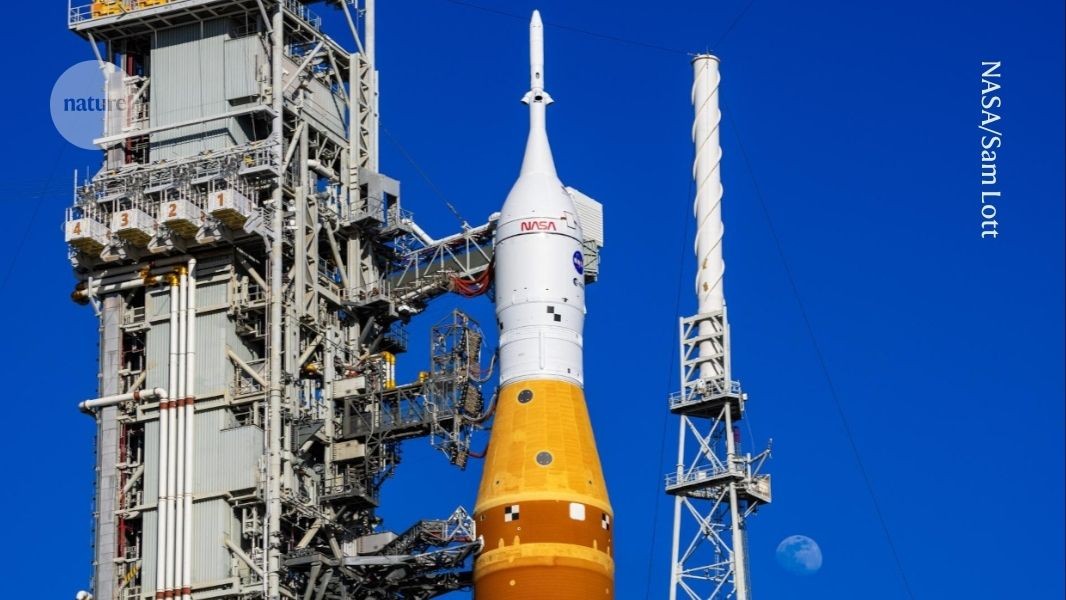

NASA’s Orion spacecraft positioned atop the Space Launch System rocket, ready for launch.Credit: NASA/Sam Lott
NASA’s Artemis II mission, which is scheduled for launch on 1 April, aims to send humans back to the Moon for the first time since 1972. If all goes to plan, the ten-day mission will see a crew of four astronauts fly by the Moon as soon as 6 April, and could set the record for the farthest a human has ever travelled from Earth.
The mission’s main goals are to test aspects of human space flight ahead of future, more complex missions. So far, however, Artemis II and its scientific projects, which range from geology to astronaut health, have yet to spark widespread enthusiasm among researchers. “A fly-by makes sense to demonstrate the systems before attempting a landing,” says Marc Norman, a planetary geochemist at the Australian National University in Canberra. But he says he is “not especially excited at this stage”. “Maybe my excitement level will increase as the program evolves,” he adds.
Human space flight is a major focus for US President Donald Trump’s administration, which has sought to accelerate some projects, including an effort to send astronauts to Mars, while also making cuts to NASA’s space science and robotic missions. Earlier this year, the agency announced an ambitious goal of landing astronauts on the Moon in 2028, and starting to build a permanent lunar base soon after that.
Ahead of Artemis’s launch, Nature asked researchers worldwide for their views on the upcoming mission, and why they will — or won’t — be watching the lunar fly-by.
The good
“On the science side, this is one of the first steps in a very long-term plan to get a human base on the Moon,” says Catherine Heymans, Astronomer Royal for Scotland in Edinburgh, UK. “The science that will be facilitated by making that happen is very exciting.” Although the mission will produce some research results, its greatest value for now will be in inspiring young people about science, and in showing — by including a Black man, Victor Glover, and a woman, Christina Koch, among the crew — that “space is for everyone”, she adds.
John Womersley, a former chief executive of the UK Science and Technology Facilities Council who is now at the University of Edinburgh, says that scientists, like the general public, have a wide range of opinions about Artemis II and crewed space exploration in general. “Among my colleagues now, though, there is some genuine admiration for the fact that NASA is actually trying to do something ambitious in space once more, and going beyond low Earth orbit.”
Jevin West, a computational social scientist at the University of Washington in Seattle, agrees. “In times like this, these are the things that can give us a reprieve,” he says.
The bad
David Blanchflower, an independent astronomer and astrophotographer, is also excited about the mission. His name will even be among the millions to be carried aboard the Orion spacecraft on a digital memory device, as part of NASA’s Send your name around the Moon programme. But when posting about the mission on social media, he says he’s often met with negative comments.
“People who reply generally either don’t care, or expect it to fail,” says Blanchflower, who is based in Newcastle upon Tyne, UK. Some have lost enthusiasm because the mission being promised and delayed for so long, he adds. “I believe if it was a landing there would be considerably more excitement.”
Others say they find it hard to rejoice, given the political context and the state of science funding in the United States. “I generally cheer on any science in space — it’s awe-inspiring stuff! — but at this moment, it is impossible to feel good about the direction NASA is taking under the Trump administration,” says Yarrow Axford, a palaeoclimatologist and science communicator based in Lexington, Massachusetts. Alongside a shift in focus towards human spaceflight, the agency has seen proposed cuts to science budgets, the cancellation of missions and internal layoffs. “Leading scientists have been leaving NASA, along with other federal science agencies, in droves,” says Axford.
Internationally, people might be getting a little tired of hearing about how these missions are the “‘biggest, best and greatest of all time’, when they are basically just doing what they did already in 1968”, says Norman. Although he says that he sees no particular antipathy towards Artemis, or NASA.

