


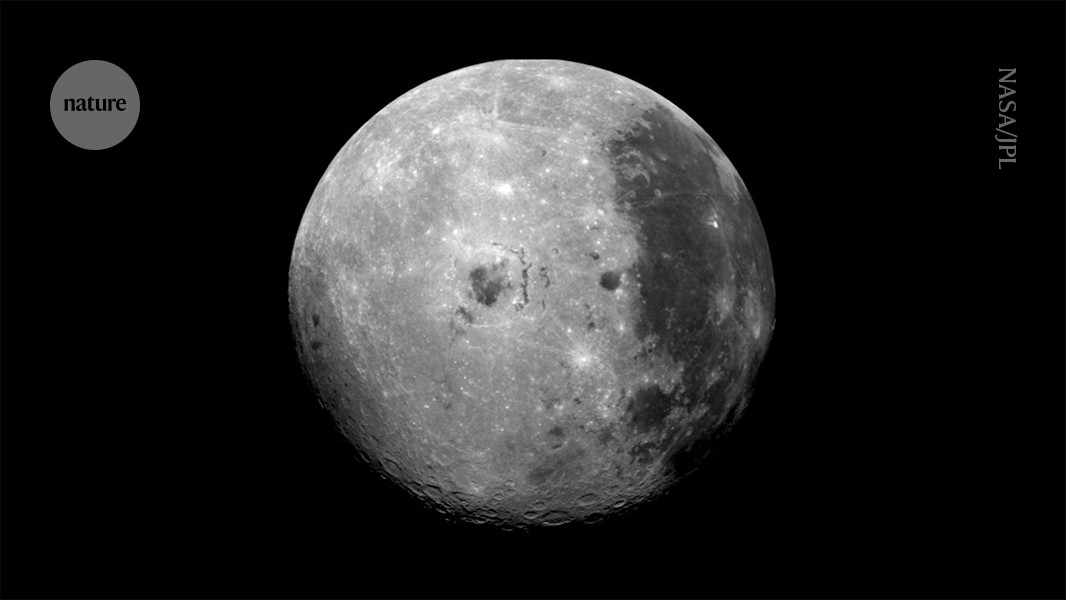

The astronauts on NASA’s Artemis II mission will see more of the Moon’s far side by eye than any human has before.Credit: NASA/JPL
If all goes to plan, as soon as tomorrow, NASA will launch four people on a journey around the Moon. The mission, known as Artemis II, would be the first time humans have left Earth’s protective environment and travelled into deep space since the US Apollo programme, which ended more than half a century ago. And it could carry its astronauts farther from Earth than any humans have ever travelled.
Artemis II is one in a series of missions that ultimately aim to build humanity’s first permanent base on the Moon. This mission is supposed to test the rocket, crew capsule and other space-flight hardware that NASA wants to use to land humans on the lunar surface in the coming years. During their nearly ten-day journey to the Moon and back, astronauts plan to run experiments that will set the stage for future explorers.
“What we’re trying to do is not pick up where Apollo left off, but to use our decades of experience and knowledge and planning to do this sustainable presence on the Moon — and then to do science alongside of that,” says Barbara Cohen, a planetary scientist at NASA’s Goddard Space Flight Center in Greenbelt, Maryland.

The four Artemis II astronauts did a dress rehearsal in December for what will happen on launch day. Clockwise from front left are pilot Victor Glover, mission specialist Jeremy Hansen, mission specialist Christina Koch and commander Reid Wiseman.Credit: Gregg Newton/AFP via Getty
Some of the key experiments that will be conducted during the Artemis II mission will explore how deep-space travel affects human health. Other research will rely on the astronauts’ ability to see geological features on parts of the Moon that have never been viewed by human eyes.
Cohen says the science findings from Artemis II will be fundamentally different from discoveries made previously by robots exploring the Solar System. “The amazing part of having crews is they have brains and eyes, and the capacity for thought and reaction,” so that they can “take the path of knowledge that is best for science”, she says.
The four astronauts who will fly aboard Artemis II have been through extensive science training, including field trips to sites in Canada and Iceland that are similar to the Moon’s otherworldly surface. One of the crew, Christina Koch, built space-science instruments before becoming an astronaut and has worked as a scientific field engineer in Antarctica and Greenland. Another, Canadian astronaut Jeremy Hansen, has a master’s degree in physics and worked in the underwater Aquarius laboratory off the coast of Florida.
“We’re excited about what the astronauts find interesting and what pulls their focus,” says Nicola Fox, head of NASA’s science mission directorate in Washington DC. “That is an incredible opportunity.”
Cells in space
One big focus for Artemis II will be to study how deep space affects human health. Studies of astronauts on short-duration space flights or in low Earth orbit on space stations have shown that space travel can raise the risk of cancer and induce vision problems, among other issues. Even the private space mission Inspiration4, which launched in 2021 and carried a crew led by Jared Isaacman — who is now the head of NASA — discovered health changes in the short, three-day spaceflight. The crew’s telomeres1, which are the protective ends of chromosomes, changed lengths.
But the Artemis II crew will be the first humans to expose their bodies to the deep-space radiation outside of Earth’s protective magnetic field since the final Apollo mission ended in 1972. Radiation sensors placed throughout their capsule’s cabin will measure exposure during the flight. And the astronauts will give saliva and blood samples before and after the mission, which researchers will check for alterations to the immune and other bodily systems.
But perhaps the most cutting-edge human-health study that will be conducted during Artemis II is an ‘organ on a chip’ experiment. For this, researchers asked each of the astronauts to donate platelets from blood before the space flight. From those donations, scientists extracted, isolated and froze immature bone marrow cells, which naturally circulate in people’s bloodstreams. Just before launch, the researchers plan to thaw and place the cells onto two chips, about the size of a USB drive, for each astronaut. One chip will fly aboard Artemis II, and the other will remain on Earth for the mission’s duration.

Researchers will place cells from each Artemis II astronaut onto an ‘organ on a chip’ to test their reaction to deep-space radiation during the flight.Credit: Emulate/NASA
Once the flight is over, researchers will compare both chips for each crew member to see if the cells that flew in space experienced more DNA damage, changes to telomere length or other signs of alteration owing to space flight2. That information can then be linked back to the particular astronaut and their health. “It’s the first time this has been done, and it’s all being done outside of low Earth orbit,” says biomedical scientist David Chou, the principal investigator for the organ-on-a-chip experiment at biotechnology company Emulate in Boston, Massachusetts.
If successful, such chips could help to protect astronauts in the future: NASA could simply fly chips containing cells from a potential astronaut into deep space to understand what might happen to them if they took such a journey.

