


You have full access to this article via your institution.
Hello Nature readers, would you like to get this Briefing in your inbox free every day? Sign up here.

Female sperm whales (Physeter macrocephalus) gather to lift a newborn calf above the water as dolphins look on nearby. (Aluma, Y., Baron, Z., Barrett, R. et al./Sci Rep)
Researchers studying sperm whale sounds were in the right place at the right time when they happened to observe a calf being born. With underwater microphones and drone cameras running, the team observed related and unrelated females working together to support the labour and keep the newborn safely at the surface. Whale births are very rarely seen, and this is the first time that such ‘assisted births’ have ever been seen in a non-primate species.
Reference: Science paper & Scientific Reports paper
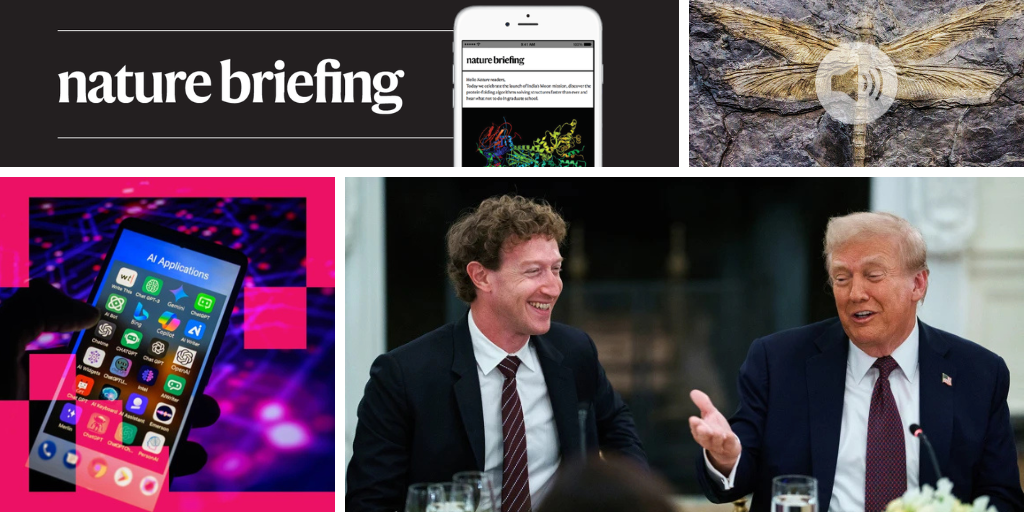
Receiving excessive approval from artificial intelligence chatbots could encourage people to be ruder to others. Researchers found that people who received highly flattering feedback from AI systems tended to be more certain of their own correctness during social conflicts and were less likely to apologize than were participants who interacted with less-affirming bots. People also rated fawning bots as more trustworthy than those that took a tougher stance, which encourages sycophancy in chatbots even when the effects could be harmful, the authors say.
Features & opinion
To rise to science superpower, China has poured vast amounts of money into research and technology over the past decade. But for the finances required to translate their cutting-edge findings into the tech of tomorrow, the nation’s government is looking to the private sector and an emerging breed of tech philanthropists. Companies such as Tencent, the firm behind China’s ubiquitous messaging app WeChat, and the phone manufacturer Xiaomi are among those that have already heeded the call — generosity that experts say could earn them political favour.
Everyday necessities come at a more personal cost than they used to in the latest short story for Nature’s Futures series.
Andrew Robinson’s pick of the top five science books to read this week includes the story of one experimental physicist’s fascination with plant intelligence and an illustrated guide to ‘the art and science of space exploration’.
The surfeit of oxygen in the late Palaeozoic might not have been why insects in those times got so huge — and why they’re (thankfully) much smaller now. “Part of my PhD work required me to build little flight chambers and fly locusts in order to measure their flight metabolic rate,” experimental physiologist Ned Snelling tells the Nature Podcast. It “suggested to me that oxygen supply is not really a big challenge for insects”. Snelling and his colleagues looked at the smallest sections of an insect’s respiratory system, known as tracheoles, and found that they don’t develop in a way that implies that oxygen is a limiting factor for body size.
Nature Podcast | 23 min listen
Subscribe to the Nature Podcast on Apple Podcasts, Spotify or YouTube Music, or use the RSS feed.
Today Leif Penguinson is relaxing at Terjit, an oasis in the Sahara Desert region of Mauritania. Can you find the penguin?
The answer will be in Monday’s e-mail, all thanks to Briefing photo editor and penguin wrangler Tom Houghton.
This newsletter is always evolving — tell us what you think! Please send your feedback to [email protected].
Thanks for reading,
Flora Graham, senior editor, Nature Briefing
With contributions by Jacob Smith
• Nature Briefing: Careers — insights, advice and award-winning journalism to help you optimize your working life
• Nature Briefing: Microbiology — the most abundant living entities on our planet — microorganisms — and the role they play in health, the environment and food systems
• Nature Briefing: Anthropocene — climate change, biodiversity, sustainability and geoengineering
• Nature Briefing: AI & Robotics — 100% written by humans, of course
• Nature Briefing: Cancer — a weekly newsletter written with cancer researchers in mind
• Nature Briefing: Translational Research — covers biotechnology, drug discovery and pharma


