


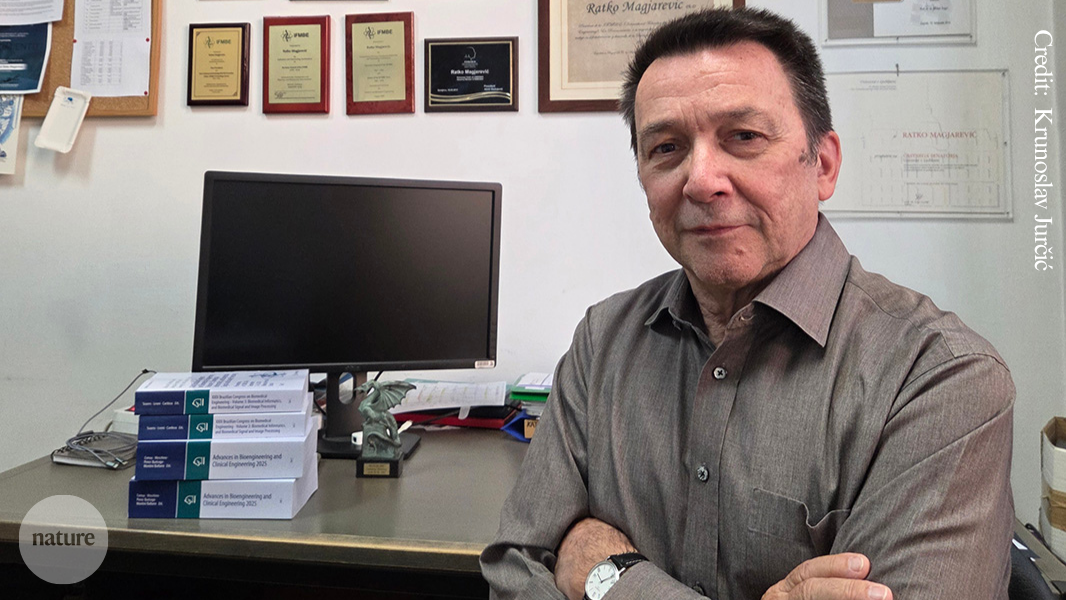

Ratko Magjarević was president of the International Federation for Medical and Biological Engineering for two terms and has been globally recognized for his contributions to the field of biomedical engineering.Credit: Krunoslav Jurčić
The first scientific society, named Accademia dei Lincei after the European lynx (Lynx lynx), was established in Rome in 1603. In the following years, similar societies were founded across much of Renaissance Europe, including the Royal Society in London, which continues to wield substantial global influence today. Now, most scientific societies are organizations of researchers, run by volunteers, that promote and advance scientific knowledge in their field of interest. They provide a structured platform through which researchers can network, share their research findings and collaborate with each other.
But modern scientific societies are under threat. Because many rely on membership fees and journal subscriptions to raise money, they are especially vulnerable to the increasing proportion of networking that is done virtually, without the need for a facilitator, and the push for research to be published through an open-access model. Both of these trends were accelerated by the COVID-19 pandemic. A survey of 66 societies found that most are unable to sustain their charitable activities, such as public outreach, with their publishing revenue alone.
Ratko Magjarević, an electrical engineer at the University of Zagreb in Croatia, served two terms as president of the International Federation for Medical and Biological Engineering (IFMBE) in 2012–15 and 2022–25. The IFMBE has an estimated 120,000 members from more than 80 affiliated organizations. As a result of his society work to enhance international scientific partnerships, Magjarević was recognized by the Senate of Colombia for his global contribution to the development of biomedical engineering in 2014 and was awarded a distinguished service award by the IFMBE last year. Magjarević spoke to Nature about how to run a scientific society in a way that provides networking and publicity opportunities for scientists.
What was your first experience with a scientific society?
As a graduate student in the 1980s, meeting in person was the only way to network. In 1991, Croatia declared independence from Yugoslavia, and to be visible as a researcher who did not come from the United States or western Europe, but instead from a country with fewer resources and a less-established scientific community, I needed a platform to let scientists from other universities know about my work.
The first scientific society I joined was the Croatian Biomedical Engineering and Medical Physics Society (abbreviated in Croatian as HDBIMF). I was just finishing my PhD studies in electrical engineering at the University of Zagreb.
Joining the HDBIMF allowed me to interact frequently with members of the society from diverse academic backgrounds who I wouldn’t normally come across as an engineer, including physicians and physicists. The society provided networking opportunities through seminars, retreats and annual meetings. As an early-career researcher, the interactions that these events facilitated helped me to build influence in my field.
They allowed me to find some early interdisciplinarity in my research as well. I was invited to participate in several projects that focused on electrically stimulating people’s skin and muscles for pain relief and to improve rehabilitation outcomes after injury, as well as to activate the heart muscles.
What are the benefits of joining scientific societies?
Joining a scientific society has a few benefits. By participating, researchers can interact with other scientists earlier in their career and more easily than if they had to build their own community from scratch.
Societies make it possible for scientists to exchange information through presentations, meetings and publications. Organizations such as the IFMBE consist of members in various jobs and fields. Moreover, attending IFMBE events allows researchers to discover the perspectives of diverse stakeholders, such as clinicians and regulators. Meeting these people is helpful for establishing industrial standards and regulations and for translational research. The connections established in a society build trust: you’re members of the same club and this paves the way for collaborations.

How to know whether a conference is right for you
Another benefit of joining a society is the opportunity to build professional networks and gain recognition for your work. This is especially important for early-career scientists who want to establish high-quality networks as early as they can. These researchers can gain professional recognition by participating in early-career competitions that are only open to society members. Society awards are also highly regarded by universities when evaluating candidates for tenure and promotion.
For senior scientists, a wide-reaching network can help to tackle transnational problems. During the COVID-19 pandemic, IFMBE members came together to share knowledge on deploying health-monitoring devices and several tools for detecting the coronavirus SARS-CoV-2 in the environment and human body. We even connected researchers with each other so that they could share specialized materials and equipment needed for their experiments. Increasingly, many nations are rolling out international grants, and scientists who have extensive networks thanks to society membership have a competitive edge when applying for them.
Finally, it’s helpful to have a representative organization to advocate for the shared interests of its members. One scientist is unlikely to be able to reform funding mechanisms or effectively rebut a conspiracy theory alone. A union of researchers wields more power and stands a much better chance of effecting positive change.
How can societies maintain momentum and grow their membership?
Large international societies such as the IFMBE rely on the commitment of a large group of professionals. The IFMBE leadership positions are held by elected representatives for three-year terms. The institution’s policies and goals are determined by the general assembly, which is made up of a number of delegates from each affiliated biomedical engineering society. It’s a robust democratic process.

I spent two years organizing an international conference. How do I get compensated for my work?

