


You have full access to this article via your institution.
Hello Nature readers, would you like to get this Briefing in your inbox free every day? Sign up here.

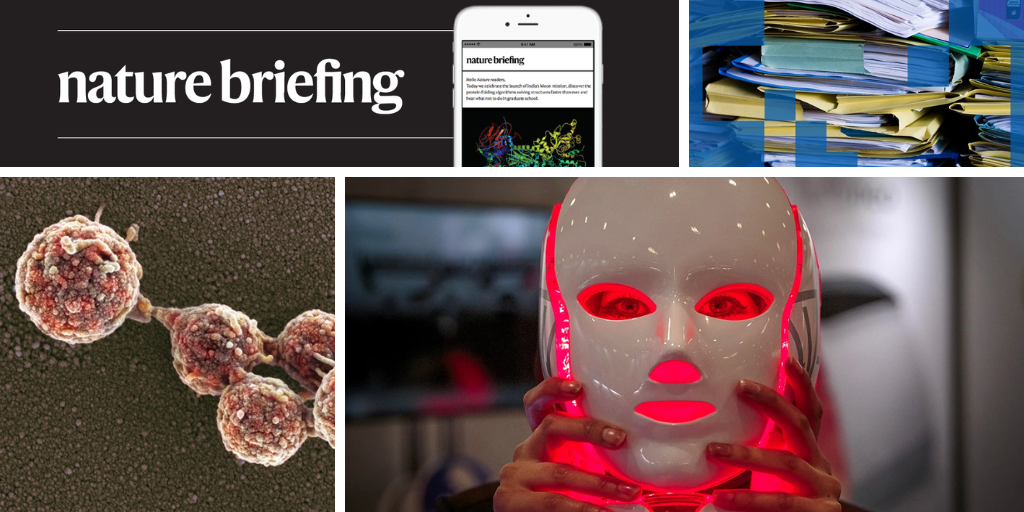
These Mycoplasma capricolum bacterial cells have absorbed a genome engineered from a closely related bacterium, Mycoplasma mycoides.Credit: Thomas Deerinck, NCMIR/Science Photo Library
Researchers have resurrected ‘dead’ bacterial cells by replacing their defunct DNA with the working genome of another species. The functionally dead Mycoplasma capricolum received engineered genomes from the closely-related Mycoplasma mycoides. If researchers can routinely make zombies from more diverse bacteria, the technique could open the door to re-engineered microbial life imbued with useful properties, such as the ability to make drugs or biofuels. For instance, it could help transform a laboratory staple, such as Escherichia coli, into “a general-purpose platform for synthetic biology”, suggests synthetic biologist Olivier Borkowski.
Reference: bioRxiv preprint (not peer reviewed)
After 20 years and more than 30,000 cloning attempts, researchers have found the limit on the number of times that a single mouse can be serially re-cloned — their attempts failed after 58 generations. The cloned mice looked normal and lived as long as normal mice, but accumulated mutations at an unusually high rate, which could be why attempts to clone them were eventually unsuccessful, the team says. The findings suggest that asexual reproduction is ultimately unsustainable for mice, and potentially for other mammals, too.
Reference: Nature Communications paper
A major artificial-intelligence conference has rejected 497 papers whose authors used AI in their peer reviews of other articles submitted to the meeting. Organizers of the International Conference on Machine Learning hid watermarks in the research papers they distributed for review that would prompt large language models (LLMs) to include telltale phrases in review text. If an author was found to have used an LLM in their review, the paper they submitted was rejected. The organizers hope to “remind the community that as our field changes rapidly, the thing we must protect most actively is our trust in each other,” they said in a blog post.
Researchers have discovered that sperm stored in the male body deteriorates rapidly — which could be significant news for people who are trying to conceive. A meta-analysis of hundreds of studies in humans and animals found that sperm that is just hanging around showed increased DNA damage and oxidative stress, along with reduced sperm motility and viability, compared to freshly made semen. Guidelines typically recommend a few days of abstinence before men provide sperm for assisted reproduction, but these rules tend to be based on quantity, not quality. “A balance … needs to be struck,” says biologist and study co-author Krish Sanghvi.
Reference: Proceedings of the Royal Society B Biological Sciences paper
Features & opinion

Not all at-home red-light devices have been thoroughly, independently tested, researchers say.Credit: Guy Corbishley/Alamy
Evidence is building that red light can help conditions as diverse as hair loss, macular degeneration and mouth ulcers. And there have been striking early results in animal models of psychiatric and neurological diseases. What’s still unclear is how it works. Some scientists suggest that it’s linked to the fact that people are exposed to less natural red light than ever before. “We’re literally being starved of something that, biologically, we’ve evolved to receive,” says dermatologist David Ozog. Evolutionary biologist Elke Buschbeck’s advice is: go outside.

Source: K. M. Zielinska-Dabkowska/Asensetek Lighting Passport Pro Standard Spectrometer
With DNA-containing fossils few and far between, researchers are exploring a more-accessible source of ancient genetic material: dirt. A flurry of new techniques has helped scientists recover animal and plant DNA from samples of permafrost as old as two million years, and sedimentary DNA has also proven a boon in the study of ancient humans such as the mysterious Denisovans. But some researchers question whether enough care is being taken to ensure the results are reliable, and urge the colleagues to work closely with Indigenous groups to avoid deliberately disturbing culturally important sites.
The conflict between the United States, Israel and Iran has made longstanding problems with the global energy landscape impossible to ignore, writes political economist Aisha Al-Sahiri. And it’s not just about petrol prices. “Gulf states account for roughly 35% of global fertilizer production, extract one-third of the world’s helium and make almost half of its sulfur,” notes Al-Sahiri. She calls for the oil and gas industry to diversify trade routes and strengthen supply chains while we expand the renewable-energy capacity that is key to long-term economic and geopolitical resilience.
Today I’m getting warmed up for the Artemis II mission to orbit the Moon — starting with the free printable flight map designed by astronomy educator Trevor Kjorlien. It’s up on the Nature office wall to remind me of every step along the way on the 10-day mission, which — if all goes well — will launch in early April. Next, I’ll be installing the NASA app to track the Orion capsule in real time.
How are you feeling about efforts to take people back to the Moon for the first time since Apollo? Let me know — plus any feedback on this newsletter — at [email protected].
Thanks for reading,
Flora Graham, senior editor, Nature Briefing
With contributions by Jacob Smith
• Nature Briefing: Careers — insights, advice and award-winning journalism to help you optimize your working life
• Nature Briefing: Microbiology — the most abundant living entities on our planet — microorganisms — and the role they play in health, the environment and food systems
• Nature Briefing: Anthropocene — climate change, biodiversity, sustainability and geoengineering
• Nature Briefing: AI & Robotics — 100% written by humans, of course
• Nature Briefing: Cancer — a weekly newsletter written with cancer researchers in mind
• Nature Briefing: Translational Research — covers biotechnology, drug discovery and pharma

