


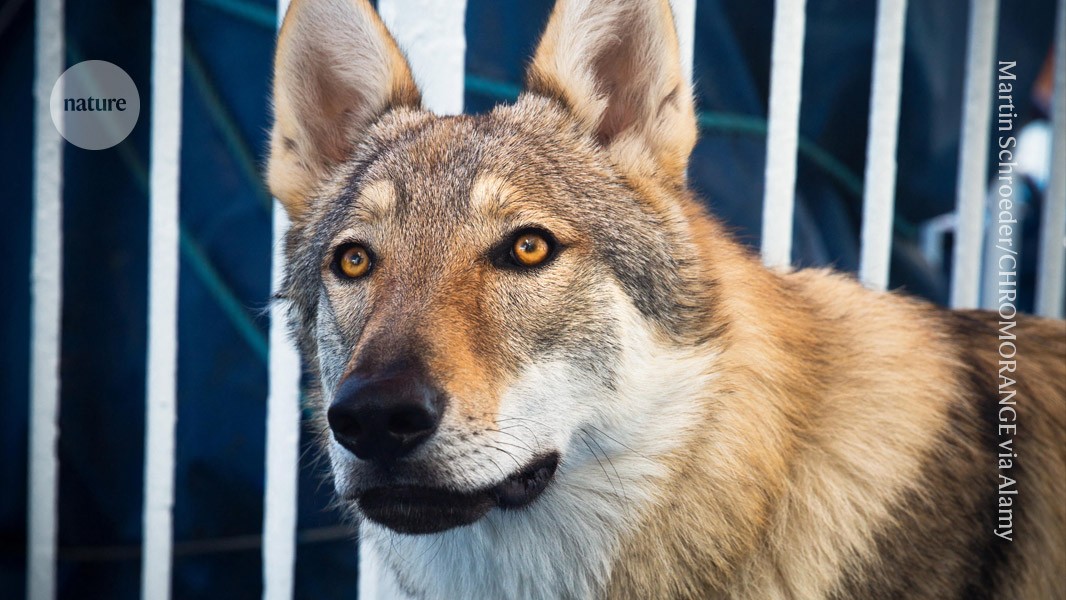

Dogs (Canis lupus familiaris) were domesticated from grey wolves (Canis lupus) at least 14,200 years ago, towards the end of the last ice age.Credit: Martin Schroeder/CHROMORANGE via Alamy
Dogs were early man’s best friend. A pair of Nature papers published today have identified the oldest dog genomes on record in remains from archaeological sites spanning Europe and the Middle East1,2.
The remains, from the United Kingdom, Switzerland and Turkey, are 14,000 to 16,000 years old and push the genetic record for dogs back by more than 5,000 years. They also identify an early domestic dog population (Canis lupus familiaris) that spanned Western Eurasia and was kept by diverse human hunter-gatherer groups. The animals’ genetic signature is still present in dogs today.
The studies do not pinpoint where, when and why dogs were first domesticated by humans, but some researchers say they narrow down the search. The studies also show that dogs were exported and exchanged by various human groups, underlying dogs’ importance to early communities with different ways of living.
“Every time people move, they take their dogs with them,” says Lachie Scarsbrook, an evolutionary geneticist at the Ludwig Maximilian University (LMU) of Munich in Germany, and a co-author of one study. “We call it the Swiss army dog. They can adapt to all these cultural roles.”
Social animals
Humans domesticated dogs from an ice-age population of grey wolves (Canis lupus). But despite decades of intense archaeological and genetic study, scientists still don’t know when or where, let alone why, this occurred.
Part of the challenge has been discerning domestic dogs from wolves when the remains are often fragmentary: bones as old as 30,000 years had been linked to domestic dogs on the basis of their shape, only for DNA sequencing to confirm them as being those of wolves. Before the latest studies, the oldest dog DNA came from fossils nearly 11,000 years old, from northwest Russia3.
To push this record back further, a team led by researchers at the LMU and the Natural History Museum (NHM) in London generated genome sequences from suspected dog remains from Gough’s Cave, in Cheddar Gorge in southwest England, and highly fragmented bone — resembling freeze-dried coffee, says Scarsbrook — from a Turkish site called Pınarbaşı.
Sequencing confirmed that the sample from Pınarbaşı, dated to 15,800 years ago and determined to be from a female puppy on the basis of teeth, and the 14,300-year-old Gough’s Cave remains were clearly those of domestic dogs. The genomes were remarkably similar, pointing to the rapid spread of domestic dogs across Europe and western Asia, the researchers say.
Although the humans associated with these two early dogs were both groups of ice-age hunter-gatherers, they were strikingly different, says co-author William Marsh, a palaeogeneticist at the NHM. At Pınarbaşı, humans also depended on fishing and small birds, whereas the humans at Gough’s Cave would have been terrestrial hunters.
Despite these differences, both groups treated the remains of their dogs as they did human remains. The skull of the Gough’s cave dog contained decorative perforations, not dissimilar to the modifications made to human skulls at the site, which are thought to be associated with ritual cannibalism. In Pınarbaşı, dog remains were intentionally buried atop deceased humans. Isotopic evidence suggests that the dogs at both sites ate the same foods as humans. “Four thousand kilometres apart, we see these dogs being treated in very similar ways,” Marsh says.

Researchers analyzed genomic data from 14,300-year-old dog jawbones (Canis lupus familiaris) to trace their ancestry from grey wolves (Canis lupus).Credit: Trustees of the Natural History Museum
Asian origins?
The second team, led by researchers at the Francis Crick Institute in London, identified another very early dog after screening hundreds of suspected dog and wolf remains. Using a technique that has supercharged ancient human genomics, in which ancient DNA is ‘captured’ among microbial contaminants, the researchers were able to discern dog from wolf in more than 130 samples. They identified 14 dogs that lived among hunter-gatherers in Europe, including a 14,200-year-old sample from a Swiss site called Kesslerloch.

