


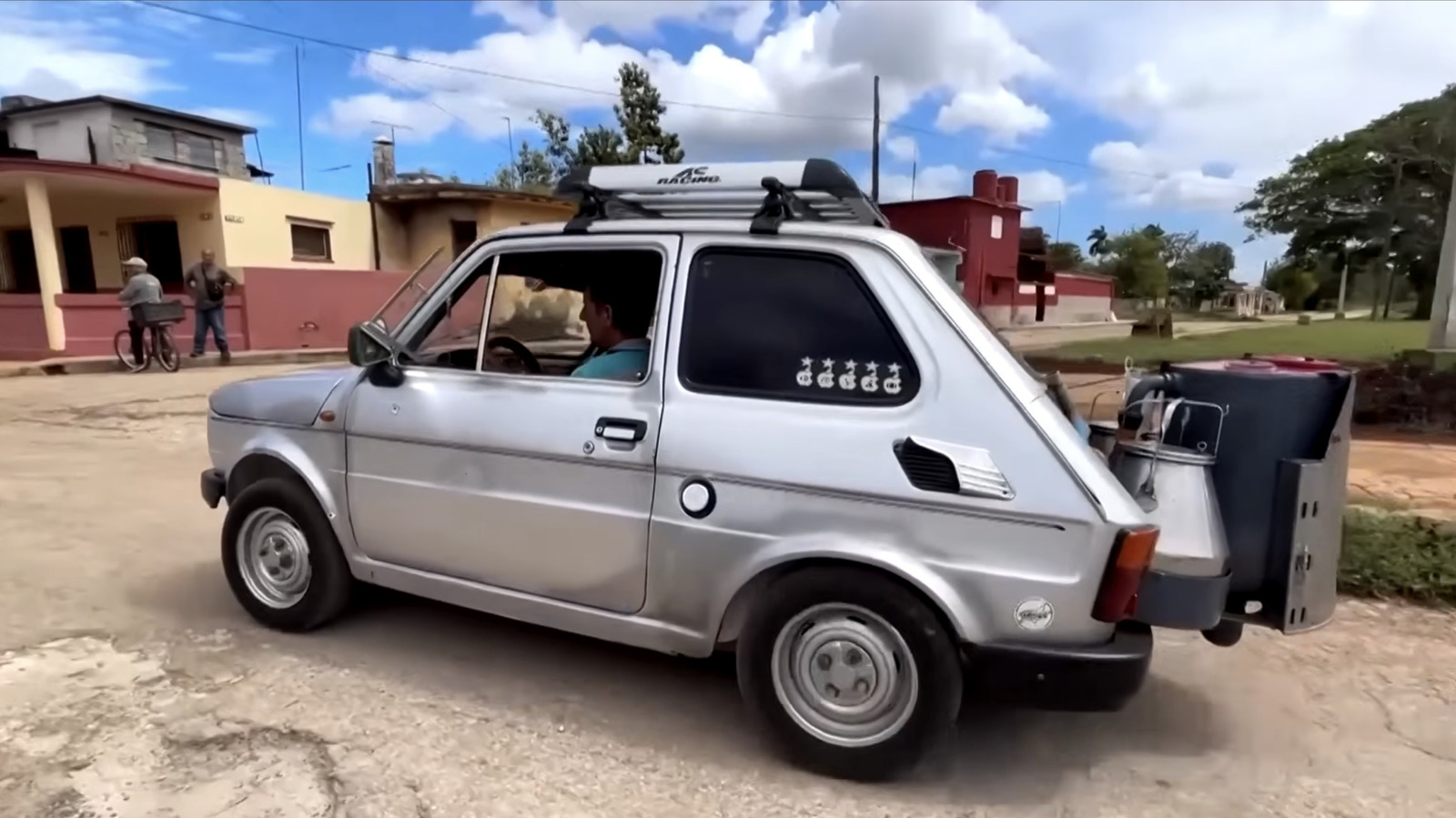
The lights went out across Cuba only a few months after the U.S. imposed an oil blockade, cutting the island nation off from precious fuel supplies. But Cubans have decades of experience keeping their cars on the road through unconventional means, and one man has managed to keep his car going, despite the lack of gasoline, by converting it to run on charcoal instead, reports Reuters.
Juan Carlos Pino did the gasoline-to-charcoal conversion on his 1980 Polski Fiat, which was basically a Fiat 126 built behind the Iron Curtain under license in Poland. He removed the engine lid (conveniently, in the back) and added his own homemade creation that enables him to run it off charcoal rather than gasoline. It looks kind of like Doc Brown’s DeLorean equipped with a Mr. Fusion, if Doc was from Cuba, drove a Polski Fiat, and the car didn’t need 1.21 gigawatts of power.
Rather than obtaining parts from the future, Pino built the entire contraption himself. An old propane tank is now the chamber where the charcoal burns, sealed shut with the lid off a power transformer. A filter between this and the engine is made of a stainless steel milk jug with old clothes inside as the filter element. It’s simple, yet effective. One of Pino’s early test runs covered 53 miles while hitting a top speed of 43 mph, which certainly beats the alternative of going nowhere fast without gas.
How does it work?
Pino credits his uncle and the website Drive On Waste for his inspiration, and designed his contraption based on plans available there. Charcoal comes in many forms but is typically a solid fuel, while gasoline is a liquid. Naturally, the process of running a car on charcoal involves turning it into a gas instead of a solid or liquid. Not gas as in gasoline, but carbon monoxide gas, which is dangerous and deadly.
The charcoal burns inside the main chamber, generating and collecting the “chargas,” which is a nicer name for the carbon monoxide that would kill if the system leaked. A blower moves the gas through a cooling chamber and filter into the carburetor. It combines the chargas and air as it normally does with gasoline vapor into a mixture that burns inside the engine. Once the engine is running, the blower can be turned off, as the engine itself becomes the pump that keeps the chargas flowing into it.
This may seem like a novel concept, but the idea isn’t new at all. Nature published an article about it all the way back in 1934, pointing out that, “In those countries where imported oil supplies are likely to be interrupted in wartime, automobiles using charcoal fuel would have advantages.” It did turn out to be popular in Europe during World War II, and the concept of burning wood or coal to create a fuel gas goes back even farther than that. It’s hardly what we would call safe, but desperate times, such as Cuba is suffering these days, call for desperate measures.

