


You have full access to this article via your institution.
Hello Nature readers, would you like to get this Briefing in your inbox free every day? Sign up here.

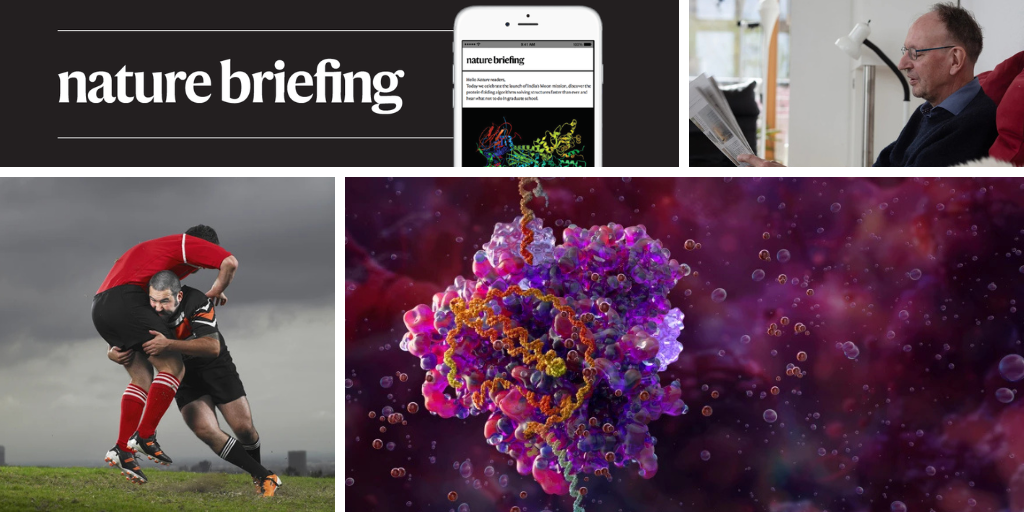
Repeated blows to the head over years of contact sports can lead to chronic brain damage.Credit: Blake Little/Getty
Repeated blows to the head from playing a contact sport can cause damage to the blood–brain barrier — a dense layer of cells that keeps harmful substances out of the brain — that can be observed decades after an athlete retires. The damage makes the barrier leaky, which seems to trigger a long-lasting immune response that is closely tied to cognitive decline. The findings could explain why athletes who play sports such as rugby often experience severe memory loss and dementia later in life.
Reference: Science Translational Medicine paper
Using the CRISPR–Cas9 gene-editing tool, researchers have developed a method to safely engineer cancer-fighting immune cells — called chimeric antigen receptor (CAR) T cells — inside a mouse’s body. The method uses a combination of virus-like particles to carry RNA and CRISPR–Cas9 machinery to T cells, and an engineered virus to deliver DNA that contains the CAR-encoding gene. A T cell had to receive both payloads to become a CAR T cell, lowering the risk of off-target effects. Reprogramming T cells inside the body would be quicker than removing and re-injecting them, which is how CAR-T-cell therapies are currently made.
Number theorist Gerd Faltings has won the 2026 Abel Prize, one of the most prestigious awards in mathematics. Faltings was awarded the prize for work that proved central results in the theory of algebraic equations that link whole numbers together. His proof confirmed a 1922 conjecture that states that equations called Diophantine equations can have at most a finite set of solutions, except in special cases. “It’s a nice sign of appreciation to get this prize,” Faltings says. “In mathematics, it’s clear what’s true and what is wrong. And I like this.”
A newly described species of ‘magic mushroom’ could upend a popular theory of when psychedelic fungi popped up around the world. Researchers had thought that the magic mushrooms that grow in southern Africa were Psilocybe cubensis, the same species that grows in the Americas. However, closer inspection revealed that the African mushrooms are a separate species, now named Psilocybe ochraceocentrata, and last shared a common ancestor with P. cubensis approximately 1.5 million years ago. These findings scupper the hypothesis that P. cubensis was inadvertently introduced to the Americas by 16th-century settlers, but the research offers no clues as to its origins across the Atlantic.
Reference: Proceedings of the Royal Society B paper
Pill versions of GLP-1 obesity drugs such as semaglutide (sold as Wegovy) are showing promise in clinical trials. But they don’t seem to have quite the same impact on body weight as do injectables. And it’s difficult to get the relatively large drug molecules through the digestive system intact. Some pharma companies are working on small-molecule alternatives, but it’s tempting to stick to what’s now a tried-and-tested treatment. For many, a weight-loss percentage in the double digits from a pill will be good enough.
Features & opinion
Static electricity is the scourge of the laundry room and the enemy of electronics — and might have played a part in zapping the first life on Earth into action. But much of how it happens is still a mystery. Now, researchers are turning to carefully controlled experiments to find the answers. A team has shown that materials ‘remember’ past contacts with each other — in which they get smoothed on the nanometre scale — and this determines how electric charge is transferred in future contacts. And carbon-carrying surface molecules seem to play a role in guiding which way charge is exchanged. “I’m not sure we’re making things simpler,” says experimental physicist Scott Waitukaitis. “But we’re doing what is necessary to make sense of this.”
Reference: Nature paper 1 & paper 2
A 14-day global weather forecast can be produced by an AI-powered system two hours faster than by a physics-based one. But there’s a catch: as yet, scientists do not know how reliable AI-based predictions are when it comes to rare, extreme weather events such as heatwaves or major storms. Because AI systems are trained on historical data, they could falter when confronted with events that differ radically from anything they have seen previously. Before adopting AI in meteorology, there first need to be clear standards and agreed datasets for testing how well these models handle out-of-sample extreme events, argue physicists Shruti Nath and Tim Palmer.
Today I’ve been tickled pink by this colourful cricket (Arota festae). Scientists once thought that this hot pink hue was the result of a genetic abnormality, but new research suggests that it’s just a natural phase of their development. The colour fades to a paler pink after some time, and eventually to green. The team suggest that this pattern mimics the ‘red flushing’ of the leaves of some plant species in the crickets’ native home, helping them to camouflage.
Why not paint our inbox red (or pink) with your feedback on this newsletter? Please send any thoughts you have to [email protected].
Thanks for reading,
Jacob Smith, associate editor, Nature Briefing
With contributions by Flora Graham and Josh Axelrod
• Nature Briefing: Careers — insights, advice and award-winning journalism to help you optimize your working life
• Nature Briefing: Microbiology — the most abundant living entities on our planet — microorganisms — and the role they play in health, the environment and food systems
• Nature Briefing: Anthropocene — climate change, biodiversity, sustainability and geoengineering
• Nature Briefing: AI & Robotics — 100% written by humans, of course
• Nature Briefing: Cancer — a weekly newsletter written with cancer researchers in mind
• Nature Briefing: Translational Research — covers biotechnology, drug discovery and pharma

