


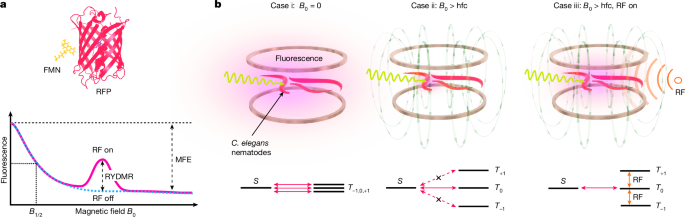
Kaptein, R. & Oosterhoff, J. L. Chemically induced dynamic nuclear polarization II: (relationwith anomalous ESR spectra). Chem. Phys. Lett. 4, 195–197 (1969).
Closs, G. L. Mechanism explaining nuclear spin polarizations in radical combination reactions. J. Am. Chem. Soc. 91, 4552–4554 (1969).
Hore, P. J. & Mouritsen, H. The radical-pair mechanism of magnetoreception. Annu. Rev. Biophys. 45, 299–344 (2016).
Bindels, D. S. et al. mScarlet: a bright monomeric red fluorescent protein for cellular imaging. Nat. Methods 14, 53–56 (2017).
Hayward, R. F. et al. Magnetic control of the brightness of fluorescent proteins. Zenodo https://doi.org/10.5281/zenodo.8137174 (2024).
Kubarev, S. J. & Pshenichnov, E. A. The effect of high frequency magnetic fields on the recombination of radicals. Chem. Phys. Lett. 28, 66–67 (1974).
Anisimov, O. A., Grigoryants, V. M., Molchanov, V. K. & Molin, Y. N. Optical detection of ESR absorption of short-lived ion-radical pairs produced in solution by ionizing radiation. Chem. Phys. Lett. 66, 265–268 (1979).
Steiner, U. E. & Ulrich, T. Magnetic field effects in chemical kinetics and related phenomena. Chem. Rev. 89, 51–147 (1989).
Hoff, A. J. Magnetic field effects on photosynthetic reactions. Q. Rev. Biophys. 14, 599–665 (1981).
Boxer, S. G., Chidsey, C. E. D. & Roelofs, M. G. Magnetic field effects on reaction yields in the solid state: an example from photosynthetic reaction centers. Annu. Rev. Phys. Chem. 34, 389–417 (1983).
Miura, T., Maeda, K. & Arai, T. Effect of Coulomb interaction on the dynamics of the radical pair in the system of flavin mononucleotide and hen egg-white lysozyme (HEWL) studied by a magnetic field effect. J. Phys. Chem. B 107, 6474–6478 (2003).
Evans, E. W. et al. Sensitive fluorescence-based detection of magnetic field effects in photoreactions of flavins. Phys. Chem. Chem. Phys. 17, 18456–18463 (2015).
Henbest, K. B. et al. Magnetic-field effect on the photoactivation reaction of Escherichia coli DNA photolyase. Proc. Natl Acad. Sci. USA 105, 14395–14399 (2008).
Xu, J. et al. Magnetic sensitivity of cryptochrome 4 from a migratory songbird. Nature 594, 535–540 (2021).
Bowman, M. K. et al. Magnetic resonance spectroscopy of the primary state, PF, of bacterial photosynthesis. Proc. Natl Acad. Sci. USA 78, 3305–3307 (1981).
Abrahams, G. et al. Quantum spin resonance in engineered proteins for multimodal sensing. Nature 649, 1172–1179 (2026).
Meng, K. et al. Optically detected and radio wave-controlled spin chemistry in cryptochrome. Preprint at https://doi.org/10.48550/arXiv.2504.16566 (2025).
Koptyug, A. V., Saik, V. O., Animisov, O. A. & Molin, Y. N. Spin-locking in concentration-narrowed OD ESR spectra. Chem. Phys. 138, 173–178 (1989).
Xiang, K. Μ. et al. Mechanism of giant magnetic field effect in a red fluorescent protein. J. Am. Chem. Soc. 147, 18088–18099 (2025).
Biswas, A., Elmatari, D., Rothman, J., LaMunyon, C. W. & Said, H. M. Identification and functional characterization of the Caenorhabditis elegans riboflavin transporters rft-1 and rft-2. PLoS One 8, e58190 (2013).
Kell, A., Ventura, N., Kahn, N. & Johnson, T. E. Activation of SKN-1 by novel kinases in Caenorhabditis elegans. Free Radic. Biol. Med. 43, 1560–1566 (2007).
Closs, G. L. & Doubleday, C. E. Determination of the average singlet-triplet splitting in biradicals by measurement of the magnetic field dependence of CIDNP. J. Am. Chem. Soc. 95, 2735–2736 (1973).
Mani, T. Molecular qubits based on photogenerated spin-correlated radical pairs for quantum sensing. Chem. Phys. Rev. 3, 021301 (2022).
Lee, H., Yang, N. & Cohen, A. E. Mapping nanomagnetic fields using a radical pair reaction. Nano Lett. 11, 5367–5372 (2011).
Feder, J. S. et al. A fluorescent-protein spin qubit. Nature 645, 73–79 (2025).
Zadeh-Haghighi, H. & Simon, C. Magnetic field effects in biology from the perspective of the radical pair mechanism. J. R. Soc. Interface 19, 20220325 (2022).
Hore, P. J. Spin chemistry in living systems. Natl Sci. Rev. 11, nwae126 (2024).
Pickett, M. A. et al. Separable mechanisms drive local and global polarity establishment in the Caenorhabditis elegans intestinal epithelium. Development 149, dev200325 (2022).
Shi, R. et al. Stochastic growth and selective stabilization generate stereotyped dendriticarbors. Preprint at bioRxiv https://doi.org/10.1101/2024.05.08.591205 (2024).
Ono, M. et al. L-band ESR spectrometer using a loop-gap resonator for in vivo analysis. Chem. Lett. 15, 491–494 (1986).
Hardy, W. N. & Whitehead, L. A. Split-ring resonator for use in magnetic resonance from 200–2000 MHz. Rev. Sci. Instrum. 52, 213–216 (1981).
Moehl, K. W., Lous, E. J. & Hoff, A. J. Low-power, low-field RYDMAR of the primary radical pair in photosynthesis. Chem. Phys. Lett. 121, 22–27 (1985).
Gintzon, E. L. Microwave Measurements (McGraw-Hill, 1957).
Freed, J. H., Leniart, D. S. & Hyde, J. S. Theory of saturation and double resonance effects in ESR Spectra. III. rf coherence and line shapes. J. Chem. Phys. 47, 2762–2773 (1967).
Taylor, J. R. An Introduction to Error Analysis: The Study of Uncertainties in Physical Measurements (University Science Books, 1997).
Burd, S. & Bagheri, N. Data for: “Spin-correlated radical pair dynamics controlled by magnetic resonance in a transgenic animal”. Zenodo https://doi.org/10.5281/zenodo.15321800 (2025).
El Mouridi, S. et al. Reliable CRISPR/Cas9 genome engineering in Caenorhabditis elegans using a single efficient sgRNA and an easily recognizable phenotype. G3 7, 1429–1437 (2017).
Silva-Garcia, C. G. et al. Single-copy knock-in loci for defined gene expression in Caenorhabditis elegans. G3 9, 2195–2198 (2019).
Brenner, S. The genetics of Caenorhabditis elegans. Genetics 77, 71–94 (1974).
Berger, P. D., Maurer, R. E. & Celli, G. B. in Experimental Design: With Application in Management, Engineering, and the Sciences 2nd edn, 1–19 (Springer, 2018).

