


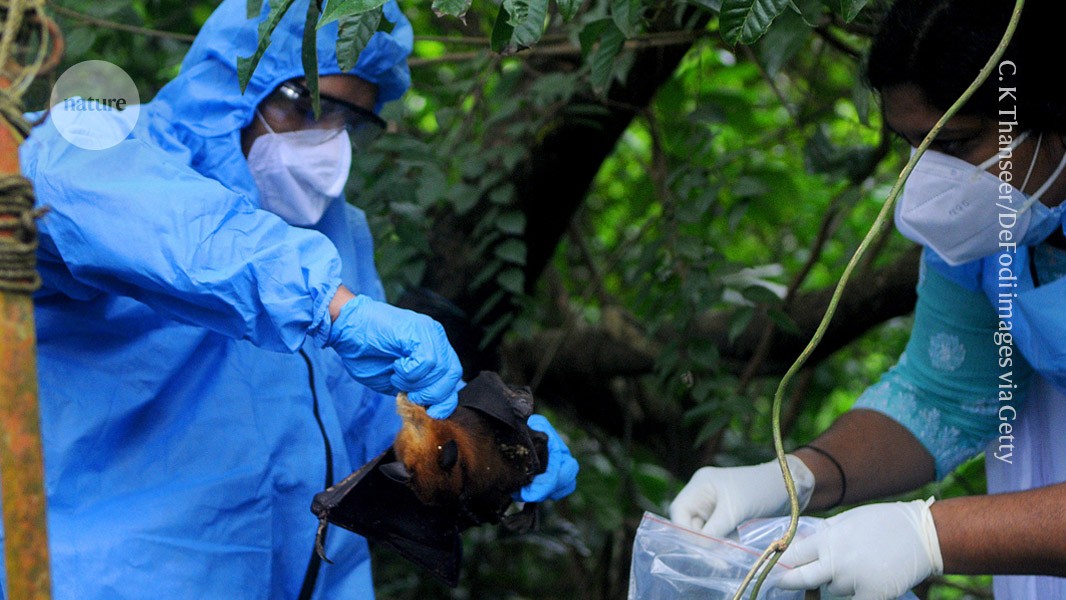

Fruit bats carry Nipah virus, which has infected people in India and several other countries.Credit: C. K Thanseer/DeFodi images via Getty
Mosquitoes that have been designed to carry vaccines in their saliva were used to inoculate bats against the rabies and Nipah viruses1. Scientists are investigating whether this technique could stop such viruses from ‘spilling over’ from bats to people. But other researchers are sceptical about whether the strategy could be implemented in the wild.
Bats carry a wide range of zoonotic viruses, often without becoming ill, acting as long-term reservoirs. Vaccinating bats could reduce the risk of these viruses infecting other animals, including people, but delivering vaccines to animals that roost in caves, form large colonies and travel long distances poses logistical challenges.
Nipah is a rare bat-borne virus that has infected people in several Asian countries. It has a fatality rate of up to 75% in people. Bats can also carry rabies, which is nearly 100% fatal in people once symptoms appear.
In a study published in Science Advances, researchers in China fed Aedes aegypti mosquitoes blood that contained either a vaccine against Nipah virus or the rabies virus. The viruses, contained in the vaccines, replicated inside the insects and reached their salivary glands, allowing them to pass on the vaccine when feeding on bats or when the bats ate the insects.
Laboratory experiments showed that mice and bats that were exposed to vaccine-carrying mosquitoes developed neutralizing antibodies against rabies. When the animals were exposed to the virus, they survived the infection.
Similar experiments showed that mice, hamsters and bats also developed antibodies against Nipah virus. Aihua Zheng, a co-author of the study and virologist at the Chinese Academy of Sciences in Beijing, says the team didn’t have access to a high-level biosecurity laboratory to conduct challenge trials on Nipah-vaccinated bats. Instead, they report that when hamsters had the similar levels of antibodies as vaccinated bats, the rodents were protected from succumbing to the virus.
Saline solutions
Fruit bats, or flying foxes, are the natural hosts of Nipah virus. But because these bats do not eat mosquitoes, the team designed saline drinking stations laced with the vaccine. Experiments in mice and bats showed that this vaccination route triggered neutralizing antibodies against rabies and Nipah virus.
Although the results are promising, researchers say the overall approach to vaccinate bats raises ethical and practical questions.

