


Salt Lakes: An Unnatural History Caroline Tracey W. W. Norton (2026)
More than 11,000 years ago, at the end of the last ice age, huge glaciers that shrouded the Sierra Nevada mountains in what is now the western United States began to melt rapidly. Vast quantities of water ran into a deep freshwater lake that once spanned 500 square kilometres, an area equivalent to almost half of Los Angeles in California. Over time, the water evaporated to form the smaller, brinier Owens Lake. Indigenous Paiute people call the Owens Valley Payahuunadü, ‘the land of the flowing water’.
Putting nature on the balance sheet: how to account for the ecological costs of our actions
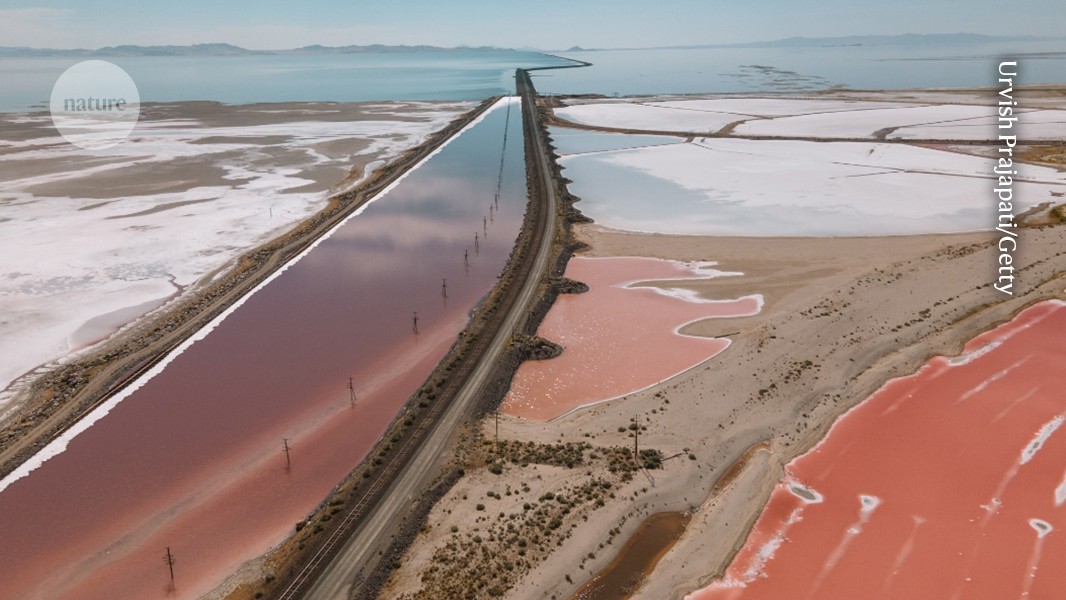
Today, Owens Lake is a “Dusty Vestige of the Old West”, as NASA described a photograph of the lake taken from space. In her book Salt Lakes, geographer Caroline Tracey describes how the valley’s waters were drained by an aqueduct, completed in 1913, to supply the growing city of Los Angeles. The basin is encrusted with salts — borax, potash, potassium and yellowish crystal trona — that are stained pink by salt-loving microorganisms called archaea. Until about 2013, Owens Lake was also one of the largest sources of dust in the United States, releasing roughly 70,000 tonnes of particles each year before mitigation measures were put into place. The dust storms contain toxic substances, such as arsenic and cadmium left over from mining activity.
So, it’s intriguing that, in 2021, Tracey chose to marry her partner Mariana on the salt beach of Owens Lake, beside a rectangular artificial pool “whose clear water reflected back the enormous sky, offering a perfect reflection of the mountains”. That pool, she writes, is part of a system of pipes and water-spouting ‘bubblers’ mandated by a 1997 court ruling to dampen down the dust clouds. The moisture enables algae and brine flies to flourish, attracting birds such as red-eyed eared grebes (Podiceps nigricollis), tiny least sandpipers (Calidris minutilla), wading avocets (Recurvirostra spp.) and California gulls (Larus californicus).
Why the couple chose this location is a key episode in Tracey’s book, which is part scientific survey of salt lakes (most of them in the western United States), part coming-of-age memoir and part a glimpse at a field called queer ecology. This theory of ecology has been around since the 1990s and aims to break down the fixed, binary categories that characterize conventional environmental conservation, such as the concept that the natural and the artificial are separate, when, in fact, they often coexist.
Desiccated landscapes
Owens Lake is a good example of queer ecology, Tracey writes, because although it is no longer a ‘real’ lake, life has resurged. Snowy plovers (Anarhynchus nivosus) build nests in truck-laid gravel and brine shrimp (Artemia spp.) reproduce in its “bermed-in trapezoids”. Engineering “has facilitated wildness and fecundity rather than stripping life away”. It’s a provocative idea, which pops up intermittently in this “unnatural history” of salt lakes.
Why amphibious, wet environments hold the key to climate adaptation
Salt lakes form in landlocked basins, shrinking when evaporation outpaces the inflow of water. Some have been damaged irrevocably. Although legislation, in a few cases, has returned water and wildlife to the lakes’ shores, the repair has often been limited and the recovery inadequate.
Take the Great Salt Lake in Utah, the largest briny lake in the Western Hemisphere, with which Tracey opens her narrative. It loses water through evaporation — as all salt lakes do — but also because the rivers that flow into it have been diverted for agricultural purposes. In this case, the water is used mainly for growing alfalfa for animal feed. Climate change has exacerbated the lake’s decline: drought has reduced run-off and increased evaporation.

Dried-out salt lakes can produce thousands of tonnes of dust that contain toxic substances.Credit: Getty

