


You have full access to this article via your institution.
Hello Nature readers, would you like to get this Briefing in your inbox free every day? Sign up here.

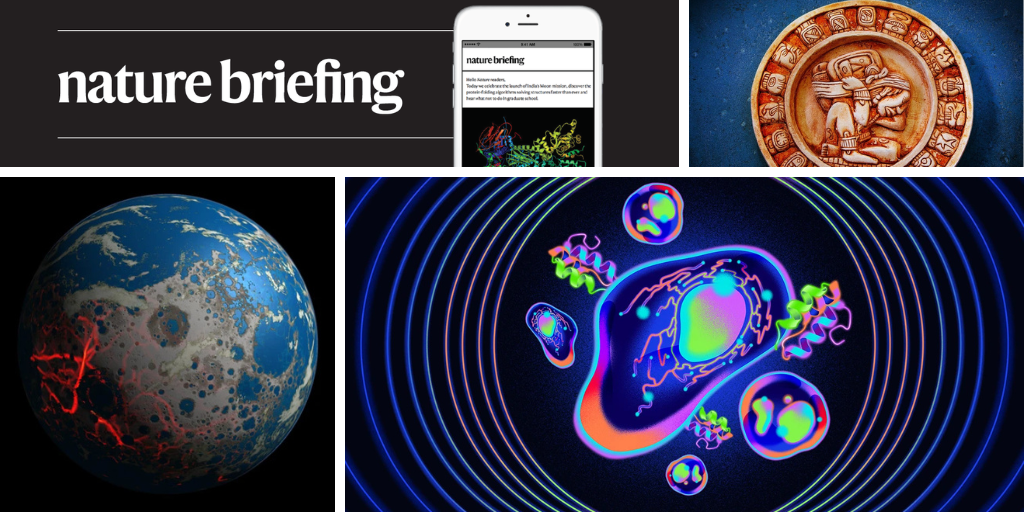
A scientifically faithful impression of Earth during the Hadean eon.Credit: Southwest Research Institute/Simone Marchi
Chemical evidence from ancient crystals suggests that Earth’s tectonic plates had already started moving 3.3 billion years ago, relatively early in our planet’s history. By analysing zircon crystals recovered from Western Australia — the oldest-known fragments of Earth rocks — researchers also found that the ancient Earth could have contained more oxygen, and possibly more water, than suspected. The movement of tectonic plates and higher-than-expected oxygen levels suggest that conditions on Earth could have been more conducive to life during this period than previously thought.
Reference: Proceedings of the National Academy of Sciences paper
Around 1590, Galileo Galilei filled the margins of a copy of Ptolemy’s The Almagest with his musings — and they have just been rediscovered. Historian Ivan Malara recognized the storied astronomer’s handwriting in the book, which was held in a library in Florence. The contents, including a transcribed psalm, could shed light on the intellectual origins of Galileo’s groundbreaking view of the Solar System.
Reference: Journal for the History of Astronomy paper (in review)
A study of more than 600 people over 40 in Finland reveals that nearly everyone had had frayed, torn or otherwise degenerated rotator cuffs — even people whose shoulders felt fine. Damage to this group of muscles and tendons is a common cause of shoulder pain, especially in older people. And surgeries to repair it are on the rise — partly because more people are getting MRI scans, says orthopaedic surgeon Brian Feeley in a commentary that accompanies the research. MRI scans are still useful for planning surgery, but stick to “old-school medicine” for diagnosis, suggests Feeley.
Reference: JAMA Internal Medicine paper & commentary
Features & opinion
Researchers have found ways to turn fluorescent-protein labels — coloured tags used to track the inner workings of a cell — into qubits, the basic units of quantum information. In this form, they can be used as quantum sensors, which could reveal cellular activity and detect molecules associated with disease with unprecedented detail. The development of protein quantum sensors is at an early stage, but could progress quickly, experts say: the approach has been shown to work in principle and the necessary equipment is standard fare.
As a child living with archaeologist parents in a small village in Mexico’s Yucatán Peninsula, epigrapher David Stuart set his sights on understanding then-indecipherable ancient Maya Hieroglyphs. Now one of the world’s leading specialists on the subject, he draws on fresh archaeological discoveries and translations of Maya writings to recount the history of this iconic civilization in his book, The Four Heavens. Stuart “breathes life into these mysterious rulers and their societies in the millennium before the existential crisis that led to their disappearance”, writes science author Andrew Robinson in his review.
Stanley Plotkin’s contribution to vaccinology has been so significant that the field’s textbook, now in its eighth edition, carries his name. But as vaccines increasingly come under attack, Plotkin, now 93, fears he knows what’s to come: many children will die from preventable diseases. “All I can say is that I’m beginning to regret having lived so long — because we’re going downhill,” he says. He worries that people have become more susceptible to anti-vaccine misinformation because they have not experienced the misery that childhood diseases once caused — and that things will not get better until outbreaks cause anguish once again.
Image of the week

Photojournalist Emre Çaylak has captured shocking images of sinkholes that are proliferating in the province of Konya in Turkey. Sinkholes have long been a feature of the landscape — this one, the Kızören Sinkhole, was an important way-stage on the Silk Road. But “over the past two years, things have accelerated” because of drought and unsustainable agricultural practices, says geologist Fetullah Arik. “The difference is hard to ignore”. (The Guardian | 9 min read) (Emre Çaylak)
Last week, I expressed my admiration for the acronym invented by researchers at the University of British Columbia Okanagan, in Canada, for a project that helps Indigenous youth heal and reconnect with cultural traditions through working with wild horses: Youth, Elders, Ecology, Horses, and Health (YEEHAH).
I asked you to send me some of your favourite scientific acronyms, and you didn’t disappoint. They included the delicious-sounding:
• BEIGNET (Basin-wide Ecosystem InteGration for Nutrients and Exposure to Toxics) — a study of the Gulf of Mexico and the rivers that flow into it, flagged by ecologist John Johnston.
• PASTA (Production with Accelerator of 47Sc for Theranostic Applications) by the Italian nuclear physics lab in Legnaro, highlighted by physicist Ursula Søndergaard.
• APERITIF (Anticoagulants for Prevention of lEft ventRIcular Thrombus after anterior acute myocardial InFarction) — a trial just published in JAMA Cardiology and spotted by physician-researcher Mathieu Pasquier.
While I tuck into this three-course meal of word salad, please do keep ‘em coming — along with any feedback on this newsletter — to [email protected].
Thanks for reading,
Flora Graham, senior editor, Nature Briefing
With contributions by Jacob Smith and Laura Woodrow
• Nature Briefing: Careers — insights, advice and award-winning journalism to help you optimize your working life
• Nature Briefing: Microbiology — the most abundant living entities on our planet — microorganisms — and the role they play in health, the environment and food systems
• Nature Briefing: Anthropocene — climate change, biodiversity, sustainability and geoengineering
• Nature Briefing: AI & Robotics — 100% written by humans, of course
• Nature Briefing: Cancer — a weekly newsletter written with cancer researchers in mind
• Nature Briefing: Translational Research — covers biotechnology, drug discovery and pharma

