


 This article published in collaboration with JUIDA, the Japan UAS Industrial Development Association.
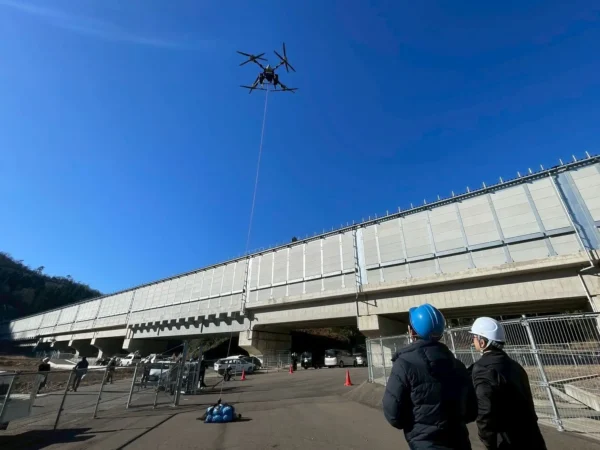
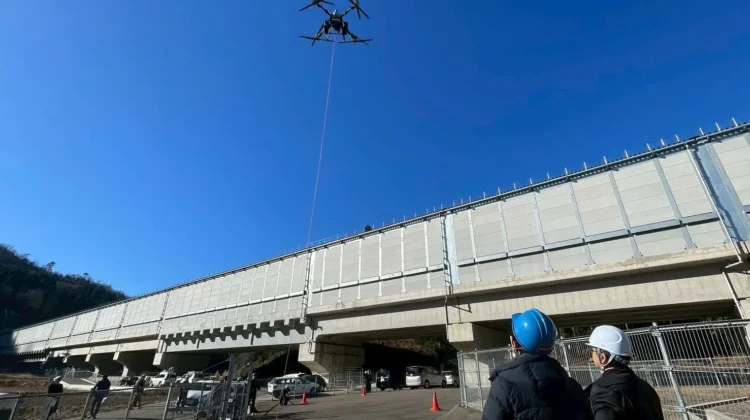
Tokyo-based drone operator TRIPLE7 completed a large-scale cargo drone trial on Japan’s Hokuriku Shinkansen line on December 19, 2025. The test, conducted in partnership with West Japan Railway Company (JR West) and JR West Shoji, deployed the DJI FlyCart 100 and DJI Dock 3 across a stretch of track between Echizen-Takefu and Tsuruga stations.
Railway Maintenance Gets a Drone Upgrade
The trial targeted a specific operational gap: transporting equipment into heavy snow zones, steep terrain, and disaster-affected areas where road vehicles cannot reach. The test sequence ran a full operational workflow — site safety assessment, cargo transport, load-down, and return flight — designed to simulate real emergency conditions.
The DJI Dock 3 led the first phase. The remotely operated drone station scanned the landing zone, assessed ground conditions, identified obstacles, and confirmed the absence of personnel and vehicle traffic. That data fed directly into the go/no-go decision for the cargo phase.
DJI FlyCart 100 Handles the Heavy Lift
The DJI FlyCart 100 then executed the material transport. The aircraft carries up to 85 kg with dual batteries over a 12 km range, and up to 100 kg on a single battery over 6 km. Its tilt-rotor design, 62-inch carbon fiber propellers, and high-torque motors deliver a single-axis thrust of 82 kg. The FlyCart 100’s safety stack includes LiDAR, millimeter-wave radar, multi-directional vision sensors, dual batteries, and an integrated parachute system.
Hamano Toshiki, of JR West’s Kanazawa Branch, oversaw the test site. “When abnormalities occur, heavy snowfall can block roads and prevent vehicles from reaching the site,” he said. “Equipment in the 80 kg class is difficult to transport manually, placing a heavy burden on workers. Being able to transport materials by drone, as demonstrated here, is something I feel is extremely effective.”
Multi-Organization Safety Framework
TRIPLE7 and the NAPA Drone Academy managed operations and safety protocols. System Five supplied the aircraft. Boundary Administrative Scrivener Corporation handled flight permits and legal compliance. Nanei Kogyo (Japan Drone Center) provided technical support, and JR West Shoji’s drone team coordinated with all relevant departments.
The team operated under a multi-layer safety framework: continuous weather and site monitoring, multi-person verification at each stage, and clearly defined abort criteria throughout the flight.
Outlook
The trial confirmed that heavy-lift drones can serve as a practical alternative in environments that ground crews and vehicles cannot safely access. TRIPLE7 says the results point toward a broader role for drone logistics in railway maintenance and emergency response across challenging terrain.
More information is available from the original press release (in Japanese)
Read More

