


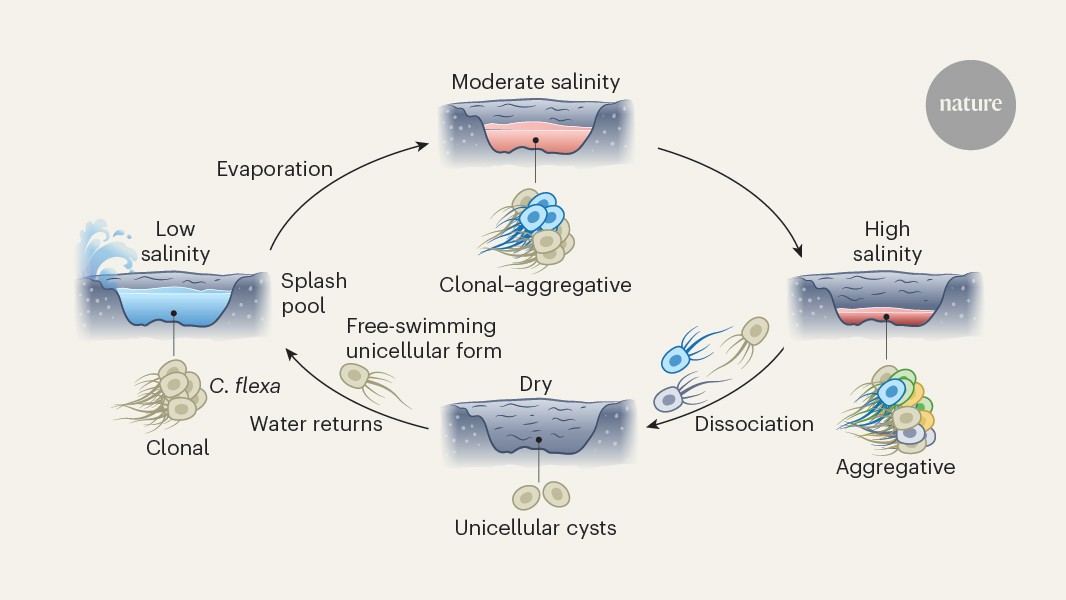
The evolution of multicellularity is often thought of as a one-step, discrete transition from a unicellular to a multicellular state. Such transitions to multicellularity are described as either being aggregative (whereby genetically distinct cells join together) or clonal (in which genetically identical cells remain attached after cell division). These two paths are commonly regarded as mutually exclusive, reflecting different selective pressures and evolutionary trajectories. Writing in Nature, Ros-Rocher et al.1 challenge this view by showing that Choanoeca flexa, a close relative of animals belonging to the choanoflagellate lineage, can become multi-cellular using both clonal and aggregative mechanisms, and can combine the two mechanisms in a single life cycle.
Competing Interests
The authors declare no competing interests.

