


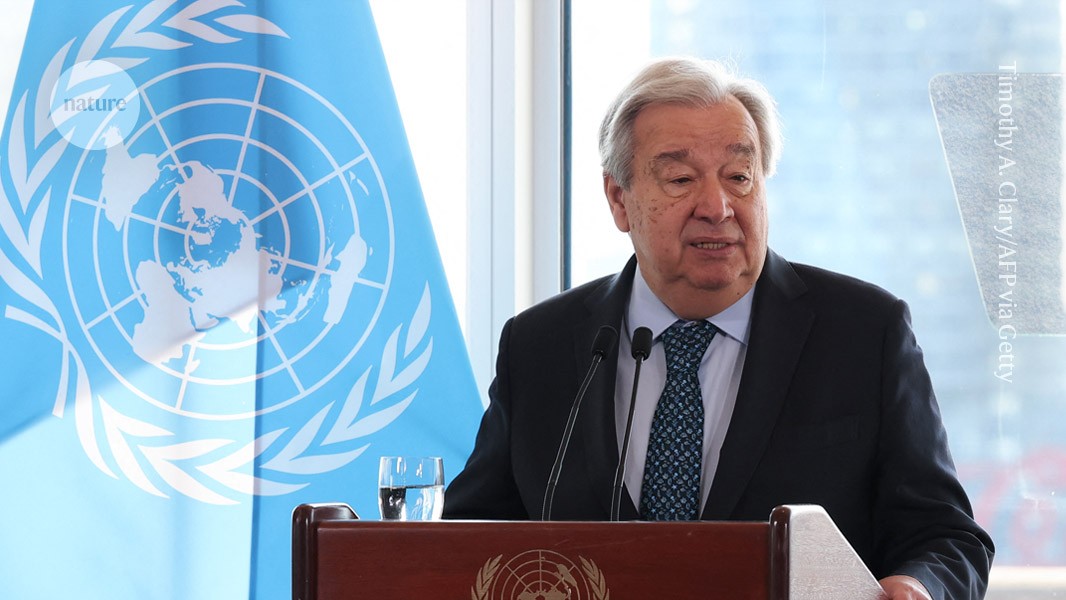

UN Secretary General Antonio Guterres announced a new Independent International Scientific Panel on Artificial Intelligence on 12 February.Credit: Timothy A. Clary/AFP via Getty
Dozens of researchers from around the world are now part of a scientific group that will analyse the impacts of artificial intelligence. Observers have compared the group, called the Independent International Scientific Panel on Artificial Intelligence and convened by the United Nations, to the influential Intergovernmental Panel on Climate Change (IPCC), which informs governments about the latest climate-change science. For more than 35 years, it has amassed evidence showing that current global warming is caused mostly by human activity.
The AI panel’s 40 members, approved in a vote by the UN’s General Assembly on 12 February, are from 37 nations. The UN says the panel will act “as an early-warning system and evidence engine, helping distinguish between hype and reality” and produce “policy-relevant” reports.
Only the United States and Paraguay voted against their appointment.
The panel is not the first prominent group to study AI impacts; the Global Partnership on AI and the International AI Safety Report are some of the most significant so far. But the UN group is “much bigger in scope and is truly global”, says Wendy Hall, a computer scientist at the University of Southampton, UK. Hall was a member of the panel’s governance-specific precursor, the UN High-level Advisory Body on AI, which ran between 2023 and 2024.
Create an IPCC-like body to harness benefits and combat harms of digital tech
Rather than focusing on a single issue, “the new panel will produce a number of scientific reports, year on year, which will be broad ranging — not just [AI] safety”, she says. Topics will include the economic, social, cultural and developmental aspects of the technology, says Brian Tse, founder of Concordia AI, a AI-safety consultancy in Beijing, who is not a member of the panel.
Similar to the way the IPCC synthesizes research on the physical science of climate change, as well as its risks and mitigation strategies, the AI panel could amass and analyse current knowledge on AI and its impacts, says Tse. And its findings might be similarly influential in guiding government actions.
The AI panel will not set policy, issue regulations or impose binding standards. Instead, it will create a “credible evidence base” to shape how governments, regulators and the public understand the technology’s risks and opportunities, says Tse.
Global representation
Members, who are appointed for a three-year period, were selected from more than 2,600 candidates in a review process led by three UN technical agencies. They include prominent AI researchers such as safety advocate Yoshua Bengio, a computer scientist at the University of Montreal in Canada, and Balaraman Ravindran, a computer scientist at the Indian Institute of Technology Madras in Chennai.
At least nine members have industry backgrounds, although like all others on the panel, they will serve in a personal capacity. These include Jian Wang, founder of the cloud computing arm of Chinese tech giant Alibaba; Nobel Peace Prize laureate Maria Ressa, a journalist based in Manila; and Joëlle Barral, an engineer and AI researcher at Google DeepMind in Paris.
For the panel, interacting with the research community is “in their DNA”, says Lucia Velasco, an economist and researcher at the Oxford Martin School’s AI Governance Initiative, who is based in New York. “They are all researchers and scientists.”
Let 2026 be the year the world comes together for AI safety
The panel’s broad geographical and cultural diversity — with members from Mexico, the Philippines and Uganda, for example — will be one of its “greatest strengths”, says Tse. The impacts of AI are highly context dependent, he says. For example, language models make more errors in languages for which little data exists online, and AI will affect each country’s labour markets differently, he says. And the panel’s international make-up, he adds, will give its findings greater global legitimacy.

