


You have full access to this article via your institution.
Hello Nature readers, would you like to get this Briefing in your inbox free every day? Sign up here.

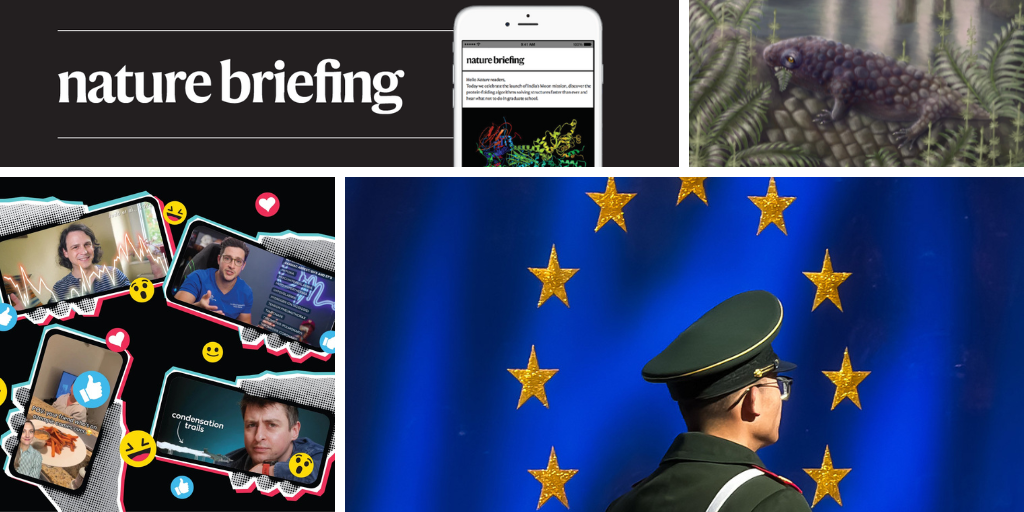
Tyrannoroter heberti, a reptile-like animal that lived in the Late Carboniferous Period, was probably around 30 centimetres in length with a stocky build. (Illustration by Hannah Fredd)
A fossilized skull dated to more than 300 million years ago has been identified as belonging to Tyrannoroter heberti, a newly described ‘microsaur’ species and one of the oldest-known vertebrate herbivores. From a 3D reconstruction of the skull, researchers found that the species had specialized teeth that resemble those of other plant-eating animals and that had been worn down from a grinding motion consistent with herbivory. The discovery suggests that vertebrate herbivores emerged around several million years earlier than scientists had previously estimated.
Reference: Nature Ecology & Evolution paper
Horizon Europe — the European Union’s €93.5-billion research-funding programme — has announced that Chinese organizations can no longer take part in most of the research projects it funds. Starting this year, organizations based in or controlled by China cannot apply for grants to fund projects that involve artificial intelligence, telecommunications, health, semiconductors, biotechnology or quantum technologies. Only select projects related to climate, biodiversity, food and agriculture remain on the table. The EU cites concerns about sharing sensitive technologies with China that could jeopardize the union’s security as the reason for the change.
Some sex differences in brain-connectivity patterns seem to become more pronounced with age. Researchers studying brain-imaging data found that sex differences in the brain’s connections are minimal in early life, but then increase drastically from puberty. Some of these differences continue to grow throughout adult life, which could explain why men and women have different likelihoods of developing some mental-health disorders such as anxiety and depression. However, some experts argue that these brain differences might reflect other factors that affect brain development, such as differences in education and gender roles, rather than sex.
Reference: bioRxiv preprint (not peer reviewed)
Features & opinion
To combat the swathes of scientific misinformation circulating on social media platforms such as TikTok, scientists and medical experts are taking strategies straight out of the influencer playbook. Some content creators try to ‘pre-bunk’ misinformation by reaching a broad audience with peer-reviewed evidence on topics such as climate change. Others, such as Doctor Mike, challenge it head-on by fact-checking specific claims, including those by US health secretary Robert F. Kennedy Jr. The task can be difficult for individual creators, who can face personal backlash, but it’s important to meet audiences where they are, says creator Simon Clark. Research has shown that these efforts can help to shift the dial on issues such as vaccine hesitancy.
In the prologue of her book Traversal, essayist Maria Popova writes that “we exist as proteins lit up with purpose”. What follows is her investigation of what that purpose is. Through the stories of figures from crystallographer Dorothy Hodgkin to novelist Mary Shelley, Popova unravels the common themes that drive people’s thirst for knowledge and celebrates those who refused to be siloed into one discipline. “It is one of those books so ambitious in scope and form that it can only succeed — or fail — spectacularly. Traversal succeeds,” writes Nature editor Urmila Chadayammuri in her review.
Popular-science writers can be experienced interviewers, but to get the most out of a conversation, they need a confident and well-prepared collaborator. Nature spoke to five authors of popular-science books who offer advice on how to be a valuable interviewee:
• Keep it simple — avoid jargon and use analogies to make your explanations accessible
• Meet in person if possible so your interviewer can get a sense of your character and work environment
• Stick to your field of expertise
• Show enthusiasm about your work and don’t expect your interviewer to understand everything immediately
Today I’m stroking my chin. No, I’m not deep in thought; I’m wondering why I have this protrusion at the bottom of my face. And I’m not alone: anthropologists have also set out to pin down why we have chins, and have suggested that they’re an ‘evolutionary spandrel’. That being a byproduct of the evolution of another characteristic, not an adaptation in itself.
This newsletter is constantly evolving — let us know what you think at [email protected]
Thanks for reading,
Jacob Smith, associate editor, Nature Briefing
• Nature Briefing: Careers — insights, advice and award-winning journalism to help you optimize your working life
• Nature Briefing: Microbiology — the most abundant living entities on our planet — microorganisms — and the role they play in health, the environment and food systems
• Nature Briefing: Anthropocene — climate change, biodiversity, sustainability and geoengineering
• Nature Briefing: AI & Robotics — 100% written by humans, of course
• Nature Briefing: Cancer — a weekly newsletter written with cancer researchers in mind
• Nature Briefing: Translational Research — covers biotechnology, drug discovery and pharma

