


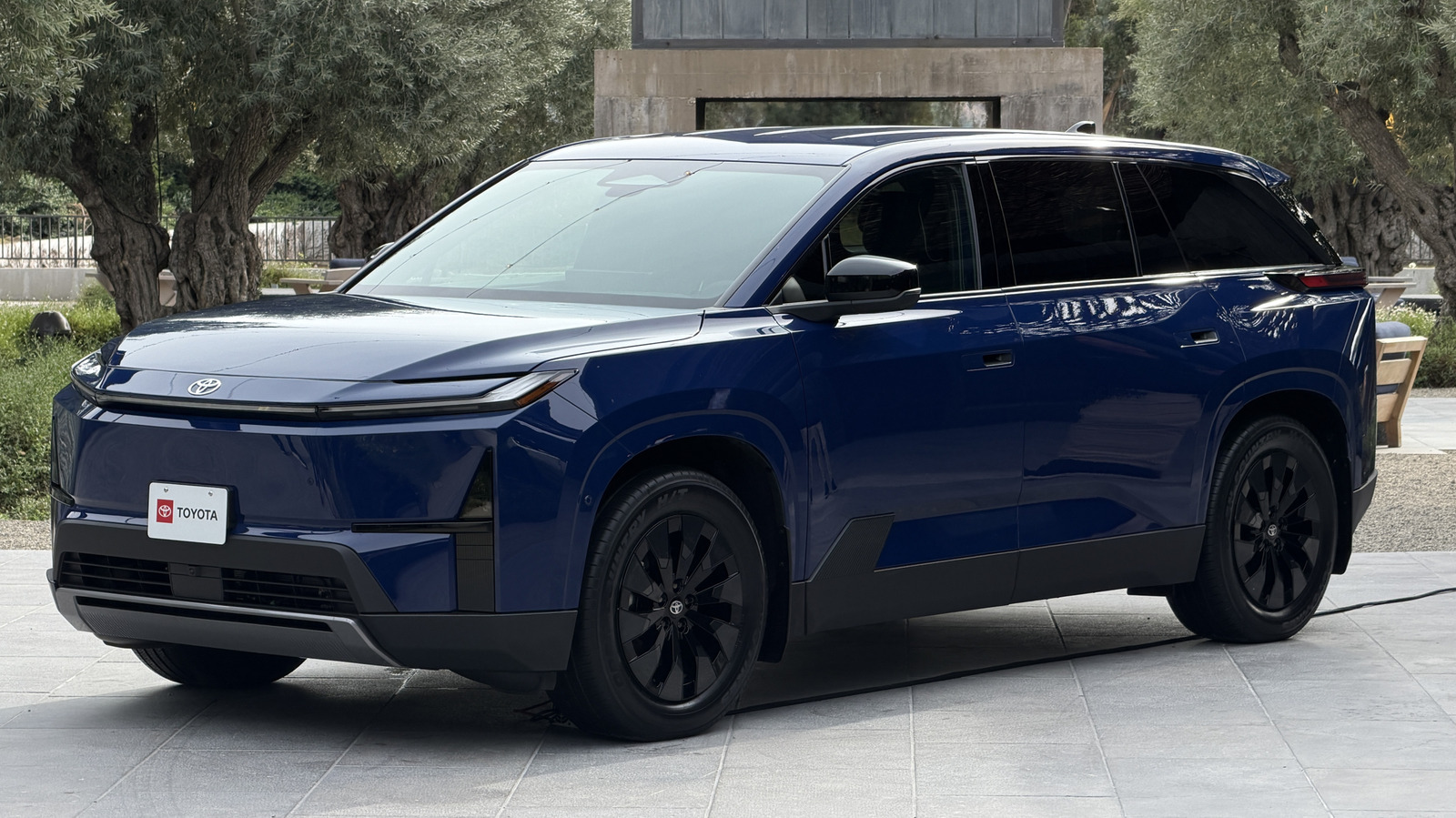
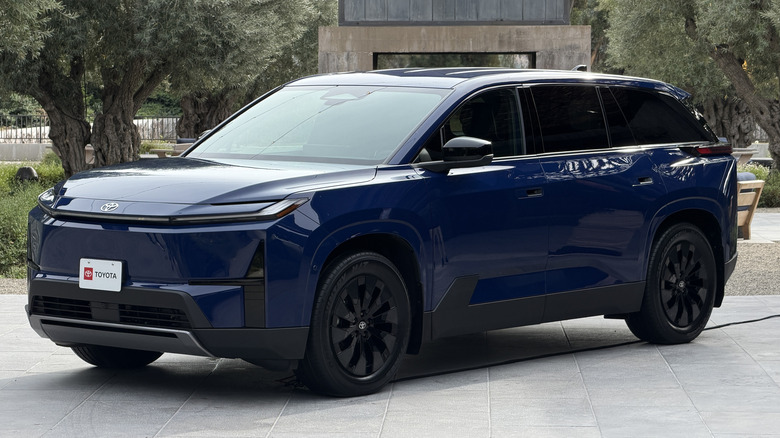
Toyota revealed the fifth-gen Highlander last week, and marking a major evolution from previous Highlanders that were pioneers of hybrid SUVs, the 2027 Highlander will only be available as an EV. For American buyers who want a three-row gas-powered SUV, Toyota has a bunch of hybrid and non-hybrid options including the Grand Highlander. There still aren’t that many three-row SUVs with electric powertrains out there, especially not on the more affordable ends of things, so when the new Highlander reaches dealers at the end of 2026 it could become an easy, default choice for a lot of buyers — much like other Toyota products.
The 2027 Highlander’s two closest competitors are the Kia EV9 and Hyundai Ioniq 9, but that’s about it when it comes to electric SUVs under $80,000 that aren’t sized like the Mercedes-Benz GLB. The Lucid Gravity and Rivian R1S are both available with three rows of seats, but they’re very different sort of SUV, and the Cadillac Vistiq is quite a bit larger than the Toyota. So for now I’m going to stick with just talking about the Koreans, but if more three-row EVs emerge in the near future I’ll come back and revisit this post.
The sizes
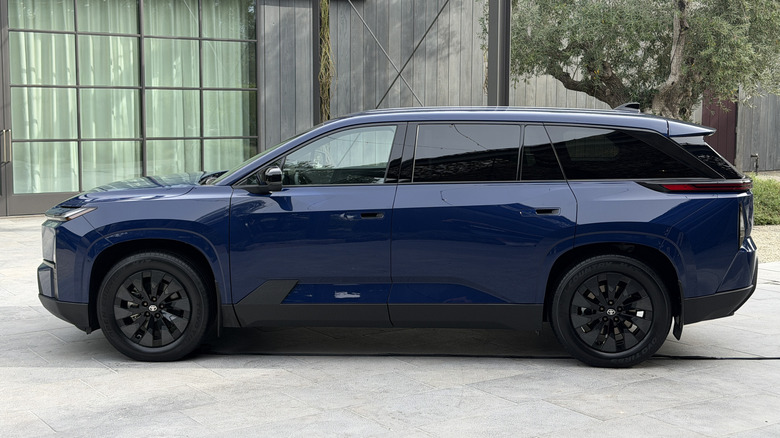
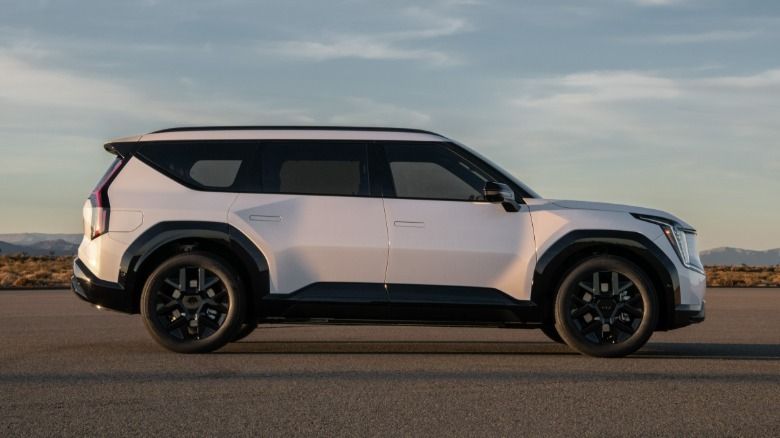
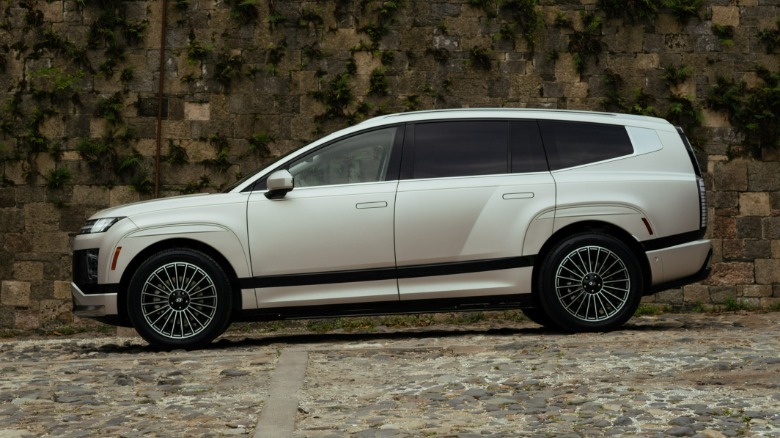
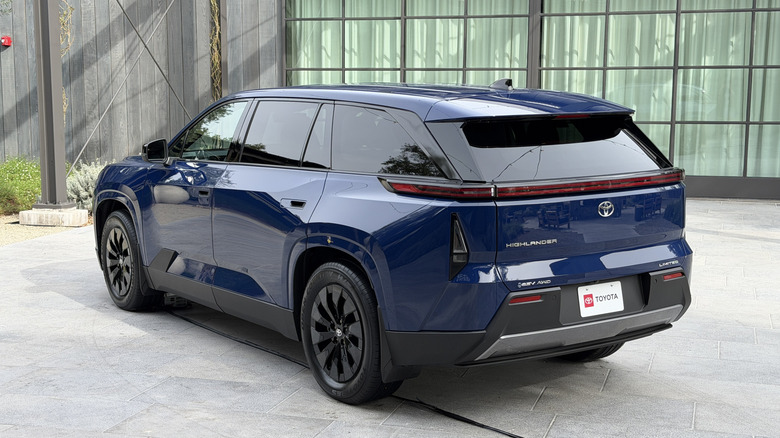
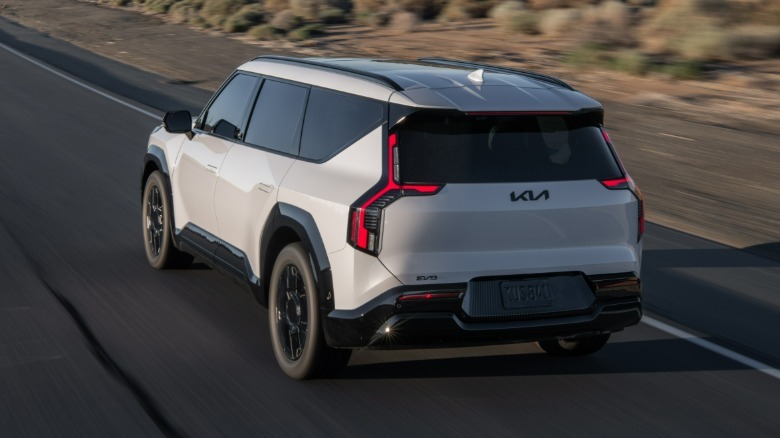
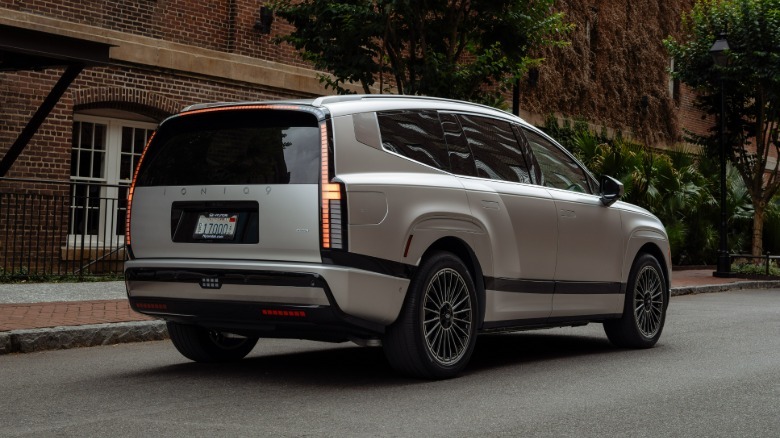
Toyota hasn’t released full specs for the Highlander yet, but we do know its dimensions, so let’s start with that. The 2027 Highlander EV is 198.8 inches long, an increase of 3.9 inches over the old internal-combustion Highlander, but its 120.1-inch wheelbase is 7.9 inches longer. Both the EV9 and Ioniq 9 are closesly matched, with the Kia at 197.2 inches with a 122.0-inch wheelbase and the Ioniq 9 measuring in at 199.2 inches long with a 123.2-inch wheelbase.
 Kia
Kia
The Highlander is lower than both Koreans, at 67.3 inches tall versus 68.9 inches for the EV9 and 70.5 inches for the Ioniq 9. Width differences are negligible, all sitting around 78 inches. Toyota hasn’t given a drag coefficient for the Highlander, but I’ll be surprised if it’s better than the 0.269 of the Ioniq 9. The smallest wheels on all three are 19-inchers, but where the Koreans are offered with wheels up to 21 inches in size, you can get 22s on the Highlander. Baller.
 Hyundai
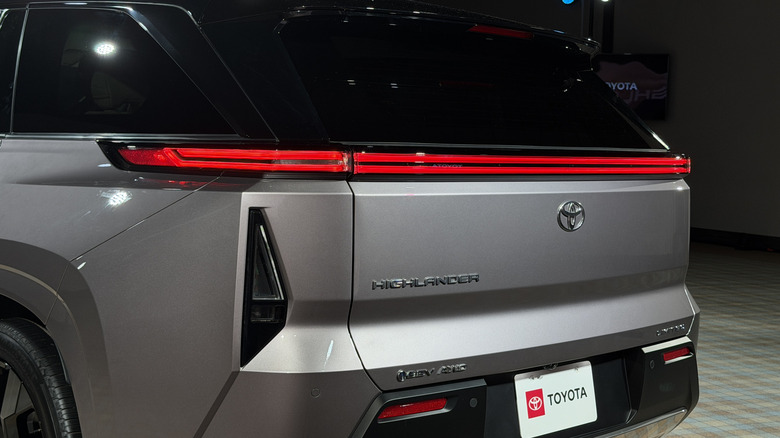
Styling is, of course, subjective. I think while the Highlander is clearly the most traditional-looking out of the three, it’s still a much more interesting design than what we’ve seen from Toyota in recent years. The rear haunches are my favorite detail, and the surfacing in general is crisp and well resolved. If I’m picking a favorite I’m going with the Ioniq 9, but I like really weird cars.
The powertrains
The base Highlander XLE has a 77.0-kWh battery pack sending electrons to a single electric motor at the front wheels that makes 221 horsepower and 198 pound-feet of torque; that model has a Toyota-estimate range of 287 miles. Going for all-wheel drive adds a motor to the rear axle, increasing output to 338 hp and 323 lb-ft but bringing range down to 270 miles. Optional on the XLE AWD and standard on the AWD-only Limited is a larger 95.8-kWh battery pack, increasing the maximum range to 320 miles.
 Kia
Kia
Every Hyundai Ioniq 9 has a 110.3-kWh battery pack; rear-wheel-drive models have 215 hp and 258 lb-ft, and all-wheel-drive Ioniq 9s have either 303 hp/446 lb-ft or 422 hp/516 lb-ft, depending on trim. The RWD Ioniq 9 is EPA rated at 335 miles, while the less-powerful AWD one gets 320 miles and the more-powerful one 311 miles. Meanwhile Kia offers one base-model trim with a 76.1-kWh battery, a rear-mounted motor with 215 hp and 258 lb-ft, and 230 miles of range. Every other EV9 has a 99.8-kWh battery pack, with the RWD models having 201 hp, 258 lb-ft and a 305-mile range, and the AWD ones getting 379 hp, up to 516 lb-ft and a range of either 280 or 283 miles. Neither Toyota nor Hyundai give acceleration estimates.
 Hyundai
All three SUVs have a NACS charge port, but while the Hyundai and Kia use an 800-volt architecture, the Toyota makes do with a 400-volt setup, specifically a modified version of its modular TNGA-K platform. Toyota doesn’t say the Highlander’s max DC fast-charge rate, but it’s likely the same 150 kW as the brand’s other EVs. The EV9 and Ioniq 9 can both plug into 350-kW chargers, with the Kia achieving peaks of either 235 kW for small-battery models and 210 kW for big-battery ones, and the Ioniq 9 can hit around 245 kW. Charging from 10-80% takes 24 minutes in the Hyundai, 20 or 24 minutes in the Kia, and around 30 minutes in the Toyota. All three SUVs also support vehicle-to-load and bi-direction charging.
The interiors
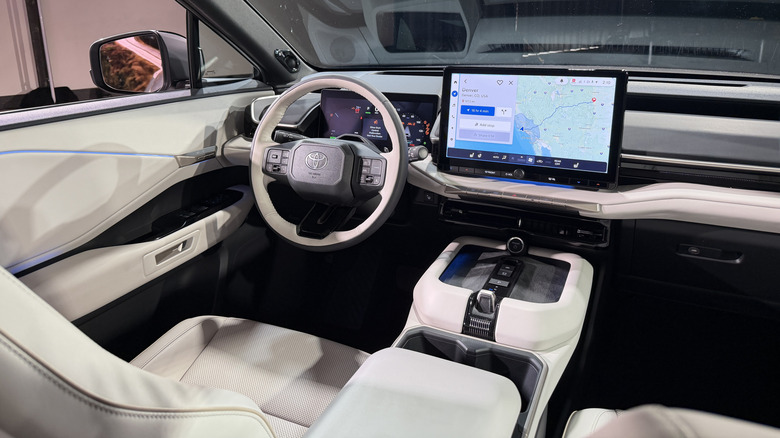
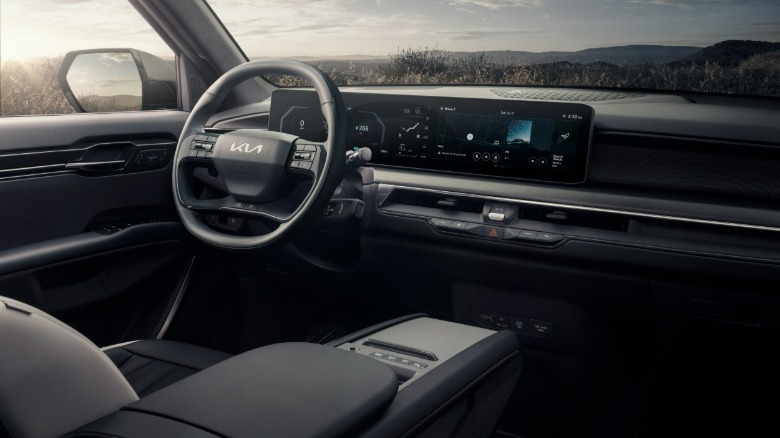
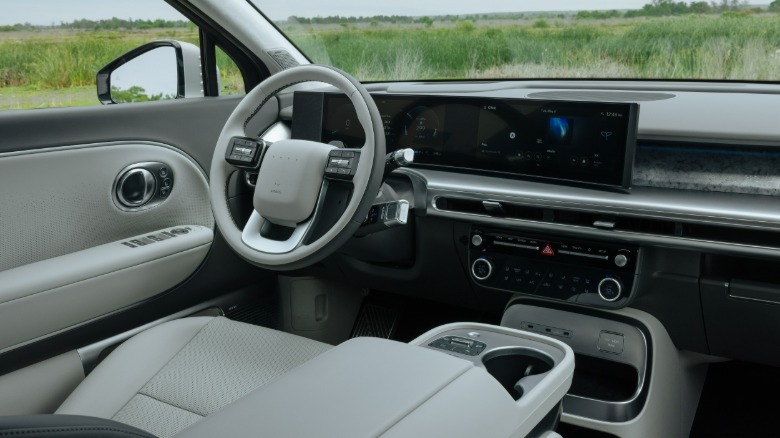
Toyota has yet to give any specs or dimensions for the Highlander’s interior, at least when it comes to passenger space, but in my brief time poking around the car it certainly felt nicely sized and arranged. We do know about one of the most important specs: Cargo volume. With the third-row seats in place the Highlander has 15.9 cubic feet of space, compared to 20.2 cubes in the EV9 and 21.9 cubes in the Ioniq 9. Fold down their third rows and you get 45.6 cubic feet in the Toyota, 43.5 in the Kia and 46.7 in the Hyundai. We don’t have a figure for the Toyota’s space with the second row folded, but we do know it doesn’t have a frunk, whereas the Koreans have a 1.8-cubic-foot frunk in AWD models and over 3 cubic feet with RWD. Second-row captain’s chairs are the only choice for the Highlander on all but the XLE AWD, with that trim being offered with a three-across bench seat.
 Kia
Kia
We also don’t know the full features and options list for the Highlander, but it’ll come with all of the stuff you expect. The base XLE has heated front seats and a heated steering wheel, 64-color ambient lighting, a built-in dashcam, 19-inch wheels with aero covers, a full-width LED light bar up front, one-touch fold for the second-row seats, and Toyota’s suite of driver-assist features. The Limited gets ventilated front seats, heated second-row seats, a head-up display, traffic jam assist, a 360-degree camera system, and a few additional driver-assist items. I wouldn’t be surprised if both cheaper and more expensive trims come down the line.
 Hyundai
Again, styling is subjective here, but I was more than pleasantly surprised with the Toyota’s cabin. It has a bunch of cool details like the door card designs and the wing-like corners of the dashboard, and materials felt more expensive than in some other new Toyotas. There seems to be plenty of storage cubbies, cupholders and USB-C ports, all of which are crucial to a car like this.
The prices
There’s also no word on pricing yet for the Highlander, but both its batteries and the car itself will be built in the U.S., so it shouldn’t get hit by tariffs. Both Koreans are also built in the U.S., too. Given how the outgoing Highlander Hybrid costs $48,815 in its base XLE trim and the new wagon-y bZ Woodland EV is $46,750, I’m guessing the Highlander EV will come in around $50,000-$55,000. That would position it pretty well against the Kia EV9 and Hyundai Ioniq 9, which start at $56,545 and $60,555, respectively. The Koreans’ MSRPs can reach well into the mid-$70k range, the Ioniq 9 especially, but I would be shocked if the Toyota does.
One aspect where the Kia and Hyundai clearly have the Toyota beat is when it comes to the warranty. The Highlander will have an 8-year/100,000-mile warranty for the electric powertrain components (battery included) and Toyota’s 3-year/36,000-mile basic new-vehicle warranty. Both the EV9 and Ioniq 9 have 10-year/100,000-mile electric powertrain warranties and 5-year/60,000-mile basic new-vehicle warranties. The Koreans offer better roadside assistance coverage, too.
The 2027 Toyota Highlander EV will go on sale at the end of 2026, so expect more information to be released in the coming months.

