


You have full access to this article via your institution.
Hello Nature readers, would you like to get this Briefing in your inbox free every day? Sign up here.

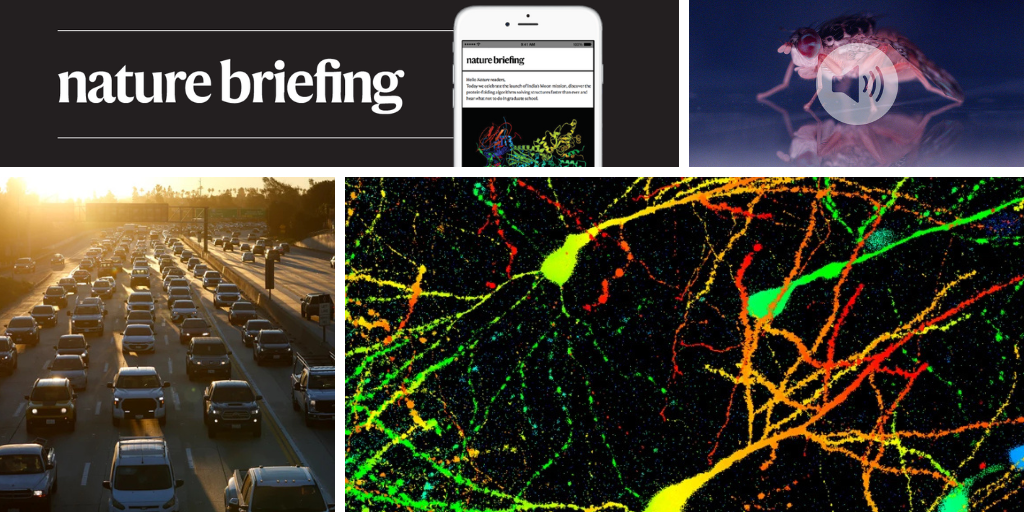
Some neurons in mice become more easily activated after multiple exercise sessions, a study has found.Credit: Dr Gopal Murti/SPL
Repeated exercise sessions on a treadmill strengthen the wiring in a mouse’s brain, making certain neurons quicker to activate. Researchers found that this ‘rewiring’ was essential for mice to gradually improve their running endurance, which suggests that the brain is actively involved in the improvement of a physical ability with practice. “Exercise is not just about muscles breaking down and building up,” says neuroscientist and study co-author Nicholas Betley. “It’s changing your whole brain.”
The US Environmental Protection Agency (EPA) has revoked the ‘endangerment finding’ — the conclusion that it can regulate greenhouse gases because they endanger public health and wellbeing. At the same time, it repealed emissions standards for vehicles — something that, by several estimates, will add billions of tonnes of greenhouse gases to the atmosphere in the coming decades. Rules for power plants might be next. Many environmental groups plan to sue but “regardless of how the law views it in the end, several years of regulatory action will be lost”, says legal scholar Adam Orford.
Can social media be addictive to young people? A jury in California is being asked to decide — even though the question still divides researchers. The young woman at the centre of the case alleges that she became addicted to social-media platforms as a child, causing the anxiety, depression, and body dysmorphia that she lives with today. Scholars expect to see a “a battle of the experts” to debate ‘dopamine hits’ of intermittent reinforcement, how our brains respond to positive social interactions and the vulnerability of young people’s developing brains.
A rare side effect of certain COVID vaccines is caused by a mutation in some people’s immune cells. Vaccine-induced immune thrombocytopenia and thrombosis (VITT) is a clotting disorder that is very rarely triggered by the AstraZeneca or Johnson & Johnson vaccines, both of which rely on a modified version of an adenovirus. Researchers spotted that an unlikely combination of a specific gene variant, a particular mutation in their antibody-producing immune cells and previous exposure to the adenovirus in the vaccine could cause a person’s immune system to attack a blood-clotting protein. Neither of the vaccines at issue are still in use, but the finding should help make future adenovirus-based vaccines even safer.
Reference: The New England Journal of Medicine paper
Features & opinion
“Long ago, my job was to educate students toward lives of passionate environmental advocacy,” writes environmental researcher Rochelle Johnson in an essay that won the 2025 Georgia Review Prose Prize. “Then my job became educating them away from widening spirals of deepening despair.” As she grapples with how to live with hope in a damaged world, Johnson draws on her own experience as an amputee. “Just as my phantom pains are my limb recalling what it has known and what it could have been if not for my disease, my students’ despair is part of the world recalling what it could have been were it not for its own disabling,” she writes. “We all grieve and strive to heal all that remains to us, all that remains of us: the residual.”
The Georgia Review | 34 min read
Relive your memories, complete with new and improved details, in the latest short story for Nature’s Futures series.
In sleeping Drosophila fruit flies, immune cells move to the blood–brain barrier, just outside the brain, to ‘take out the trash’ — collect lipids that are created as a byproduct of neurons’ waking activity. When this system is stopped from working correctly, the lipids build up and the flies have impaired memory and reduced lifespan, chronobiologist Amita Sehgal tells the Nature Podcast. “We are now looking at fly models for neurodegeneration, for Alzheimer’s, to ask whether sleep loss is contributing to pathology in that case via buildup of lipids,” says Sehgal.
Nature Podcast | 25 min listen
Subscribe to the Nature Podcast on Apple Podcasts, Spotify or YouTube Music, or use the RSS feed.
Today Leif Penguinson is enjoying the sunrise in the Tabernas Desert, Spain. Can you find the penguin?
The answer will be in Monday’s e-mail, all thanks to Briefing photo editor and penguin wrangler Tom Houghton.
This newsletter is always evolving — tell us what you think! Please send your feedback to [email protected].
Thanks for reading,
Flora Graham, senior editor, Nature Briefing
With contributions by Jacob Smith
• Nature Briefing: Careers — insights, advice and award-winning journalism to help you optimize your working life
• Nature Briefing: Microbiology — the most abundant living entities on our planet — microorganisms — and the role they play in health, the environment and food systems
• Nature Briefing: Anthropocene — climate change, biodiversity, sustainability and geoengineering
• Nature Briefing: AI & Robotics — 100% written by humans, of course
• Nature Briefing: Cancer — a weekly newsletter written with cancer researchers in mind
• Nature Briefing: Translational Research — covers biotechnology, drug discovery and pharma


