


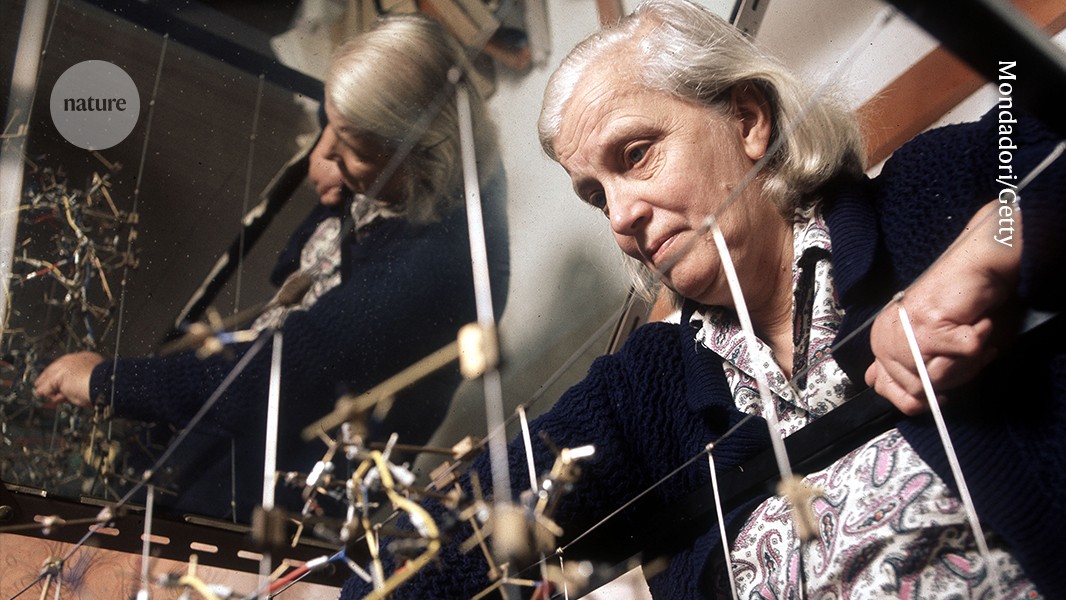
Traversal Maria Popova Farrar, Straus & Giroux (2026)
A mentor once told me that, when writing a research statement for a professorship, I had to start with the most ambitious pitch I could imagine — and then go ten times bigger. It’s tricky enough to do this as a cosmologist, given that the topic of study is the entire Universe. But there is a quest that is more ambitious still: to find out ‘what are we doing here?’
Against the odds: 12 women who beat bias to succeed in science
“Between the scale of atoms and the scale of stars,” Maria Popova writes in the prologue to her daring book Traversal, “between the time of mayflies and the time of mountains, we exist as proteins lit up with purpose.” And she sets out to investigate just what this purpose is.
Popova is the acclaimed essayist behind the popular blog The Marginalian (formerly known as Brain Pickings). What started as an eclectic weekly newsletter sent out to inspire her colleagues’ creativity has ended up in the archives of the US Library of Congress as a gem of cultural heritage.
In Traversal, this incredibly interdisciplinary exploration of knowledge and meaning gets to grow across 600 pages. Whether she is writing about colonialist explorer James Cook, crystallographer Dorothy Hodgkin or novelist Mary Shelley, about poetry, abolitionism or paint, Popova has a way of weaving one story into the next as if the boundaries between disciplines, cultures and centuries do not exist.
An incomparable intellectual who fell through the cracks of history
It is one of those books so ambitious in scope and form that it can only succeed — or fail — spectacularly. Traversal succeeds.
Popova’s book is, above all, an ode to polymathy, an insistence that knowledge cannot be siloed. Cook appears not just as a mariner but as the leader of an astronomical expedition — to observe the transit of Venus and thus deduce the distance from Earth to the Sun — and as an early ethnographer of Tahitian culture. Hodgkin, the Nobel-prizewinning chemist who mapped the structures of insulin and vitamin B12 using X-ray crystallography, grew up sketching the mosaics she and her parents had excavated at archaeological sites in the Middle East, priming her brain for pattern recognition and her hands for intricacy. Marie Tharp, who discovered the Mid-Atlantic Ridge, appears as both oceanographer and violinist. Alfred Wegener, who proposed the theory of continental drift, started out as an avid adventurer before becoming an atmospheric scientist.

