


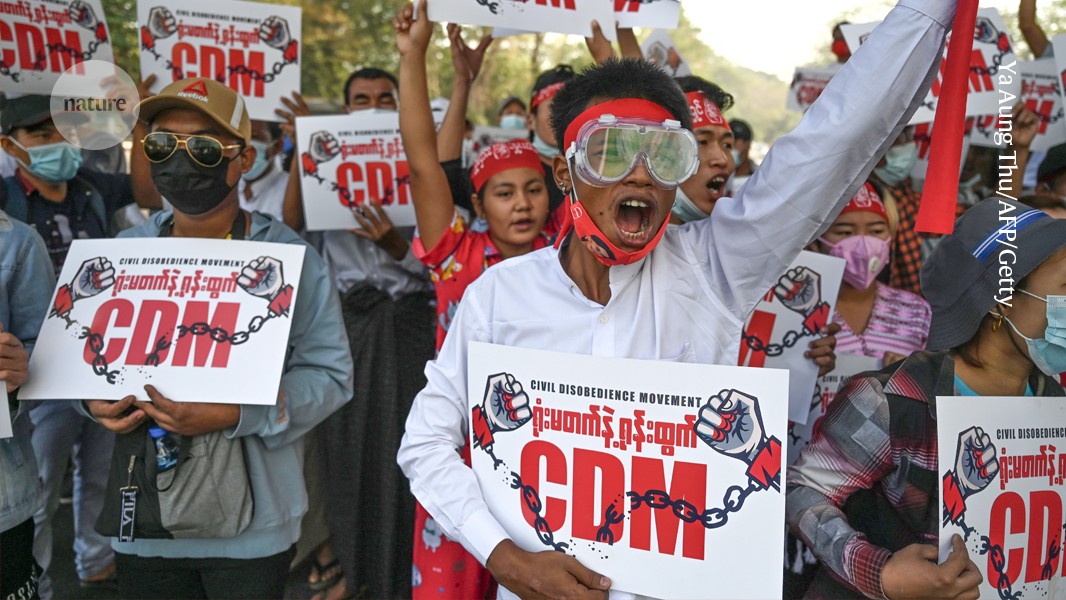

Many health-care workers in Myanmar joined the Civil Disobedience Movement to protest against a coup by the nation’s military.Credit: Ya Aung Thu/AFP/Getty
On 1 February 2021, Myanmar’s democratically elected government was overthrown in a military coup. There were mass protests against the military seizing power and many people were arrested for criticizing the new leadership. Frequent military airstrikes killed civilians and destroyed schools, hospitals and places of worship. According to the UK government, nearly 20 million people in Myanmar now need humanitarian aid.
More than 400,000 civil servants — including around 60,000 health-care workers — joined the Civil Disobedience Movement (CDM), resigning from their positions in protest against military rule. May T. N. Noe was one of them.

Moving labs, moving countries: how to get both right
Noe worked in a private hospital in Myanmar for two years before becoming a government-employed physician, then a teacher and finally a nutrition team leader. In February 2021, she joined the CDM and, as part of the movement, resigned from her job: a decision that left her unemployed for more than 18 months.
In 2023, as she approached her 35th birthday, Noe successfully applied to the Swiss Government Excellence Scholarships programme and is now living in Lausanne, Switzerland, where she is completing a PhD project on mental health in academia. She shares her story with Nature in the hope that it can encourage other people facing adversity.
What was it like in Myanmar when the coup happened?
It was frightening. Overnight, everything changed: communications were cut, the Internet was down and soldiers were on the streets. People were afraid — knowing that we were back under military control after just five years of democracy — and angry. That anger quickly turned into resistance.
Why did you join the CDM?
I joined the CDM because I wanted to resist the military regime. After the coup, life became difficult for many people. Most of the physicians in the country decided to resist by taking part in the CDM. There was a lot of social pressure for physicians to join, and those who didn’t faced criticism and public shaming from members of the community, especially on Facebook.
At the same time, being part of the CDM meant giving up the life-saving role of a physician. Many people who were living in poverty depended on public hospitals but there weren’t enough hospital staff members to treat them. It was also challenging for physicians, because we knew that people still needed treatment but we couldn’t do much to help. Personally, by joining the movement, I faced many hardships, including unemployment, stress and anxiety. Despite these difficulties, I felt that it was important to stand up for what we believed in, even though the military still governs the nation to this day.
How did you become a PhD candidate?
It was extremely difficult. I was unemployed, living with my parents and depressed. I started drafting a research proposal about depression, anxiety and stress in 18- to 49-year-old people in my country. I should probably thank my mother for pushing me. She had been a homemaker all her life and was afraid that her daughters, like her, would not have the opportunity to pursue a career. After I resigned, she would nag me about why I wasn’t working. The political situation meant that I couldn’t work, so writing my proposal showed her that I was doing something.
With that proposal, I applied for a PhD through the Swiss Government Excellence Scholarships programme. To be eligible, I needed to have a supervising professor. One researcher from the University of Zurich in Switzerland responded positively to my proposal, but it was too close to the deadline. The following year, my aunt died from post-COVID-19 complications. Overwhelmed, I missed the window to prepare a revised application and the opportunity slipped away.
I started applying for jobs in my country, and the rejections flooded in. I realized that my identity as a physician who had resisted the military through the CDM made me too politically risky to hire for organizations that were working with the government.
One day, while revisiting my research proposal, I decided to apply for the scholarship again. This time, with the support of a different professor, I was accepted as a PhD candidate at the University of Lausanne in May 2023. When I found out that I was successful, I cried.

May T. N. Noe left Myanmar by crossing the border into Thailand, risking arrest for breaking travel restrictions.Credit: May Noe
I can’t return to Myanmar for data collection so, instead of my original proposal, I’m now working on a mental-health project exploring job demands, job resources, burnout and work engagement in researchers across several nations in the European Union.
How did it feel to finally get to Switzerland?
Travel restrictions set by the Myanmar authorities prevent young people from moving abroad because they could resist the government openly from another country. My CDM status meant that I risked being arrested if I tried to leave Myanmar.

