


You have full access to this article via your institution.
Hello Nature readers, would you like to get this Briefing in your inbox free every day? Sign up here.

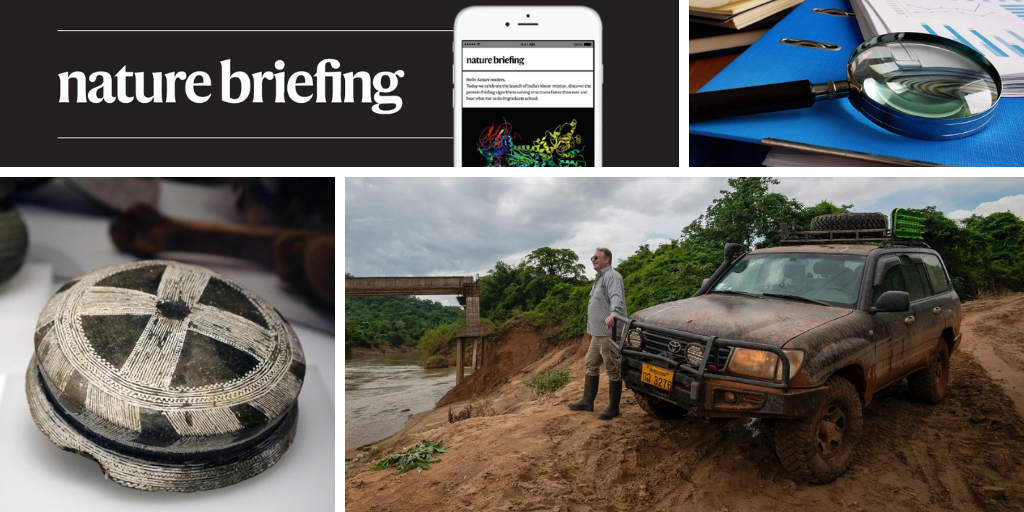
The Bell Beaker culture, named after a type of ceramic vessel, arose in Europe from around 2800 BC.Credit: Lanmas/Alamy
Ancient genomic data has revealed that inhabitants of the Rhine-Meuse river delta — wetland and coastal areas of modern-day Netherlands, Belgium and western Germany — maintained high levels of hunter-gatherer genetic ancestry for thousands of years after successive migrations from the east transformed most of Europe into farming and animal-herding communities. This group’s eventual mix with communities of people with ancestry from the central Eurasian steppe catalysed the expansion of Bell Beaker culture, which was accompanied by major shifts in the genetic make-up of both Britain and the Rhine–Meuse delta.
The Chinese Ministry of Science and Technology (MOST) has announced that it will crack down on institutions that turn a blind eye to serious research misconduct. The announcement states that institutions should investigate papers that are retracted in international science journals as a result of misconduct, and that the results of such investigations must be published. MOST says that a failure to do so — and sanction offenders if necessary — will incur serious penalties, but doesn’t specify what these penalties might be.
The administration of US President Donald Trump moved forwards last week with its plan to make it easier to fire some government workers — including scientists. The rule change, which Trump’s team says aims to improve employee accountability, would reassign career civil servants who influence government policy into a new worker class called ‘Policy/Career’ and strip them of the job protections that they usually have under US law. The Office of Personnel and Management recommended that agencies including the National Science Foundation and National Institutes of Health consider reclassifying several positions involved in awarding research grants at such agencies, which could leave them vulnerable to termination for “subverting Presidential directives”.
Dreaming of receiving that phone call from Sweden? Maybe don’t collaborate with a Nobel laureate, suggests a study of nomination data for the physics Nobel. It found that researchers who worked alongside prizewinners were less likely to win a Nobel themselves. This could be because they are perceived as less independent and innovative, or could reflect a genuine lack of breakthrough originality in projects that already involve a laureate.
Reference: Scientometrics paper
Features & opinion
The move away from fossil fuels is picking up speed. A chart-packed feature shows that clean-energy technologies account for the bulk of new energy investments and renewable energy is getting cheaper. But the shift to clean energy isn’t happening fast enough. Direct government investments in fossil fuels still outstrip those that flow into clean energy, and red tape and outdated electricity grids stand in the way of progress. “It’s not about needing government handouts anymore”, says analyst Lauri Myllyvirta. “It’s about governments getting out of the way.”
A reliance on weight-loss drugs such as semaglutide — sold under brand names such as Wegovy — for the management of obesity and overweight ignores the socio-economic factors that can lead to obesity in the first place, and their cost can exacerbate inequalities in access to healthcare, say some experts. As pharmaceutical companies race to develop new products, some researchers worry that a ready availability of weight-loss drugs will reinforce the stigma surrounding obesity. “We’ve built a world, and especially medicine has built a world, where fat people are not allowed, and these are the conditions under which people are taking Ozempic,” says disability researcher Fady Shanouda.
This article is part of Nature Spotlight: Obesity, an editorially independent supplement.
Where I work

Credit: Dave Tacon for Nature
Archaeologist Daniel Davenport and his team uncover the secrets, both ancient and modern, hidden in the Hin Nam No National Protected Area in southern Laos. The challenging terrain is pocked with craters left from bombings during the Vietnam War, and can become near impassable during months-long wet seasons. But “it’s a stunning beautiful landscape”, says Davenport, and home to a unique network of more than 220 kilometres of caves and underground rivers. “There are hundreds, possibly thousands of unexplored caves in the park”, Davenport says. “It’s an archaeologist’s dream.” (Nature | Leisurely scroll)
Today I’m tuning into the Winter Olympics. I’m partial to watching curling because whichever country is competing, I can always cheer for the Brits. Not the athletes, of course, but the stones.
Despite being used around the world, the stones used to make curling rocks hail from only two places in the world: an island in Scotland and a quarry in Wales.
While I brush up on the rules of this slippery sport, why not send us your feedback at [email protected].
Thanks for reading,
Jacob Smith, associate editor, Nature Briefing
With contributions by Gemma Conroy and Flora Graham
• Nature Briefing: Careers — insights, advice and award-winning journalism to help you optimize your working life
• Nature Briefing: Microbiology — the most abundant living entities on our planet — microorganisms — and the role they play in health, the environment and food systems
• Nature Briefing: Anthropocene — climate change, biodiversity, sustainability and geoengineering
• Nature Briefing: AI & Robotics — 100% written by humans, of course
• Nature Briefing: Cancer — a weekly newsletter written with cancer researchers in mind
• Nature Briefing: Translational Research — covers biotechnology, drug discovery and pharma

