


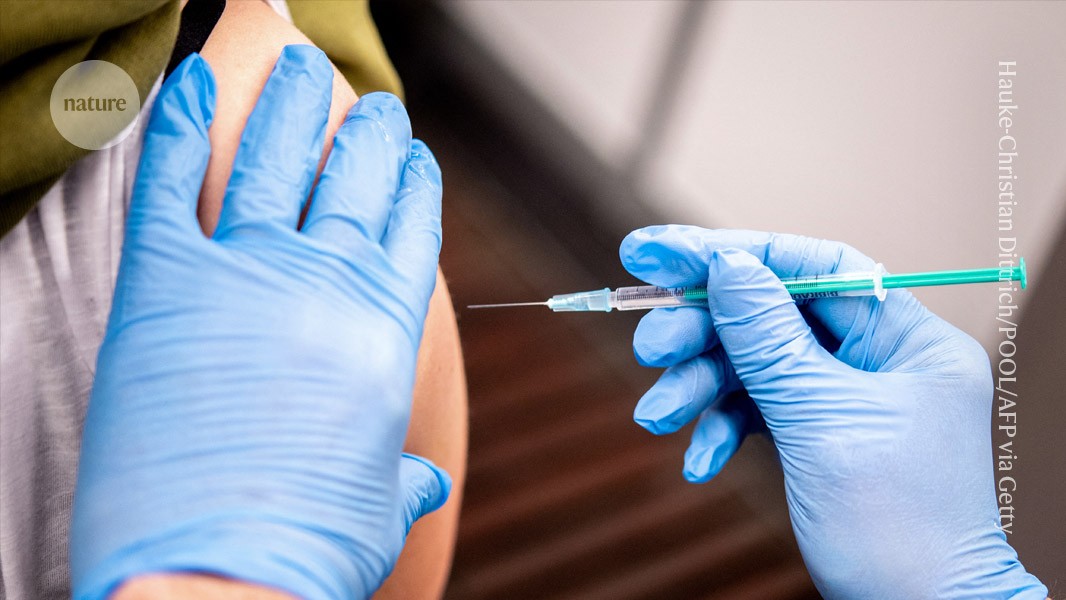

Many countries changed their advice about who should have the AstraZeneca vaccine (pictured) following reports it could trigger a rare blood-clotting disorder.Credit: Hauke-Christian Dittrich/POOL/AFP via Getty
Researchers have uncovered the molecular trigger for a rare but potentially deadly clotting disorder that some people experienced after receiving some COVID-19 vaccines. The findings are published in The New England Journal of Medicine yesterday1.
About one in 200,000 people developed vaccine-induced immune thrombocytopenia and thrombosis (VITT), as the syndrome became known, after receiving a vaccine made by Johnson & Johnson in the United States. The rare condition was also reported in about three out of every 100,000 people who received the vaccine made by AstraZeneca in the United Kingdom. Both vaccines used a modified version of an adenovirus, a type of virus known to cause the common cold, to carry the gene for part of the SARS-CoV-2 virus into human cells. This triggered the immune system to create antibodies against SARS-CoV-2.
Although the vaccines were generally safe and reduced the risk of severe COVID-19 for most people, a small number of cases of VITT were documented worldwide. This led to several governments changing their vaccine recommendations. For example, in 2021 in the UK, where the AstraZeneca vaccine was mainly used, the government advised people under 40, who had a slightly higher risk of VITT, to take an alternative vaccine.
First clues
In 2021, researchers reported that the antibodies in people with VITT were attacking a naturally occurring blood-clotting protein called platelet factor 4 (PF4)2.
In the latest study, the researchers suggest that when people with a specific gene variant (up to 60% of the population) encounter an adenovirus — either through vaccination or natural infection — their immune system produces antibodies against an adenovirus protein called pVII. For almost everyone, this response is harmless.
But the team suggests that a subset of people have a mutation in their antibody-producing immune cells in which a positively charged amino acid known as lysine (K) is swapped out for a negatively charged one known as glutamic acid (E). This tiny chemical change reshapes the antibody so that it binds to PF4 instead of pVII.
If these people had previously been exposed to the adenovirus in the vaccine, the author’s hypothesize that the vaccination triggered an explosion of their anti-PF4 antibodies, leading to severe clotting and a drop in platelets.
“This is the first time we’ve been able to trace an autoimmune disorder back to the original triggering event,” says co-author Tom Gordon, an immunopathologist at Flinders University in Adelaide, Australia.
When the team engineered versions of the anti-PF4 antibodies without the amino acid change and tested them in mice, the animals developed many fewer clots. The study looked at samples from 21 people who developed VITT — all of them had the mutation.
The problem was not with the vaccine design, says Gordon, but a series of unlikely events that triggered the clotting disorder.
Nature has contacted AstraZeneca and Johnson & Johnson for comment on the study results.

