


Hughes, T. P. et al. Climate change, human impacts, and the resilience of coral reefs. Science 301, 929–933 (2003).
Alvarez-Filip, L., Dulvy, N. K., Gill, J. A., Côté, I. M. & Watkinson, A. R. Flattening of Caribbean coral reefs: region-wide declines in architectural complexity. Proc. R. Soc. B 276, 3019–3025 (2009).
Cramer, K. L. et al. Widespread loss of Caribbean Acroporid corals was underway before coral bleaching and disease outbreaks. Sci. Adv. 6, eaax9395 (2020).
Dillon, E. M. et al. Fossil dermal denticles reveal the preexploitation baseline of a Caribbean coral reef shark community. Proc. Natl Acad. Sci. USA 118, e2017735118 (2021).
Lueders-Dumont, J. A., Wang, X. T., Jensen, O. P., Sigman, D. M. & Ward, B. B. Nitrogen isotopic analysis of carbonate-bound organic matter in modern and fossil fish otoliths. Geochim. Cosmochim. Acta 224, 200–222 (2018).
Kast, E. R. et al. Cenozoic megatooth sharks occupied extremely high trophic positions. Sci. Adv. 8, 7–18 (2022).
Skinner, C., Cobain, M. R. D., Zhu, Y., Wyatt, A. S. J. & Polunin, N. V. C. Progress and direction in the use of stable isotopes to understand complex coral reef ecosystems: a review. Oceanogr. Mar. Biol. An Annu. Rev. 60, 373–432 (2022).
Burke, L., Reytar, K., Spalding, M. & Perry, A. Reefs at risk revisited. World Resour. Inst. 74, 1–130 (2011).
Sing Wong, A., Vrontos, S. & Taylor, M. L. An assessment of people living by coral reefs over space and time. Glob. Chang. Biol. 28, 7139–7153 (2022).
Aronson, R. B. Foraging behavior of the west Atlantic trumpetfish, Aulostomus maculatus: use of large, herbivorous reef fishes as camouflage. Bull. Mar. Sci. 33, 166–171 (1983).
Lukoschek, V. & McCormick, M. I. A review of multi-species foraging associations in fishes and their ecological significance. Proc. Ninth Int. Coral Reef Symp. I, 467–474 (2000).
Layman, C. A., Quattrochi, J. P., Peyer, C. M. & Allgeier, J. E. Niche width collapse in a resilient top predator following ecosystem fragmentation. Ecol. Lett. 10, 937–944 (2007).
Frédérich, B., Lehanse, O., Vandewalle, P. & Lepoint, G. Trophic niche width, shift, and specialization of Dascyllus aruanus in Toliara Lagoon, Madagascar. Copeia 2010, 218–226 (2010).
Layman, C. A. & Allgeier, J. E. Characterizing trophic ecology of generalist consumers: A case study of the invasive lionfish in the Bahamas. Mar. Ecol. Prog. Ser. 448, 131–141 (2012).
Odum, H. T. & Odum, E. P. Trophic structure and productivity of a windward coral reef community on Eniwetok Atoll. Ecol. Monogr. 25, 291–320 (1995).
Polovina, J. J. Model of a coral reef ecosystem: I. The ECOPATH model and its application to French Frigate Shoals. Coral Reefs 3, 1–11 (1984).
Woodhead, A. J., Hicks, C. C., Norström, A. V., Williams, G. J. & Graham, N. A. J. Coral reef ecosystem services in the Anthropocene. Funct. Ecol. 33, 1023–1034 (2019).
Letourneur, Y., Briand, M. J. & Graham, N. A. J. Coral reef degradation alters the isotopic niche of reef fishes. Mar. Biol. 164, 224 (2017).
Wang, X. T. et al. Isotopic composition of carbonate-bound organic nitrogen in deep-sea scleractinian corals: a new window into past biogeochemical change. Earth Planet. Sci. Lett. 400, 243–250 (2014).
Lueders-Dumont, J. A. et al. Comparison of the isotopic composition of fish otolith-bound organic N with host tissue. Can. J. Fish. Aquat. Sci. 77, 264–275 (2020).
Rao, Z. C. et al. A nitrogen isotopic shift in fish otolith–bound organic matter during the Late Cretaceous. Proc. Natl Acad. Sci. 121, e2322863121 (2024).
Lin, C.-H. et al. Reconstructing reef fish communities using fish otoliths in coral reef sediments. PLoS ONE 14, e0218413 (2019).
Leonhard, I. & Agiadi, K. Addressing challenges in marine conservation with fish otoliths and their death assemblages. Geol. Soc. London 529, 243–262 (2023).
Salas, S., Chuenpagdee, R., Charles, A. T. & Seijo, J. C. Coastal Fisheries of Latin America and the Caribbean (Food and Agriculture Organization of the United Nations, 2011).
Bearhop, S., Adams, C. E., Waldron, S., Fuller, R. A. & Macleod, H. Determining trophic niche width: a novel approach using stable isotope analysis. J. Anim. Ecol. 73, 1007–1012 (2004).
Post, D. M. The long and short of food-chain length. Trends Ecol. Evol. 17, 269–277 (2002).
Ward, C. L. & McCann, K. S. A mechanistic theory for aquatic food chain length. Nat. Commun. 8, 2028 (2017).
Depczynski, M. & Bellwood, D. R. The role of cryptobenthic reef fishes in coral reef trophodynamics. Mar. Ecol. Prog. Ser. 256, 183–191 (2003).
Brandl, S. J., Goatley, C. H. R., Bellwood, D. R. & Tornabene, L. The hidden half: ecology and evolution of cryptobenthic fishes on coral reefs. Biol. Rev. 93, 1846–1873 (2018).
Zhu, Y., Newman, S. P., Reid, W. D. K. & Polunin, N. V. C. Fish stable isotope community structure of a Bahamian coral reef. Mar. Biol. 166, 160 (2019).
Tilley, A., López-Angarita, J. & Turner, J. R. Diet reconstruction and resource partitioning of a Caribbean marine mesopredator using stable isotope Bayesian modelling. PLoS ONE 8, e79560 (2013).
Hempson, T. N. et al. Coral reef mesopredators switch prey, shortening food chains, in response to habitat degradation. Ecol. Evol. 7, 2626–2635 (2017).
Stuthmann, L. E. & Castellanos-Galindo, G. A. Trophic position and isotopic niche of mangrove fish assemblages at both sides of the Isthmus of Panama. Bull. Mar. Sci. 96, 449–467 (2020).
Vaslet, A., Phillips, D. L., France, C. A. M., Feller, I. C. & Baldwin, C. C. Trophic behaviour of juvenile reef fishes inhabiting interlinked mangrove-seagrass habitats in offshore mangrove islets. J. Fish Biol. 87, 256–273 (2015).
Cocheret de la Morinière, E. et al. Ontogenetic dietary changes of coral reef fishes in the mangrove-seagrass-reef continuum: stable isotopes and gut-content analysis. Mar. Ecol. Prog. Ser. 246, 279–289 (2003).
Frédérich, B. et al. Comparative feeding ecology of cardinalfishes (Apogonidae) at Toliara reef, Madagascar. Zool. Stud. 56, e10 (2017).
Rader, J. A. et al. Isotopic niches support the resource breadth hypothesis. J. Anim. Ecol. 86, 405–413 (2017).
Schoener, T. W. Theory of feeding strategies. Annu. Rev. Ecol. Syst. 2, 369–404 (1971).
Clever, F. et al. The gut microbiome variability of a butterflyfish increases on severely degraded Caribbean reefs. Commun. Biol. 5, 770 (2022).
Stewart, S. D., Kelly, D., Biessy, L., Laroche, O. & Wood, S. A. Individual diet specialization drives population trophic niche responses to environmental change in a predator fish population. Food Webs 27, e00193 (2021).
Steube, T. R., Altenritter, M. E. & Walther, B. D. Distributive stress: individually variable responses to hypoxia expand trophic niches in fish. Ecology 102, e03356 (2021).
Stouffer, D. B. & Bascompte, J. Compartmentalization increases food-web persistence. Proc. Natl Acad. Sci. USA 108, 3648–3652 (2011).
Hixon, M. A. & Beets, J. P. Predation, prey refuges, and the structure of coral-reef fish assemblages. Ecol. Monogr. 63, 77–101 (1993).
Beukers, J. S. & Jones, G. P. Habitat complexity modifies the impact of piscivores on a coral reef fish population. Oecologia 114, 50–59 (1998).
Tunney, T. D., McCann, K. S., Lester, N. P. & Shuter, B. J. Food web expansion and contraction in response to changing environmental conditions. Nat. Commun. 3, 1105 (2012).
Brandl, S. J. et al. Demographic dynamics of the smallest marine vertebrates fuel coral reef ecosystem functioning. Science 364, 1189–1192 (2019).
Young, H. S., McCauley, F. O., Micheli, F., Dunbar, R. B. & McCauley, D. J. Shortened food chain length in a fished versus unfished coral reef. Ecol. Appl. 34, e3002 (2024).
Morillo-Velarde, P. S. et al. Habitat degradation alters trophic pathways but not food chain length on shallow Caribbean coral reefs. Sci. Rep. 8, 4109 (2018).
Briones-Fourzán, P. et al. Coral reef degradation differentially alters feeding ecology of co-occurring congeneric spiny lobsters. Front. Mar. Sci. 5, 516 (2019).
Schindler, D. E. et al. Population diversity and the portfolio effect in an exploited species. Nature 465, 609–612 (2010).
Schiettekatte, N. M. D., Brandl, S. J. & Casey, J. M. fishualize: Color Palettes Based on Fish Species (GitHub, 2019); https://nschiett.github.io/fishualize/index.html.
Randall, J. Food Habits of Fishes of the West Indies (NOAA, 1967).
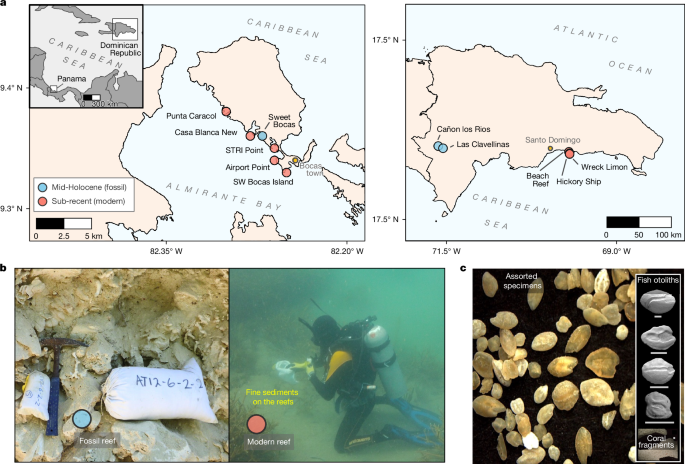
O’Dea, A. et al. Defining variation in pre-human ecosystems can guide conservation: an example from a Caribbean coral reef. Sci. Rep. 10, 2922 (2020).
Mann, P., Taylor, F. W., Burke, K. & Kulstad, R. Subaerially exposed Holocene coral reef, Enriquillo Valley, Dominican Republic. Bull. Geol. Soc. Am. 95, 1084–1092 (1984).
Greer, L. & Swart, P. K. Decadal cyclicity of regional mid-Holocene precipitation: evidence from Dominican coral proxies. Paleoceanography 21, PA2020 (2006).
Cuevas, D. N., Sherman, C. E., Ramírez, W. & Hubbard, D. K. Coral growth rates from the Holocene Cañada Honda fossil reef, southwestern Dominican Republic: comparisons with modern counterparts in high sedimentation settings. Caribb. J. Sci. 45, 94–109 (2009).
Fredston-Hermann, A. L., O’Dea, A., Rodriguez, F., Thompson, W. G. & Todd, J. A. Marked ecological shifts in seagrass and reef molluscan communities since the mid-Holocene in the southwestern Caribbean. Bull. Mar. Sci. 89, 983–1002 (2013).
Wang, X. T. et al. Isotopic composition of skeleton-bound organic nitrogen in reef-building symbiotic corals: a new method and proxy evaluation at Bermuda. Geochim. Cosmochim. Acta 148, 179–190 (2015).
Wang, X. T. et al. Influence of open ocean nitrogen supply on the skeletal δ15N of modern shallow-water scleractinian corals. Earth Planet. Sci. Lett. 441, 125–132 (2016).
Donnelly, H. A. et al. Groundtruthing nitrogen isotopes as a symbiosis proxy using the facultatively symbiotic coral Oculina arbuscula. Front. Mar. Sci. 11, 1433382 (2024).
Luu, V. H. et al. Nitrogen isotope ratios across the Bermuda coral reef: implications for coral nitrogen sources and the coral-bound nitrogen isotope proxy. Front. Mar. Sci. 12, 1554418 (2025).
Sims, Z. C., Cohen, A. L., Luu, V. H., Wang, X. T. & Sigman, D. M. Uptake of groundwater nitrogen by a near-shore coral reef community on Bermuda. Coral Reefs 39, 215–228 (2020).
Wang, X. T. et al. Deep-sea coral evidence for lower Southern Ocean surface nitrate concentrations during the last ice age. Proc. Natl Acad. Sci. USA 114, 3352–3357 (2017).
Lueders-Dumont, J. A. et al. Controls on the nitrogen isotopic composition of fish otolith organic matter: lessons from a controlled diet switch experiment. Geochim. Cosmochim. Acta 316, 69–86 (2022).
Braman, R. S. & Hendrix, S. A. Nanogram nitrite and nitrate determination in environmental and biological materials by vanadium (III) reduction with chemiluminescence detection. Anal. Chem. 61, 2715–2718 (1989).
Sigman, D. M. et al. A bacterial method for the nitrogen isotopic analysis of nitrate in seawater and freshwater. Anal. Chem. 73, 4145–4153 (2001).
Weigand, M. A., Foriel, J., Barnett, B., Oleynik, S. & Sigman, D. M. Updates to instrumentation and protocols for isotopic analysis of nitrate by the denitrifier method. Rapid Commun. Mass Spectrom. 30, 1365–1383 (2016).
Boecklen, W. J., Yarnes, C. T., Cook, B. A. & James, A. C. On the use of stable isotopes in trophic ecology. Annu. Rev. Ecol. Evol. Syst. 42, 411–440 (2011).
Casey, J. M. et al. Reconstructing hyperdiverse food webs: gut content metabarcoding as a tool to disentangle trophic interactions on coral reefs. Methods Ecol. Evol. 10, 1157–1170 (2019).
Parravicini, V. et al. Delineating reef fish trophic guilds with global gut content data synthesis and phylogeny. PLoS Biol. 18, e3000702 (2020).
Kahle, D. & Wickham, H. ggmap: spatial visualization with ggplot2. R J. 5, 144–161 (2013).

