


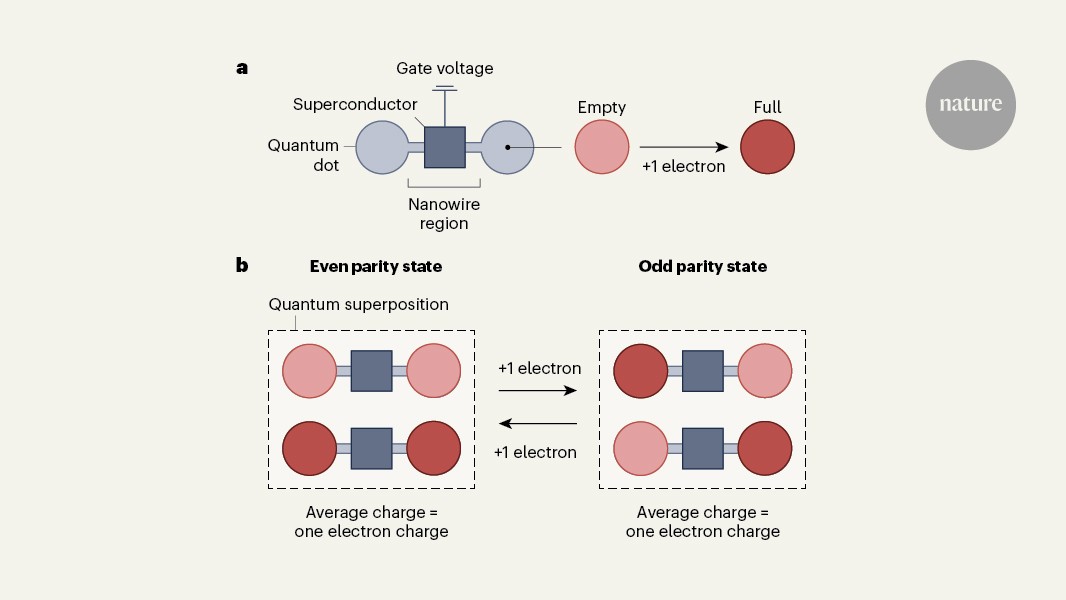
In superconducting materials, pairs of electrons form a shared quantum-mechanical state. Control of this macroscopic quantum state is a key feature that is required for superconducting quantum computing. Some combinations of materials, however, turn usual electron pairing on its head. Superconductors and semiconductors, carefully controlled at the nanoscale, can coax electrons to spontaneously unpair. The unpaired electrons have fascinating properties. In contrast to ordinary electrons, the unpaired electrons can in some cases seem electrically neutral, so charge cannot be used to describe their quantum state. A different quantum number, called parity, is needed instead. Parity measures whether an electron is paired (even parity) or unpaired (odd parity).
Competing Interests
The author declares no competing interests.

