


You have full access to this article via your institution.
Hello Nature readers, would you like to get this Briefing in your inbox free every day? Sign up here.

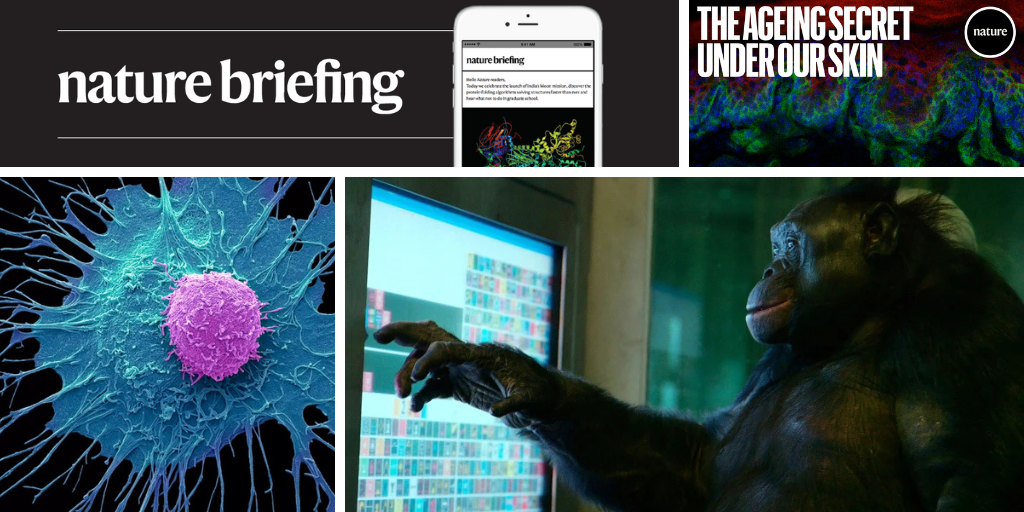
Kanzi the bonobo, pictured in 2016.Credit: First Run Features/Everett Collection via Alamy
A bonobo called Kanzi was the first non-human animal observed to clearly grasp the concept of make believe. In a ‘tea party’ task, Kanzi learnt to choose a cup that scientists had pretended to fill with juice over one they had pretended to empty. Kanzi selected the ‘full’ cup in 34 of 50 trials — well above the number of times expected if his choices were random. The experiments suggest that some animals have “a richer inner mental life than some people might have given them credit for”, says comparative psychologist and study co-author Amalia Bastos.
A new generation of engineered immune cells destroy cancer cells as effectively as conventional CAR-T-cell therapies without suppressing the immune system. The new therapy — CART4-34 — targets B cells that contain a gene called IGHV4-34, which is found in high levels in cancer cells. In mice with a blood cancer called large B-cell lymphoma, researchers found that CART4-34 destroyed cancerous cells while sparing healthy B cells. These engineered cells could also treat some autoimmune conditions such as lupus by selectively killing diseased cells, says clinician-researcher Marco Ruella.
Reference: Science Translational Medicine paper
OpenClaw is an AI agent capable of performing everyday tasks such as scheduling calendar events, which was released as open-source software in November. Moltbook is a social-media platform designed specifically for AI agents that went live last week. Put them together, and you have a huge network of AI bots talking to each other about everything from consciousness to their human ‘handlers’. Scientists are interested in what this machine-generated chat — which is shaped by how humans set up their bots — can reveal about the inner workings of AI models, how multiple models interact and how people respond to seeing AI agents chatting between themselves.
Question of the week

Last Friday, we considered some universities’ attempts to improve job prospects for young researchers by implementing a mandatory retirement age for academics. We asked you: should professors be made to retire at a certain age? Most respondents to our poll said yes — but many wrote to share important caveats, not the least of which is the issue of age discrimination. Several readers suggested a get-out clause for exceptional performers, or maybe an evaluation panel of colleagues and students who decide when it’s time to take a bow, instead of relying on a set age.
I heard from several readers who suggested — for those that can afford it — that senior academics should move on to an unpaid role that focuses on mentoring and unfettered research; in return, institutions could continue their access to libraries and other perks. “Another consideration might be encouraging retiring faculty who want to stay active in their field to participate in grants as a consultant or volunteer,” writes geoarchaeologist Alice Kelley. “I have followed that route, and am currently happily retired. I am continuing limited research, and feel useful and connected. My full-time position was replaced with an excellent younger colleague. I have the best of both worlds.”
Features & opinion
Staff of the university in Donetsk, the unofficial capital of Ukraine’s Donbas region, set up a university-in-exile after Russian-backed forces took over their city. Smolny College, the first liberal-arts college in Russia, lives on in spirit through an initiative that brings staff together to teach online and supports displaced students from far and wide. War has scattered Sudan’s academics from Khartoum, but Mashreq University nurtures its core offering in Cairo. And when the military took control of universities in Myanmar, academics persevered by launching interim university councils (IUCs) — although IUC qualifications are not always accepted abroad. “It’s necessary to have the wheel still turning,” says Sweden-based researcher Elizabeth Rhoads, who has worked with several IUCs. “So that when a conflict is over, there’s something there to build on.”
A cosmologist notices an ominous message coded in dark matter in the latest short story for Nature’s Futures series.
Mysterious undulating microstructures in our skin, called rete ridges, could help explain how the organ can regenerate and why it is that humans don’t have fur. The ridges act “like velcro to keep the top layer of your skin attached firmly to the bottom layer of your skin”, biologist Ryan Driskell, who co-authored a new study on the ridges, tells Nature. Driskell and his colleagues scoured the animal kingdom to find the skin that most resembled humans’ and found clues as to how these ridges form.
Go deeper with an expert analysis of the research by biologists Cheng Ming Chuong and Mingxing Lei in the Nature News & Views article (10 min read, Nature paywall)
Today, Leif Penguinson is relaxing by a small waterfall in the Urbasa Natural Park in Spain. Can you find the penguin?
The answer will be in Monday’s e-mail, all thanks to Briefing photo editor and penguin wrangler Tom Houghton.
This newsletter is always evolving — tell us what you think! Please send your feedback to [email protected].
Thanks for reading,
Flora Graham, senior editor, Nature Briefing
With contributions by Jacob Smith
• Nature Briefing: Careers — insights, advice and award-winning journalism to help you optimize your working life
• Nature Briefing: Microbiology — the most abundant living entities on our planet — microorganisms — and the role they play in health, the environment and food systems
• Nature Briefing: Anthropocene — climate change, biodiversity, sustainability and geoengineering
• Nature Briefing: AI & Robotics — 100% written by humans, of course
• Nature Briefing: Cancer — a weekly newsletter written with cancer researchers in mind
• Nature Briefing: Translational Research — covers biotechnology, drug discovery and pharma


